HomePod Will Support Spatial Audio for Apple Music, But Not Lossless Audio
Apple Music will be gaining support for two new audio formats in June, including Spatial Audio and Lossless Audio, but MacRumors has received confirmation that the HomePod and HomePod mini will not support Lossless Audio.
Apple's website does indicate that the HomePod will support Spatial Audio, but it's unclear if this includes the HomePod mini.
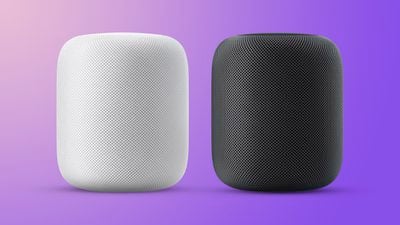
Spatial Audio, based on Dolby Atmos, is an immersive three-dimensional audio format that enables musicians to mix music so it sounds like the instruments are all around you in space. On the other hand, Lossless Audio refers to audio recordings that have been compressed without any reduction in the overall quality of the audio, which can result in an improved listening experience, although the difference is not always obvious.
Apple Music will have two tiers of lossless audio, including standard "Lossless" audio up to 48kHz and "Hi-Res Lossless" audio that ranges from 48kHz to 192kHz. Apple said "Hi-Res Lossless" will require external equipment like a USB digital-to-analog converter.
Spatial Audio and Lossless Audio will be available in June for all Apple Music subscribers at no additional cost on devices running iOS 14.6, iPadOS 14.6, macOS 11.4, and tvOS 14.6 or later, according to Apple. Presumably, there will also be a companion HomePod software update that enables Spatial Audio support in time for the feature's launch.
Spatial Audio will be available for thousands of tracks at launch, with more to be added regularly. Lossless audio will be available for 20 million tracks at launch, and this will rise to 75 million by the end of the year.
Popular Stories
Last year, Apple launched CarPlay Ultra, the long-awaited next-generation version of its CarPlay software system for vehicles. Nearly nine months later, CarPlay Ultra is still limited to Aston Martin's latest luxury vehicles, but that should change fairly soon.
In May 2025, Apple said many other vehicle brands planned to offer CarPlay Ultra, including Hyundai, Kia, and Genesis.
In his Powe...
Apple today confirmed to Reuters that it has acquired Q.ai, an Israeli startup that is working on artificial intelligence technology for audio.
Apple paid close to $2 billion for Q.ai, according to sources cited by the Financial Times. That would make this Apple's second-biggest acquisition ever, after it paid $3 billion for the popular headphone and audio brand Beats in 2014.
Q.ai has...
The calendar has turned to February, and a new report indicates that Apple's next product launch is "imminent," in the form of new MacBook Pro models.
"All signs point to an imminent launch of next-generation MacBook Pros that retain the current form factor but deliver faster chips," Bloomberg's Mark Gurman said on Sunday. "I'm told the new models — code-named J714 and J716 — are slated...
Apple recently updated its online store with a new ordering process for Macs, including the MacBook Air, MacBook Pro, iMac, Mac mini, Mac Studio, and Mac Pro.
There used to be a handful of standard configurations available for each Mac, but now you must configure a Mac entirely from scratch on a feature-by-feature basis. In other words, ordering a new Mac now works much like ordering an...
Apple is planning to launch new MacBook Pro models with M5 Pro and M5 Max chips alongside macOS 26.3, according to Bloomberg's Mark Gurman.
"Apple's faster MacBook Pros are planned for the macOS 26.3 release cycle," wrote Gurman, in his Power On newsletter today.
"I'm told the new models — code-named J714 and J716 — are slated for the macOS 26.3 software cycle, which runs from...