

Ask MacRumors
iPhone Fold
Contents
Apple has been working on a foldable iPhone for many years now, and we've been hearing rumors about it for more than a decade. It's finally time for an iPhone that folds to launch, and rumors suggest that we're going to get it this fall.
The foldable iPhone, or "iPhone Fold" as it's been referred to in rumors, will be part of the fall 2026 iPhone lineup. It will be introduced alongside the iPhone 18 Pro and the iPhone 18 Pro Max in September. We don't know what name Apple plans to use yet, but since Samsung calls its smartphone the Galaxy Fold, it's unlikely Apple will actually refer to the device as the iPhone Fold.
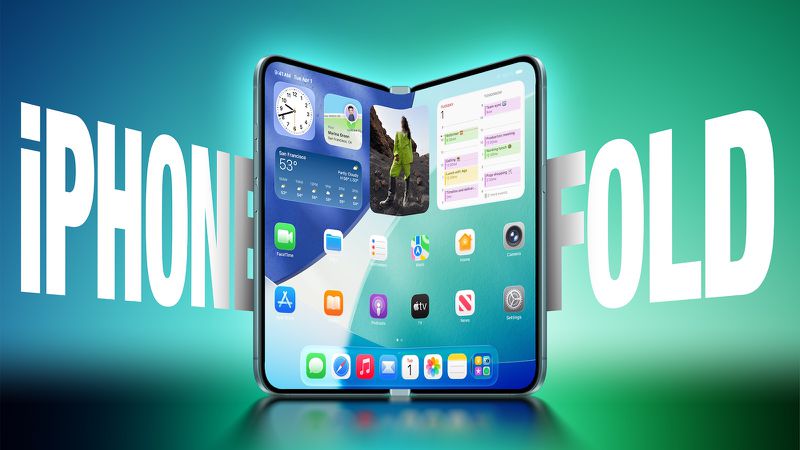
Apple decided on a book-style foldable design that's wider than it is tall, which will make it unique among foldable smartphones. The foldable iPhone is supposed to have a 4:3 aspect ratio like an iPad, and it will have an iPad mini-sized OLED display when it's opened up. It will look like a hybrid between an iPhone and an iPad, with iPad-like functionality when unfolded. Bloomberg reporter Mark Gurman says it will be the "most significant overhaul in the iPhone's history."
The iPhone Fold will be around 5.5 inches when it's closed, and 7.8 inches when it's open, making it just a bit smaller than the 8.3-inch iPad mini. It's supposedly going to be as thin as 4.5mm, which would make it Apple's thinnest iPhone to date. Apple is using a titanium chassis for durability because the foldable will be so thin, and the company spent time making a durable hinge and a display that's close to crease-free. Many foldables on the market have a highly visible crease in the middle, and Apple wanted to minimize the crease as much as possible.
With such a thin chassis, Apple has to compromise in some areas. The iPhone Fold will have two rear cameras instead of three (with no Telephoto), and there is no space for the TrueDepth camera system, so it's going to use Touch ID instead of Face ID. There will be a Touch ID power button, similar to the Touch ID button on Apple's iPads.
A foldable iPhone won't be cheap, and rumors suggest that it's going to be priced starting at over $2,000. It will be the most expensive iPhone in the 2026 lineup.
Note: See an error in this roundup or want to offer feedback? Send us an email here.
Foldable iPhone Design
Apple tested several fold styles and device sizes, including smartphones with a middle fold that opens horizontally into an iPad-sized device and a clamshell design that folds in half vertically. Apple went with the book-style foldable that will have an outer display and camera that can be used when the iPhone is closed, and a larger, inner display that offers more screen space.
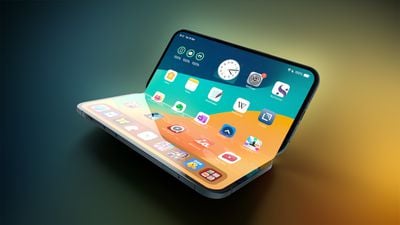
Rumors suggest the foldable iPhone will have a frame made from titanium and aluminum. Apple could use titanium for the stress-bearing parts of the frame to ensure that it doesn't bend, and aluminum in other areas for heat dissipation and to keep weight low.
Current rumors suggest that the foldable iPhone will feature a display that's around 5.5 inches when it's folded in half, and a larger 7.8-inch iPad-like display when it's opened up.
The iPhone Fold could be around 4.5mm when it is open, and 9mm to 9.5mm when it is closed. If it is 4.5mm when open, the foldable iPhone will be Apple's thinnest device by far. That title is currently held by the 13-inch iPad Pro, which is 5.1mm thick. Some rumors suggest it will be a few millimeters thicker, but it is expected to be thinner than current iPhones.
One analyst, Jeff Pu, believes Apple could be working on not one, but two foldable iPhones, in different 7.9-inch and 8.3-inch sizes, but no other rumors have backed up this claim.
According to one leaker, the inner (unfolded) display will measure in at 7.76 inches with a 2,713 x 1,920 resolution, while the outer display (folded) will measure in at 5.49 inches with a 2,088 x 1,422 resolution and a 4:3 aspect ratio. Another leaker has suggested it will have a 7.6-inch display size when unfolded.
Minimal Crease
The 2026 foldable iPhone reportedly has no visible crease, a problem that affects most foldable devices on the market. Apple is said to have pursued eliminating the crease "regardless of cost," and the company has developed a "new material property" that makes the crease disappear. The crease has been described as "nearly invisible" when the iPhone is unfolded.

One of the reasons that Apple waited so long to release a foldable iPhone is because it struggled to make a device that did not have a visible crease, but it may be a problem that has now been largely solved given the uptick in rumors.
Apple is planning to use ultra-thin glass for the foldable iPhone, and Chinese manufacturer Lens Technology could be Apple's primary glass supplier. Corning is likely to provide the raw materials to Lens Technology, with Apple choosing the supplier because of its expertise in glass strengthening and minimizing side cracks after cutting.
The foldable iPhone will use a new type of display panel created by Samsung, using a custom display process that Apple has the trademark for. The process includes integrating touch sensors directly into the display panel, reducing overall thickness by approximately 19 percent. The engineering advancement brings a lighter build and a more rigid display structure, and the display meets Apple's requirements for thinness, power efficiency, and brightness.
Apple could use a structural glass mid-frame to minimize the visible display crease in the fold, while applying a color filter-on-encapsulation layer together with a circular polarizer module to improve color purity and light transmission.
Advances in optically clear adhesive (OCA) have been important in Apple's quest to minimize the visible crease in the iPhone Fold. Very subtle shifts in alignment of the display panel components can cause micro-cracks or deformation, leading to a visible crease. OCA formulations stay pliable during gradual bending, and can flow into microscopic irregularities to reduce light scattering and the visibility of the crease.
Leakers suggest the iPhone Fold will have a crease depth that's under 0.15mm, which is shallow and should be less noticeable to the eye and to the touch than a crease that is deeper. The crease angle is under 2.5 degrees. The crease angle describes how sharp the fold line appears when the display is unfolded. A smaller angle suggests a smoother, flatter transition across the fold.
Smartphone makers like Samsung do not publish details on crease measurements, so it is difficult to compare Apple's crease design rumors to existing foldable devices.
Hinge Design
To minimize the crease in the display, Apple plans to use liquid metal for the iPhone's hinge, which will improve durability. This is one technique that might allow Apple to get rid of the crease that has plagued other foldable smartphones. Apple's hinge will be higher quality than hinges used for other foldable smartphones.

Liquid metal, or amorphous metal, has a structure that is more resistant to bending, deformation, and denting than traditional metal. Its properties are derived from the manufacturing method, which involves rapid heating and cooling. Its structure makes it tougher than titanium alloy, and it has a stainless steel look.
Apple may also use a combination of titanium and stainless steel for the hinge.
Design Mockups
A 3D printed mockup version of the iPhone Fold provides an idea of what the device will look like. The mockup isn't spot on because we don't know Apple's exact specifications for the iPhone Fold as of yet, but it is in line with multiple rumors that we've heard at ~7.6 to 7.8 inches when open and 5.5 inches when closed.
It's smaller than the iPad mini, but it will have the largest display of an iPhone to date. It's rumored to have a 4:3 aspect ratio, and it will be short and wide, featuring a book-like form factor.
The first alleged iPhone Fold dummy model came out in early April, and more images followed later in the month. We don't know if these images are reflective of the iPhone Fold's actual design, but they have all of the design features that have been rumored, along with the right sizing.
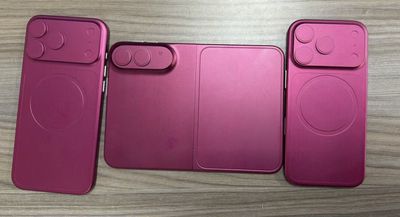
There is a raised camera bump that does not span across the entire back of the device, which is expected. It has a two-lens camera system, and a thin chassis.
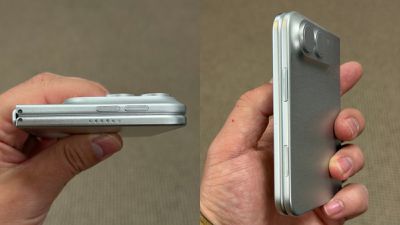 Image via Vadim Yuryev.
The dummy models show no signs of an Action Button or a MagSafe magnetic ring for charging purposes, so it's possible these features will be missing due to the thinness of the device. We're also not expecting a SIM slot, much like the iPhone Air.
Foldable iPhone Colors
Apple is said to be planning to "stay away from fun colors" and stick to more traditional space gray/black and silver/white finishes for the iPhone Fold.
No Face ID
Because the iPhone Fold is so thin, there isn't room for a TrueDepth camera system. It won't use Face ID, and will instead have a Touch ID side button, similar to an iPad.
There will be a front-facing hole punch camera for both the inner and outer displays for selfies, but unlocking the iPhone biometrically will be done with Touch ID.
A20 Chip
The foldable iPhone will use Apple's A20 chip, built on TSMC's 2nm process.
The transition to 2nm will allow for more transistors in each chip, which will boost performance. The A20 chips could be up to 15 percent faster and 30 percent more efficient than A19 chips. Apple is also expected to use TSMC's Wafer-Level Multi-Chip Module (WMCM) chip packaging technology. WMCM will see RAM directly integrated on the chip's wafer with the CPU, GPU, and Neural Engine.
Incorporating RAM this way could bring faster performance for overall tasks, better thermal management, and improved Apple Intelligence.
RAM
The iPhone Fold is expected to feature 12GB RAM.
Foldable iPhone Cameras
The foldable iPhone could have an under-display camera for the interior of the device, with a single hole punch camera for the exterior when it's folded up. The under-display camera is not expected to feature Face ID, with Apple instead adopting Touch ID. The camera could have a 24-megapixel resolution, which would be an industry first. Some Android devices use under-display cameras, but not at that high resolution.
The foldable iPhone rear camera setup will have a Main lens and an Ultra Wide lens with no Telephoto lens. Rumors suggest that both lenses will be 48 megapixels, which isn't too surprising because current iPhone models have 48-megapixel lenses.
All-in-all, the foldable iPhone is expected to include four total cameras.
Modem
The foldable iPhone is expected to include Apple's second-generation C2 modem, a successor to the C1X modem. The C2 will be on par with Qualcomm's modems, and it will support mmWave 5G, unlike the C1 and C1X.
No SIM Slot
Apple's foldable iPhone won't have a SIM slot and will instead use eSIM, much like the iPhone Air.
Battery
Apple worked to increase the power efficiency of its first foldable display in an effort to maximize battery life, and rumors suggest that the foldable iPhone will have decent battery life despite a thin size. Apple reduced the display driver integrated circuit (IC) from 28nm to 16nm, which could lead to battery savings. Apple plans to use high-density battery cells for the foldable iPhone.
The foldable iPhone could have a battery in the 5,400 to 5,800 mAh range, which would make it the largest battery capacity that Apple has used in an iPhone. The iPhone 17 Pro Max has the current largest battery at 5,088 mAh.
Naming
A few rumors have claimed that Apple will call its foldable iPhone the "iPhone Ultra," including Macworld. The iPhone Ultra reportedly won't have "18" numbering like the iPhone 18 Pro and iPhone 18 Pro Max.
During the rumor cycle, sites have taken to calling the new iPhone the iPhone Fold, but it's unlikely Apple will actually use that name. Samsung already has the Galaxy Fold, and that would be too similar for Apple's tastes. Apple already uses the Ultra naming for the Apple Watch and for the version of CarPlay that more deeply integrates with in-car systems.
iOS Updates
The foldable iPhone will allegedly have a display with a 4:3 aspect ratio, much like the iPad. Since the display will be close to the iPad mini in size, the foldable iPhone is going to be able to run two apps side-by-side for the first time, with a simplified version of multitasking available.

Apple is updating iOS to accommodate the larger iPhone Fold display, and in addition to being able to use two apps at once, the iPhone Fold apps will also have sidebars on the left, similar to iPadOS.
Though Apple is making some iPad-like updates to iOS for the iPhone Fold, it's not going to run iPadOS and it won't support iPad apps. Apple does plan to make APIs that will make it easy for developers to transition their apps to an iPhone Fold layout.
Pricing
Apple's first foldable iPhone could cost nearly twice as much as the iPhone 17 Pro Max.
Apple analyst Ming-Chi Kuo believes that Apple's foldable iPhone will be priced somewhere between $2,000 and $2,500, and Bloomberg's Mark Gurman has also suggested a similar price range. UBS analysts believe Apple will price it between $1,800 and $2,000, and Fubon Research says it will cost $2,400.
The iPhone Fold will have three storage options, including 256GB, 512GB, and 1TB. One rumor suggests that approximate pricing could be as follows:
- 256GB - ~$2,320
- 512GB - ~$2,610
- 1TB - ~$2,900
Launch Date
We've heard back and forth rumors on release timing. Some rumors have suggested the iPhone Fold will be delayed past September because of late stage production issues, while others suggest it's on time for a September launch.
In March, a Barclays analyst suggested the iPhone Fold could be introduced in September alongside the iPhone 18 Pro, but launch later, perhaps as late as December.
A report from DigiTimes reconciles the launch timing rumors, suggesting that there is indeed a delay in the test phase, but Apple may be able to make up ground during the mass production phase. Mass production was set to begin in June 2026, but it has been pushed back to August.
If the iPhone Fold does launch in September alongside the iPhone 18 Pro models, it's likely it will be in short supply. Reports agree that the device is complex and manufacturing isn't smooth sailing. In December, Apple analyst Ming-Chi Kuo said production challenges could cause supply shortages into 2027.
Other Apple Foldable Rumors
Along with a foldable iPhone, rumors suggest that Apple is exploring other foldable devices, including iPads and MacBooks that have foldable OLED displays. Initial rumors suggested that Apple would unveil a foldable iPad or Mac before a foldable iPhone, but now it sounds like the foldable iPhone is coming first.
Apple's Second Foldable iPhone
After Apple launches its first foldable iPhone in 2026, it will introduce a second-generation model in 2027. The 2027 foldable iPhone will fall on the 20th anniversary of the iPhone's launch.

