Today Marks the 10th Anniversary of the Mac App Store

While the App Store launched on the iPhone in July 2008, the Mac App Store did not become available until January 6, 2011, when Apple released Mac OS X Snow Leopard version 10.6.6. Accordingly, today marks the 10th anniversary of the Mac App Store.
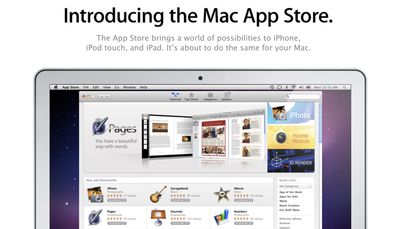
introducing the mac app store banner
Apple announced that the Mac App Store was "open for business" in a press release timed with the launch. "With more than 1,000 apps, the Mac App Store is off to a great start," said Steve Jobs, Apple's co-founder and former CEO. "We think users are going to love this innovative new way to discover and buy their favorite apps."

Within its first year, the Mac App Store achieved a few milestones, topping one million downloads on its first day and 100 million downloads by December 2011.

All apps submitted to the Mac App Store are reviewed by Apple, and must be sandboxed, a security mechanism that helps protect user data from unauthorized access by apps. Developers can choose to distribute their software directly on the internet, without sandboxing, but all Mac apps must be notarized by Apple in order to run by default on macOS Catalina and later to ensure these apps are free of known malware.

In line with the App Store on other platforms, Apple collects a 30 percent commission from developers on the sale of paid Mac apps and in-app purchases tied to digital goods and services. However, Apple recently introduced a Small Business Program that reduces the App Store's commission rate to 15% for developers earning up to $1 million per calendar year in net revenue. Developers must enroll in the program to participate.

Since its inception, the Mac App Store has attracted its fair share of criticism from developers. Apple has addressed some of these complaints over the years by allowing developers to offer free trials via in-app purchase, create app bundles, distribute apps on multiple Apple platforms as a universal purchase, view analytics for Mac apps, respond to customer reviews, and more, but some developers remain unsatisfied with the Mac App Store due to Apple's review process, the lack of upgrade pricing, the lack of sandboxing exceptions for trusted developers, the absence of TestFlight beta testing for Mac apps, and other reasons.

In 2018, the Mac App Store received a major redesign as part of macOS Mojave, complete with a new "Discover" tab that highlights popular apps and games and features editorials from Apple. Apple also softened its rules surrounding sandboxing. Soon after these changes, Microsoft Office and Adobe Lightroom became available on the Mac App Store, and some popular apps like BBEdit and Transmit returned to the Mac App Store.
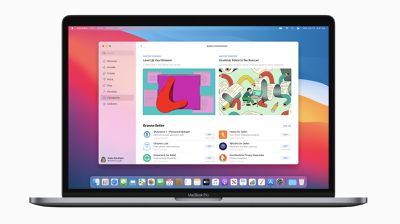
mac app store big sur macbook pro
In 2019, with the release of macOS Catalina and Xcode 11, Apple made it possible for developers to easily create a Mac version of an ‌iPad‌ app. In most cases, adding macOS support to an ‌iPad‌ app is as simple as opening an Xcode project and clicking the Mac checkbox under General > Deployment Info, although some developers faced issues.

2019 also marked the launch of Apple Arcade, which has its own tab in the Mac App Store for discovering all of the games available as part of the subscription service.

Another advancement to the Mac App Store came in 2020, when Apple made iPhone and iPad apps available on Macs with Apple silicon, given that the M1 chip in Macs shares the same Arm architecture as A-series chips in iPhones and iPads. Developers can opt out of distributing their iPhone and iPad apps on the Mac App Store if they desire.

All in all, Apple has certainly made progress with the Mac App Store over the last 10 years, but some developers feel that further improvements are necessary if they are to embrace the storefront. The next decade of the Mac App Store begins now.


Popular Stories

Aston Martin CarPlay Ultra Screen

Apple's CarPlay Ultra to Expand to These Vehicle Brands Later This Year

Sunday February 1, 2026 10:08 am PST by
Last year, Apple launched CarPlay Ultra, the long-awaited next-generation version of its CarPlay software system for vehicles. Nearly nine months later, CarPlay Ultra is still limited to Aston Martin's latest luxury vehicles, but that should change fairly soon. In May 2025, Apple said many other vehicle brands planned to offer CarPlay Ultra, including Hyundai, Kia, and Genesis. In his Powe...
Apple Logo Black

Apple's Next Launch is 'Imminent'

Sunday February 1, 2026 12:31 pm PST by
The calendar has turned to February, and a new report indicates that Apple's next product launch is "imminent," in the form of new MacBook Pro models. "All signs point to an imminent launch of next-generation MacBook Pros that retain the current form factor but deliver faster chips," Bloomberg's Mark Gurman said on Sunday. "I'm told the new models — code-named J714 and J716 — are slated...
Apple MacBook Pro M4 hero

New MacBook Pros Reportedly Launching Alongside macOS 26.3

Sunday February 1, 2026 5:42 am PST by
Apple is planning to launch new MacBook Pro models with M5 Pro and M5 Max chips alongside macOS 26.3, according to Bloomberg's Mark Gurman. "Apple's faster MacBook Pros are planned for the macOS 26.3 release cycle," wrote Gurman, in his Power On newsletter today. "I'm told the new models — code-named J714 and J716 — are slated for the macOS 26.3 software cycle, which runs from...
iOS 26

iOS 26.3 and iOS 26.4 Will Add These New Features to Your iPhone

Tuesday February 3, 2026 7:47 am PST by
We are still waiting for the iOS 26.3 Release Candidate to come out, so the first iOS 26.4 beta is likely still at least a week or two away. Following beta testing, iOS 26.4 will likely be released to the general public in March or April. Below, we have recapped known or rumored iOS 26.3 and iOS 26.4 features so far. iOS 26.3 iPhone to Android Transfer Tool iOS 26.3 makes it easier...
14 inch MacBook Pro Keyboard

Apple Changes How You Order a Mac

Saturday January 31, 2026 10:51 am PST by
Apple recently updated its online store with a new ordering process for Macs, including the MacBook Air, MacBook Pro, iMac, Mac mini, Mac Studio, and Mac Pro. There used to be a handful of standard configurations available for each Mac, but now you must configure a Mac entirely from scratch on a feature-by-feature basis. In other words, ordering a new Mac now works much like ordering an...

Top Rated Comments

Unggoy Murderer Avatar
66 months ago

An abject failure in every sense of the word. I don't know of anyone who uses it for anything other than MacOS updates
Sure, a "failure" that's enabled billions of dollars in sales to third-party developers across the world. :rolleyes::rolleyes::rolleyes:
Score: 8 Votes (Like | Disagree)
martyjmclean Avatar
66 months ago

An abject failure in every sense of the word. I don't know of anyone who uses it for anything other than MacOS updates
Pages, Numbers, Keynote, Xcode, Codye, Final Cut Pro, Compressor, Motion, Logic Pro, MainStage, Twitter, Amphetamine, Magnet, Final Draft, Affinity Designer, Affinity Photo, Affinity Publisher... most of which I use at work are all in the App Store.

Also... updates are in System Preferences not the App Store.
Score: 7 Votes (Like | Disagree)
macbookpro212 Avatar
66 months ago
A great idea thats been neglected for a decade, hopefully the new universal apps (iPhone compatible apps) will bring in a lot of creative apps to MacOS.
Score: 7 Votes (Like | Disagree)
LV426 Avatar
66 months ago

I was going to make the same point, of Mac App Store apps (especially utilities) sometimes being crippled versions of what's available direct from the developer, and was also going to cite DaisyDisk as a good example. If there's an app I want, I don't see any compelling reason to choose the MAS version over the developer version even if both are exactly the same, but there seems to be advantages in favouring the dev version (no MAS constraints for future updates, earlier updates, quicker patches etc). I guess the MAS version does bring the advantage that the app is less likely to be doing something 'naughty' at a system level, but for system utility apps they need to be able to operate at this level so there's got to be a degree of trust.
I made the mistake of purchasing an animation app (no names mentioned) directly from the vendor's site as there was no MAS version available. I was appalled to find that it slapped a bunch of icons on the toolbar for managing stuff you can buy from their site, checking for updates etc, as well as starting up a bunch of background programs.

This kind of behaviour I can do without, as it's a utility I only wanted to use sporadically. I suspect the reason it wasn't on the MAS was because it would never pass the review process in a month of Sundays.
Score: 4 Votes (Like | Disagree)
scottishwildcat Avatar
66 months ago

An abject failure in every sense of the word. I don't know of anyone who uses it for anything other than MacOS updates
And I don't know anyone who doesn't use it to install and update at least some of their apps. But I guess you're right and they're all wrong.
Score: 4 Votes (Like | Disagree)
hagar Avatar
66 months ago
Look at those icons. While I understand it was time to move on, I still like those Pages and Numbers icons more than the bland ones we have today.
Score: 4 Votes (Like | Disagree)