Apple Pay Overtakes Starbucks as Most Popular Mobile Payment Platform in the US - MacRumorsOpen MenuShow RoundupsShow Forums menuVisit ForumsOpen Sidebar
Skip to Content

Apple Pay Overtakes Starbucks as Most Popular Mobile Payment Platform in the US

Apple Pay has overtaken the Starbucks mobile app to become the most popular mobile payment system in the United States, claims a new report out today.
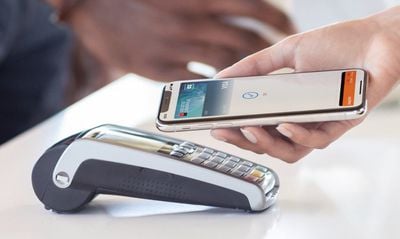
apple pay
According to eMarketer, ‌Apple Pay‌ became the market leader last year, when 27.7 million Americans used the app to make a purchase. Since then, however, ‌Apple Pay‌ has grown even faster than expected.

In 2019, ‌Apple Pay‌ will have 30.3 million users, or 47.3 percent of mobile payment users. That compares with Starbucks' 25.2 million customers via its mobile app in the same year, representing 39.4 percent of mobile payment users.

"Apple Pay has benefited from the spread of new point-of-sale (POS) systems that work with the NFC signals Apple Pay runs on," said eMarketer principal analyst Yory Wurmser. "The same trend should also help Google Pay and Samsung Pay, but they will continue to split the Android market."

Citing data from Digital Trends, the analysis predicts ‌Apple Pay‌ will be available in 70 percent of U.S. retailers by the end of 2019. In contrast, the Starbucks app has commanded a 40 percent market share of mobile payments for the last few years, but growth potential is limited because it can only be used in Starbucks stores.

Total spending via contactless mobile payments will approach $100 billion this year in the U.S., according to eMarketer. On average, that is equivalent to a user spending $1,545 per year, up more than 24 percent over last year.

Nearly 64 million people (30 percent of all U.S. smartphone users) are expected to make use of mobile payments this year, a 9.1 percent increase over 2018. In terms of demographics, nearly 50 percent of all smartphone users are adults aged 25 to 34, so the growth of mobile payments is expected to be strongest in this age group, although digital wallet use is said to be growing across the board.

"Although a growing number of millennials feel secure using payment apps, virtually all still find credit and debit cards equally convenient," said eMarketer forecasting analyst Vincent Yip. That bodes well for Apple Card, which launched earlier this year. ‌Apple Pay‌ is now in 47 markets and in the June quarter, started adding more new users than PayPal, with monthly transaction volume growing four times as fast.

Related Roundup: Apple Pay

Popular Stories

iPhone 18 Pro Deep Red Feature

iPhone 18 Pro Launching Later This Year With These 12 New Features

Wednesday March 18, 2026 7:39 am PDT by
While the iPhone 18 Pro and iPhone 18 Pro Max are not expected to launch for another six months or so, there are already plenty of rumors about the devices. It was initially reported that the iPhone 18 Pro models would have fully under-screen Face ID, with only a front camera visible in the top-left corner of the screen. However, the latest rumors indicate that only one Face ID component...
Apple Logo Sketch Feature

Apple Has Now Unveiled Eight New Products This Month

Tuesday March 17, 2026 9:25 am PDT by
Apple has unveiled a whopping eight new products so far this March, including an iPhone 17e, iPad Air models with the M4 chip, MacBook Air models with the M5 chip, MacBook Pro models with M5 Pro and M5 Max chips, an updated Studio Display, a higher-end Studio Display XDR, and now the AirPods Max 2 this week. iPhone 17e features the same overall design as the iPhone 16e, but it gains Apple's...
ios 26 4 yellow

Here Are Apple's Release Notes for iOS 26.4

Wednesday March 18, 2026 11:56 am PDT by
Apple provided developers and public beta testers with the release candidate versions of iOS 26.4 and iPadOS 26.4, which means we're going to see a public launch as soon as next week. The RC versions of the software include Apple's official release notes, giving us final details on what's included in the update. Apple Music - Playlist Playground (beta) generates a playlist from your...

Top Rated Comments

84 months ago
That seems like a weird comparison to make, but as long as it has been made, it actually to me makes Apple Pay sound less popular than I would have guessed.

If I understand this right, only slightly more people use Apple Pay, which is a way of using almost any credit card for any purchase at any location, than use the Starbucks mobile order app at Starbucks cafes.

That means out of the virtually endless places you could use Apple Pay, about the same number use the Starbucks mobile app to pay at a single store.

I don't see that as a winning statistic.


Too bad it’s a credit card, I would defintely indulge in prepaid debit or something
Cause: 24% more spending YoY
I don't think they're referring to Apple Card but to Apple Pay which you can use with virtually any payment method like a debit card or Apple's own Apple Cash.
Score: 27 Votes (Like | Disagree)
joelhinch Avatar
84 months ago
You can use Apple Pay or any other contactless technology at 99.9% of payment terminals in Australia. Essentially all stores, restaurants and cafes. Even trains and busses. How contactless payments are still niche in the US is crazy to think.
Score: 22 Votes (Like | Disagree)
84 months ago

That seems like a weird comparison to make, but as long as it has been made, it actually to me makes Apple Pay sound less popular than I would have guessed.

If I understand this right, only slightly more people use Apple Pay, which is a way of using almost any credit card for any purchase at any location, than use the Starbucks mobile order app at Starbucks cafes.

That means out of the virtually endless places you could use Apple Pay, about the same number use the Starbucks mobile app to pay at a single store.

I don't see that as a winning statistic.


I don't think they're referring to Apple Card but to Apple Pay which you can use with virtually any payment method like a debit card or Apple's own Apple Cash.
Well, the article states that 47.3% of people are using ApplePay this year, which is nearly half of all users that use any mobile payment option at all. That’s a pretty darn good statistic, especially considering that ApplePay is only available on iPhones.

Starbucks allegedly is used by 39.4% of mobile payment users, so ApplePay is decently ahead of them. Again, consider that Starbucks mobile pay can be used on any smartphone.

Being the number 1 mobile payment solution *and* Having an almost 10% lead over the second-place solution while also only being limited to around 22% of the smartphone market share is pretty impressive.
Score: 18 Votes (Like | Disagree)
84 months ago

Well, thats odd. I have always been wondering why the US is virtually 10 years behind other countries in this regard.
Short version of why the US didn't move to chip readers sooner is it didn't have much reason to do so. The telecommunications infrastructure allowed for live authentication vs batch processing, so there wasn't the incentive to implement chip+PIN to reduce fraud as there was elsewhere.

More info here: https://www.zdnet.com/article/emv-understanding-why-the-us-migration-didnt-happen-sooner/
Score: 7 Votes (Like | Disagree)
84 months ago

Well, thats odd. I have always been wondering why the US is virtually 10 years behind other countries in this regard. In Europe, the contactless payment was introduced several years ago. Actually, I had my first credit card with a chip instead of magnetic stripe some 10 years ago. In China for example, there is currently no need of POS terminals at all as virtually everything can be paid with WeChat.


Well, small business just need to purchase a POS terminal that is not 10 years old. Not really expensive or difficult to implement.
Speaking from the industy -- We aren't virtually behind anything. We were the first country to launch contactless payments in 2004 while everyone else was trying to figure out the chip. So we had to deal with the tin-foil hats for the rest of you. About how people were going to steal your credit card from a mile away. Complaints to remove PayPass and PayWave from cards. We had a huge ramp up for about 5 years, then a slowing down (and even ripping out) for the next 5 years where the loud mouth minority got their way.

Then there's also the scale of what needs to be done. Card by card, store by store. There's 330 million Visa cards in the US... 771 million in the rest of the world combined. Mastercard is 231 vs 644. AmEx is 54 vs 60. That's nearly 50% of the whole pie that needs to be replaced... for a second time. And as of calendar close 2018, we were 50% done. Fueling the slow pace this time around is that as soon as its adopted, fraud responsibility falls on the merchant. Previously, someone uses a fake card, merchant gets paid the full amount; the credit card issuer eats the loss. Not anymore.

Anyway... Visa and Mastercard has mandating that all terminals must support contactless -- for example, 1 January 2020 the entire EU must support it or they'll charge merchants larger fees for using outdated terminals. In the US it'll be by market segment.

In relation to WeChat. Real-Time Payments are now a thing here. Banks are rolling it out now, first to corporates.
Score: 5 Votes (Like | Disagree)
84 months ago

That is why do many places don't accept apple pay, apple gets a cut. Apple are themselves slowing the adoption of it by being a middleman.
Do you have a source for this?

Last I knew, merchant fees aren't affected. It's the card issuers who pay Apple's cut.

Edit:
Apple claims no cost to merchants, see https://support.apple.com/en-us/HT204274
Merchants may even pay _lower_ fees on Apple Pay transactions due to the higher level of security, see https://www.macworld.com/article/2682873/apple-pay-nets-a-discount-from-banks-walmart-says-no-thanks.html
Score: 4 Votes (Like | Disagree)
Related Apple News: Motoring | South Africa | Business | Iphone | Iphone