SSD Speed Variations in 2014 MacBook Air Still Due to Drive Brand Mix, Not Broader Changes
For many years, Apple has used different suppliers for the solid-state drives (SSDs) in its MacBook Air models, with drive performance varying among manufacturer brands. A recent study by Macworld demonstrated rather dramatic differences in SSD read and write speeds between tested 2013 and 2014 models, but at the time it was unclear whether the poorer performance for the 2014 models was still simply due to drive brand variances or if there was something specific to the 2014 machines causing an overall degradation in performance.
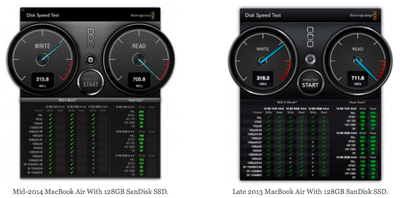
Other World Computing (OWC) has now performed some apples-to-apples testing between 2013 and 2014 models with SanDisk SSDs, and has found that performance is nearly identical.
In OWC's testing using Blackmagic Disk Speed Test, the new MacBook Air model with a 128 GB SanDisk SSD reported read/write speeds of 705/315 MBps, while the 2013 version also with a 128 GB SanDisk drive scored similarly with read/write speeds of 711/316 MBps.
Macworld's testing of four machines (various combinations of 2013/2014 models at 11 and 13 inches) had included drives of two different capacities from three different manufacturers, making it difficult to determine the exact cause of the performance differences.
This variability in brand performance was noticed years ago, when Apple started using both Toshiba and Samsung SSDs in its MacBook Air models. Apple continues to use drives from different manufacturers in its 2014 models, including units from Samsung, Toshiba and SanDisk. How various batches of drives from the different manufacturers are assigned to various machines is unknown, and consumers are unable determine which brand of SSD is in their MacBook Air without opening the box and either booting the machine to examine system profile information or physically opening the machine.
Apple's new MacBook Airs are available from Apple's website beginning at $899, while the 2013 models are being sold at significant discounts through a number of retailers.
Popular Stories
Last year, Apple launched CarPlay Ultra, the long-awaited next-generation version of its CarPlay software system for vehicles. Nearly nine months later, CarPlay Ultra is still limited to Aston Martin's latest luxury vehicles, but that should change fairly soon.
In May 2025, Apple said many other vehicle brands planned to offer CarPlay Ultra, including Hyundai, Kia, and Genesis.
In his Powe...
We are still waiting for the iOS 26.3 Release Candidate to come out, so the first iOS 26.4 beta is likely still at least a week or two away. Following beta testing, iOS 26.4 will likely be released to the general public in March or April.
Below, we have recapped known or rumored iOS 26.3 and iOS 26.4 features so far.
iOS 26.3
iPhone to Android Transfer Tool
iOS 26.3 makes it easier...
The calendar has turned to February, and a new report indicates that Apple's next product launch is "imminent," in the form of new MacBook Pro models.
"All signs point to an imminent launch of next-generation MacBook Pros that retain the current form factor but deliver faster chips," Bloomberg's Mark Gurman said on Sunday. "I'm told the new models — code-named J714 and J716 — are slated...
Apple is planning to launch new MacBook Pro models with M5 Pro and M5 Max chips alongside macOS 26.3, according to Bloomberg's Mark Gurman.
"Apple's faster MacBook Pros are planned for the macOS 26.3 release cycle," wrote Gurman, in his Power On newsletter today.
"I'm told the new models — code-named J714 and J716 — are slated for the macOS 26.3 software cycle, which runs from...
In 2022, Apple introduced a new Apple Home architecture that is "more reliable and efficient," and the deadline to upgrade and avoid issues is fast approaching.
In an email this week, Apple gave customers a final reminder to upgrade their Home app by February 10, 2026. Apple says users who do not upgrade may experience issues with accessories and automations, or lose access to their smart...