Since Apple announced plans for the 0.50 euro Core Technology Fee that apps distributed using the new EU App Store business terms must pay, there have been ongoing concerns about what that fee might mean for a developer that suddenly has a free app go viral.
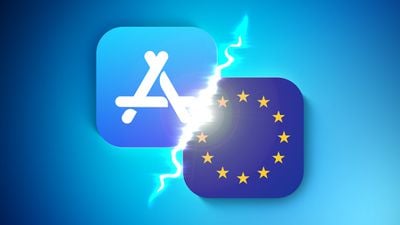
Apple's VP of regulatory law Kyle Andeers today met with developers during a workshop on Apple's Digital Markets Act compliance. iOS developer Riley Testut, best known for Game Boy Advance emulator GBA4iOS, asked what Apple would do if a young developer unwittingly racked up millions in fees.
Testut explained that when he was younger, that exact situation happened to him. Back in 2014 as an 18-year-old high school student, he released GBA4iOS outside of the App Store using an enterprise certificate. The app was unexpectedly downloaded more than 10 million times, and under Apple's new rules with Core Technology Fee, Testut said that would have cost $5 million euros, bankrupting his family. He asked whether Apple would actually collect that fee in a similar situation, charging the high price even though it could financially ruin a family.
In response, Andeers said that Apple is working on figuring out a solution, but has not done so yet. He said Apple does not want to stifle innovation and wants to figure out how to keep young app makers and their parents from feeling scared to release an app. Andeers told Testut to "stay tuned" for an answer.
What we are trying to do is tear apart a model that has been integrated for 15 years. And so for 15 years, the way we've monetized everything was through the commission. It covered everything from technology to distribution to payment processing, and the beauty of that model is that it allowed developers to take risks. Apple only got paid if the developer got paid, and that was an incredible engine for innovation over the last 15 years. We've seen it go from 500 apps to more than 1.5 million.
To your point, we've seen kids everywhere from 8-year-olds, 9-year-olds, 10-year-olds, to teenagers come up with some amazing applications and it's been one of the great success stories of the App Store. In terms of the Core Technology Fee and our business model, we had to change. The mandates of the DMA forced us to tear apart what we had built and price each component individually. And so we now have a fee associated with technology, tools, and services, we now have a fee associated with distribution and the services we provide through the App Store, and then we have a separate fee for payment processing if a developer wants to use it.
To your point - what is the impact on the dreamer, the kid who is just getting started. It could be a kid, it could be an adult, it could be a grandparent. We want to continue to encourage those sorts of developers. We build a store based on individual entrepreneurs, not so much catering to large corporate interests. And so we really wanted to figure out how do we solve for that.
We haven't figured out that solution here. I fully appreciate that. We looked at the data. We didn't see many examples of where you had that viral app or an app just took off that incurred huge costs. That said, I don't care what the data said. We don't care what the data said. We want people to continue to feel... and not be scared... some parents... hey, I've got four kids who play around with this stuff. I don't have five million euros to pay. This is something we need to figure out, and it is something we're working on. So I would say on that one, stay tuned.
It is not clear when Apple might come up with a solution or what that solution might be, but it sounds like the company might soon have some kind of option for these rare fringe cases when an app goes unexpectedly viral.
The 0.50 euro Core Technology Fee (CTF) that Apple is charging applies to all apps created under Apple's new business terms, both those distributed in the App Store and those distributed outside of the App Store in the European Union. The CTF must be paid for every "first" app install over one million installs.
A free app that is distributed outside of the App Store and downloaded over a million times will owe 0.50 euros for every subsequent "first" install, aka the first time a customer downloads an app on a device each year. The fee is incurred whether or not an app charges, creating a situation where an app developer could owe Apple money without ever making a dime.
As it stands, the CTF is a major unknown for any kind of freemium or free app built under the new business terms that might go viral, effectively making it very risky to develop a free or freemium app outside of the App Store. A free or freemium app that gets two million annual "first installs" would need to pay an estimated $45,290 in fees per month, or more than half a million dollars per year, even with no money earned. That's not a sustainable model for free apps, and freemium apps would need to earn at least 0.50 euros per user to break even.
App developers are able to continue to use Apple's current App Store business terms instead of adopting the new terms, paying just 15 to 30 percent commission to Apple with no change. That prevents distribution outside of the App Store, and it prevents developers from using third-party alternative payment solutions in the App Store. Adopting any of the new features that Apple has implemented because of the Digital Markets Act requires opting in to the updated business terms.
Apple has been tweaking the app ecosystem rules that it introduced in the European Union based on developer feedback. Developers can now opt back in to the current App Store rules after trying out the new rules, though this is only available one time. Apple also recently did away with an app marketplace restriction that required alternative marketplaces to offer apps from any third-party developer that wanted to participate.
Third-party app stores are now able to offer apps only from their own catalog, and developers will soon be able to distribute apps directly from their websites as long as they meet Apple's requirements. Note that all of these changes are limited to the European Union, and the App Store is operating as before in the United States and other countries.