Right to Repair Advocate on Apple's Program: 'Still Too Many Hoops to Jump Through' to Fix iPhones

Apple's new Self Service Repair program leaves iPhone owners with too many hoops to jump through to successfully fix their own devices, right to repair advocate Nathan Proctor said in a statement today. Proctor leads the U.S. PIRG's right to repair campaign, working to pass legislation that would allow consumers to repair their own electronics.
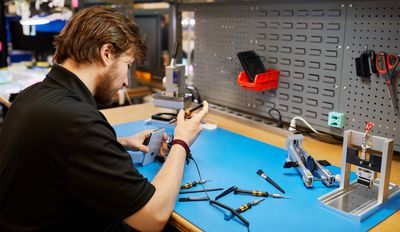
apple repair
Proctor said that the program is encouraging because Right to Repair is "breaking through," but Apple is exerting too much control by locking parts to a specific device and requiring Apple verification during the repair process.

"We are really pleased to see public access to Apple service guides for the first time in decades. However, it's clear that Apple is doubling down on requiring each part be encoded to a specific phone, and then requiring a connection to Apple to verify the part before it gains full functionality. I don't see how locking parts to a specific device and requiring manufacturer approval to install it offers any benefit to the product owner, but it does allow Apple to maintain a lot of control over the repair process. It also means that Apple can decide to stop supporting repairs. If Apple decides that a phone is too old, they can effectively put an expiration date on any product needing repair, defeating one of the most important aspects of repair -- minimizing toxic electronic waste.

"While this is a start, there are still too many hoops to jump through to fix phones. As it's becoming clear that Apple and other manufacturers can give us the Right to Repair, we should require them to. And we should have more options. Not just one set of parts. Not just a few manufacturers. No product should be tossed in the scrap heap, wasting money and adding to our toxic electronic waste problem, because the manufacturer doesn't properly support repair."

Proctor believes that Apple and other tech companies should give consumers more options and better access to parts from different manufacturers rather than requiring parts supplied by the company itself.

Repair outlet iFixit expressed similar thoughts on the program, and said that it is a "great step" forward, but restrictive because of the part verification requirements that tie new components to serial numbers.

Apple's new ‌Self Service Repair‌ program launched this morning, and customers can currently opt to receive repair kits to fix the battery, bottom speaker, camera, display, SIM Tray, or Taptic Engine of an ‌iPhone‌ 12 or ‌iPhone‌ 13 device.

Initiating a repair requires a serial number or IMEI, and after some of the repairs are complete, customers will need to initiate System Configuration with Apple. Repairs can be done with the rental toolkit from Apple, which costs $49 to rent for a seven day period.

Apple's rental toolkit includes all of the tools necessary to get into an ‌iPhone‌, but the actual replacement components are a separate charge. Apple's toolkit is massive at a total weight of 79 pounds, and kits must be returned to a UPS location when a repair is complete.

The toolkit rental and return process, the cost of replacement parts, and the verification may be more effort than some users want to put into ‌iPhone‌ repair, so it is unclear how popular Apple's program will be with ‌iPhone‌ users. On the plus side, repairs do not have labor costs associated, and all of the parts and tools are genuine Apple components, which isn't always the case with third-party repairs from companies other than Apple.


Popular Stories

iOS 26

iOS 26.3 and iOS 26.4 Will Add These New Features to Your iPhone

Tuesday February 3, 2026 7:47 am PST by
We are still waiting for the iOS 26.3 Release Candidate to come out, so the first iOS 26.4 beta is likely still at least a week or two away. Following beta testing, iOS 26.4 will likely be released to the general public in March or April. Below, we have recapped known or rumored iOS 26.3 and iOS 26.4 features so far. iOS 26.3 iPhone to Android Transfer Tool iOS 26.3 makes it easier...
Apple Logo Black

Apple's Next Launch is 'Imminent'

Sunday February 1, 2026 12:31 pm PST by
The calendar has turned to February, and a new report indicates that Apple's next product launch is "imminent," in the form of new MacBook Pro models. "All signs point to an imminent launch of next-generation MacBook Pros that retain the current form factor but deliver faster chips," Bloomberg's Mark Gurman said on Sunday. "I'm told the new models — code-named J714 and J716 — are slated...
iOS 26 Home Feature

Apple Gives Final Warning to Home App Users

Tuesday February 3, 2026 8:55 am PST by
In 2022, Apple introduced a new Apple Home architecture that is "more reliable and efficient," and the deadline to upgrade and avoid issues is fast approaching. In an email this week, Apple gave customers a final reminder to upgrade their Home app by February 10, 2026. Apple says users who do not upgrade may experience issues with accessories and automations, or lose access to their smart...
Aston Martin CarPlay Ultra Screen

Apple's CarPlay Ultra to Expand to These Vehicle Brands Later This Year

Sunday February 1, 2026 10:08 am PST by
Last year, Apple launched CarPlay Ultra, the long-awaited next-generation version of its CarPlay software system for vehicles. Nearly nine months later, CarPlay Ultra is still limited to Aston Martin's latest luxury vehicles, but that should change fairly soon. In May 2025, Apple said many other vehicle brands planned to offer CarPlay Ultra, including Hyundai, Kia, and Genesis. In his Powe...
Apple Foldable Thumb

First Foldable iPhone Design Details Revealed

Monday February 2, 2026 7:19 am PST by
Apple's first foldable iPhone will feature relocated volume buttons, an all-black camera plateau, a smaller Dynamic Island, and more, according to design leaks from a known Weibo leaker. The user known as "Instant Digital" today claimed to share several key details about the design of the foldable iPhone: The volume buttons will be located on the top edge of the device, aligned to the...

Top Rated Comments

apparatchik Avatar
49 months ago
Well, the idea behind locking parts to a device is to discourage phone stealing, if someone steals or tries to sell a stolen iPhone it shouldn’t be worth the parts.
Score: 31 Votes (Like | Disagree)
Macative Avatar
49 months ago
Translation: It's still difficult and still costs money to fix them, so right to repair people will never be happy.

Right to repair is just a smokescreen for people who don't want to pay what Apple charges for repairs. Until they find out that buying OEM parts and renting the tools is still going to cost almost as much. Suddenly they won't want to repair them anymore.
Score: 30 Votes (Like | Disagree)
Macintosh TV Avatar
49 months ago
Person who makes money on repairs wants it easier to make money on repairs. Imagine that. I don't need their hot take.
Score: 18 Votes (Like | Disagree)
CWallace Avatar
49 months ago
As others have mentioned on the other threads today about Apple's program, the likely reason for Apple's "control" is to prevent stolen iOS devices from being harvested for spare parts. Yes, the cynic can (rightly) say that it's just to protect Apple's cut of the spare parts revenue stream, but it also helps curb the appeal of stealing iOS devices to feed an "underground parts network" and this should hopefully suppress the risk of iOS device theft significantly increasing.
Score: 16 Votes (Like | Disagree)
jtkiley Avatar
49 months ago
It seems telling that the new "this isn't good enough" complaint is that people can't just use whatever parts they want. It's almost as if the whole point of "right to repair" is to boost margins by substituting cheaper parts for original ones.

A lot of Apple's moves in this area (and others, e.g., the App Store) seem to revolve around one idea: if things break on a product used by hundreds of millions of people (the vast majority of whom aren't tech enthusiasts), Apple thinks they'll be blamed for it. They're probably right about that.
Score: 14 Votes (Like | Disagree)
hasanahmad Avatar
49 months ago
"Proctor believes that Apple and other tech companies should give consumers more options and better access to parts from different manufacturers rather than requiring parts supplied by the company itself."

this statement right here proves that right to repair movement is more about cheaper lower quality parts for users than the right to repair itself. the movement was called right to repair, not right to fix it for cheap
Score: 12 Votes (Like | Disagree)