An early look at an ongoing analysis of Apple's App Tracking Transparency suggests that the vast majority of iPhone users are leaving app tracking disabled since the feature went live on April 26 with the release of iOS 14.5.
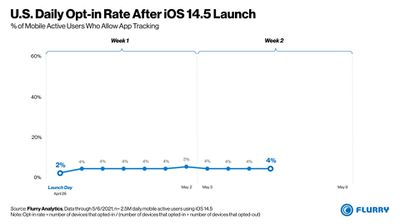
According to the latest data from analytics firm Flurry, just 4% of iPhone users in the U.S. have actively chosen to opt into app tracking after updating their device to iOS 14.5. The data is based on a sampling of 2.5 million daily mobile active users.
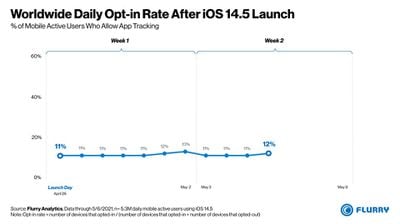
When looking at users worldwide who allow app tracking, the figure rises to 12% of users in a 5.3 million user sample size.
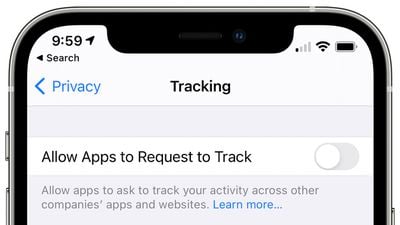
With the release of iOS 14.5, apps must now ask for and receive user permission before they can access a device's random advertising identifier, which is used to track user activity across apps and websites. Users can either enable or disable the ability for apps to ask to track them. Apple disables the setting by default.
Since the update almost two weeks ago, Flurry's figures show a stable rate of app-tracking opt-outs, with the worldwide figure hovering between 11-13%, and 2-5% in the U.S. The challenge for the personalized ads market will be significant if the first two weeks end up reflecting a long-term trend.
Facebook, a vociferous opponent of ATT, has already started attempting to convince users that they must enable tracking in iOS 14.5 if they want to help keep Facebook and Instagram "free of charge." That sentiment would seem to go against the social network's earlier claim that ATT will have a "manageable" impact on its business and could even benefit Facebook in the long term.
Flurry Analytics, owned by Verizon Media, is used in over 1 million mobile applications, providing aggregated insights across 2 billion mobile devices per month. Flurry intends to update its figures every weekday for the daily opt-in rate as well as the share of users that apps cannot ask to track, both in the U.S. and globally.
Tuesday February 3, 2026 7:47 am PST by Joe Rossignol
We are still waiting for the iOS 26.3 Release Candidate to come out, so the first iOS 26.4 beta is likely still at least a week or two away. Following beta testing, iOS 26.4 will likely be released to the general public in March or April.
Below, we have recapped known or rumored iOS 26.3 and iOS 26.4 features so far.
iOS 26.3
iPhone to Android Transfer Tool
iOS 26.3 makes it easier...
Sunday February 1, 2026 12:31 pm PST by Joe Rossignol
The calendar has turned to February, and a new report indicates that Apple's next product launch is "imminent," in the form of new MacBook Pro models.
"All signs point to an imminent launch of next-generation MacBook Pros that retain the current form factor but deliver faster chips," Bloomberg's Mark Gurman said on Sunday. "I'm told the new models — code-named J714 and J716 — are slated...
Tuesday February 3, 2026 8:55 am PST by Joe Rossignol
In 2022, Apple introduced a new Apple Home architecture that is "more reliable and efficient," and the deadline to upgrade and avoid issues is fast approaching.
In an email this week, Apple gave customers a final reminder to upgrade their Home app by February 10, 2026. Apple says users who do not upgrade may experience issues with accessories and automations, or lose access to their smart...
Sunday February 1, 2026 10:08 am PST by Joe Rossignol
Last year, Apple launched CarPlay Ultra, the long-awaited next-generation version of its CarPlay software system for vehicles. Nearly nine months later, CarPlay Ultra is still limited to Aston Martin's latest luxury vehicles, but that should change fairly soon.
In May 2025, Apple said many other vehicle brands planned to offer CarPlay Ultra, including Hyundai, Kia, and Genesis.
In his Powe...
Apple's first foldable iPhone will feature relocated volume buttons, an all-black camera plateau, a smaller Dynamic Island, and more, according to design leaks from a known Weibo leaker.
The user known as "Instant Digital" today claimed to share several key details about the design of the foldable iPhone:
The volume buttons will be located on the top edge of the device, aligned to the...
The default is for tracking to be disabled when iOS 14.5 is installed. So in reality this is "4% of users have opted in to having apps ask whether to track or not". 96% of users have just done nothing.
Why would anyone ever choose to turn on tracking? Open to any use cases....
I had it disabled out interest. I just wanted to know which app had the audacity to ask me in the first place. Then I deleted the least important ones.