

Hulu on Reddit this week announced that it will begin rolling out support for 60 frames per second live streams on its "Hulu With Live TV" cord-cutting service, launching in time for viewers to stream the Olympics and March Madness. Hulu said it was aware that 60fps streaming was "one of the most-requested features" by its viewers, leading to this week's announcement (via Cord Cutters News).
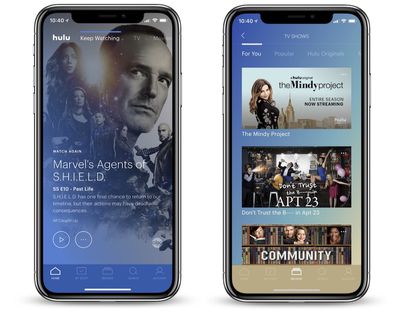
The company explained that the update will see a launch in phases, and began yesterday with Phase 1, including the following channels now supporting 60fps on Hulu With Live TV: CNN, CNN International, HLN, TNT, TBS, TCM, TruTV, Cartoon Network, Adult Swim, all SHOWTIME channels, "about half" of available FOX affiliates, all NBC affiliates, and New England Channel News.
Due to the dependencies required to enable 60fps, we’ll be rolling it out in phases to get you these higher-quality streams as quickly as possible. By offering our live streams at this frame rate, our goal is to provide a significantly more immersive viewing experience for Live TV. You’ll notice the difference most when watching sports or news, so we’re excited to have this in time for the 2018 Winter Olympics and March Madness (NBC and Turner channels, respectively).
Hulu noted that individual affiliates "may temporarily revert back" to 30fps streams when adjusting for internet speeds, giving viewers a more stable experience. Phase 1 will include Hulu apps on iPhone, iPad, Apple TV, Xbox One, Fire TV, Samsung Tizen TV, and Nintendo Switch.
The company hasn't yet indicated when Phase 2 will begin, or what channels/devices will be part of that rollout. Later this year, Hulu will also be launching a redesigned user interface across its on-demand and live services, including a new Live TV guide. For the Live TV section of Hulu, the latest numbers put the service at 450,000 paid subscribers, beating out YouTube TV (300,000), but still trailing DirecTV Now (1 million) and Sling TV (nearly 2 million).
















Top Rated Comments
I tried DirectTV Now and the CBS app subscriptions... both had garbage video quality (overly compressed, jittery). Hulu knows how to get it done.
Can't wait for them to start streaming some shows / channels in 4k!
All OTA (ATSC) is 60Hz (same goes for satellite and cable). Some HD channels like CBS and NBC broadcast in 1080i. Others, like FOX and ABC, broadcast in 720p. Both are 60Hz though. In the case of 1080i, this is interlaced video, meaning the motion information per frame is shared between two fields, and technically the frame rate is 30 fps (well, 29.97), but there are still actually 60 fields per second. For 720p, this is progressive video and there are 60 frames/fields per second
This would actually serve no purpose, unless your TV/decoder just does a really poor job of matching the source content to its native display refresh rate. The vast majority of scripted programming was originally shot at 24fps, so converting this content to 60fps would mean that frames need to be repeated. Now, this is a very typical procedure done in broadcast today for sure, but this is purely for matching the source to the broadcast standard in play for that channel. This is not done to 'benefit' the video. And as most people have already commented on wrt UHD Blu-ray, when a film that was mastered for disc at 2K and scaled to 4K for the UHD disc, the video quality here is far inferior to films that were natively mastered at 4K.
Correct about Billy Lynn being the only major Hollywood Studio release of a film natively shot and distributed at 60fps. But for non-Hollywood content, especially sports, this has been going on for years. You would be very hard-pressed to find any sporting event in North America on broadcast TV shot at 24fps. They are shot and produced at either 720p60 or 1080i60, depending on the network.
Hulu is getting the same signal your local station relay and satellite or cable provider receives. Again, all broadcast tv is 60Hz. Hulu is just now deciding to deliver to their customers the native 60fps of the 720p channels, and likely separating the fields of the native 1080i channels into sequential frames, which results in the same net effect of 60 fps.
Right on.
This is sort of correct. Again, I wouldn't term it as fps, as that does video broadcasting standards a disservice due to interlacing. Hulu is most likely taking the 60i ('30fps') interlaced source and separating the fields into a 60p version of the source to feed into their encoder (this is all likely done within the encoder, but I'm just splitting it out here so that it may be easier to visualize). For native 60fps content, of which about 30% of the channels in NTSC land are, Hulu is just maintaining the input.
This is a pretty accurate readout actually. Both 1080i and 1080p60 actually have the same number of fields, so on a good tv with a good preprocessing engine, the difference between 1080i and and 1080p would not be too much. The 1080p version should look much sharper, due to it having twice the effective vertical resolution, but the motion itself wouldn't be too much different.
Correct, but this is not what they are doing. There are two main methods to convert video from one lower frame rate to a higher one. The first is called interpolation, and this is what most TVs do when you enable their 'smooth motion' process or whatever they choose to call it. The net effect of this is that 'soap opera' effect you allude to. The second option is call pulldown or telecine. In this method, frames or fields are repeated. The net effect of this is judder. This is no doubt something that everyone is used to as it is the standard used by broadcasters to convert 24fps content to their native broadcast signal.
Again, another misconception here about what a TV is doing. If the TV were just taking in a 1080i signal and doubling the frames to 60fps, this would look exactly like how OTT sports that are encoded at 30fps would look. This is because NO TV has a native refresh rate of 30Hz. What the TV is actually doing is similar to what I describe Hulu is probably doing, which is separating each field in an interlaced channel and laying them out sequentially to maintain all of the original source motion resolution. This method does require a vertical scale, but the TV has to do that too in order to size the source for its own native resolution. To test this, you can go ahead and tune to a 1080i channel and point a camera at it that can record at 60fps (even an iPhone these days would suffice). Then view the recorded file frame-by-frame. You will see that all frames on your TV's display are unique (of course, the content has to be something like sports, and not the latest episode of NCIS or such).
The split for HD broadcast in NTSC-land is around 70-30% for 1080i vs 720p. But to think of video in terms of fps (and really someone in delivery broadcast television should know this) is not correct. Almost all video broadcast by standard non-PPV channels are broadcast at 60Hz. For 720p60 on a standard 60Hz TV, this is easy to understand how each frame is displayed. For 1080i60 on a 60Hz TV, this should also be relatively easy to understand how each field is displayed, especially given my above descriptions. I do not think you could find a TV that would just discard the non-dominant field of an interlaced signal and actually only display 30fps (maybe if you go back a few years to the first 4K 'TVs' that only supported 4K @ 30Hz, then this may be an example, but those were rare and really more akin to monitors than true TVs anyway).
So in short (lol I know by now if you're still with me), this is most definitely NOT just a gimmick. For any non-sports, non-news, or non-reality-tv programming (i.e. all film-based original content), then this announcement indeed has little value. But if you want to watch events like the Olympics, the World Cup, the NCAA basketball playoff, or the Super Bowl on one of these streaming services on your TV and not feel like you're watching a pirated stream, then this is fantastic news and ushers in a new era for more competitive video quality on these streaming services (and yes, I know, Hulu is a bit late to the game here so I am not just talking about them).
So basically this is a gimmick at best. Even broadcasting at 29.97 most Footage is shot at 23.98 so they can play it back at whatever they want but it won’t change the look any because it wasn’t shot with that many frames.
The only time 60 FPS makes a difference is when you are talking Footage that’s created at 60 such as video game footage and maybe some sports, I’m not sure what they shoot at. Content created under won’t see any benefit to a higher frame rate.