Here's How Apple Improves the iOS and Mac User Experience While Protecting Your Privacy

Apple has added a new entry to its Machine Learning Journal with in-depth technical details about how it uses differential privacy to gather anonymous usage insights from devices like iPhones, iPads, and Macs.
ios differential privacy copy
At a high level, differential privacy allows Apple to crowdsource data from a large number of users without compromising the privacy of any individual.

There are two types of differential privacy: central and local. Apple has chosen to use the local setting, which means that data is randomized before being sent from devices, so that its servers never see or receive raw data from users.

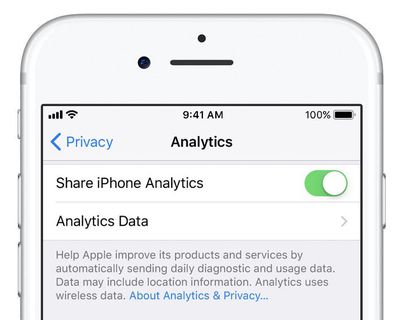
When users set up their device, Apple explicitly asks users if they wish to provide usage information on an opt-in basis. If a user declines, no data is collected by Apple unless they choose to opt in at a later time.

The toggle for sending usage information can be found under Settings > Privacy > Analytics on iOS 10 and later and under System Preferences > Security & Privacy > Privacy > Analytics on macOS Sierra and later.

Apple says the data it collects helps to, for example, improve the QuickType keyboard's predictive words and emoji suggestions, and to help identify problematic websites that use excessive power or too much memory in Safari.

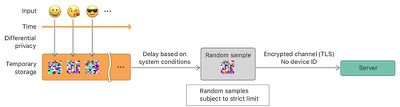
An opted-in user who types an emoji, for example, may trigger usage information to be collected based on the following process:

• The data is immediately privatized via local differential privacy.

• The data is temporarily stored on-device using a technology called Data Protection, which is explained on page 11 of Apple's iOS Security Guide.

• After a delay, a random sample of the data is collected and sent to Apple's server.

The data sent to Apple does not include device identifiers or timestamps of when the events in the usage information occurred. The communication between a device and Apple's server is encrypted using TLS.
emoji differential privacy
In iOS, information being shared with Apple for the categories of data that are protected using Differential Privacy is visible under Settings > Privacy > Analytics > Analytics Data, in entries that begin with "DifferentialPrivacy."

In macOS, users can launch the Console app and view the information under the Differential Privacy category of System Reports.

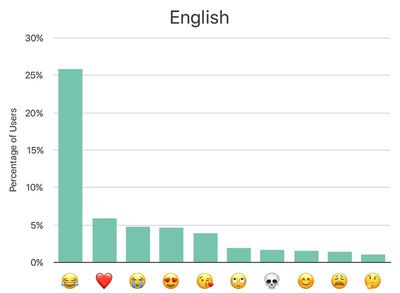
On a side note, the blog post reveals that "Face With Tears of Joy" is the most popular emoji, used by more than 25 percent of English-speaking users of Apple devices. We saw this chart before, but now it's labeled along the y-axis.
emoji chart apple
For a detailed explanation of the mathematical algorithms that Apple is using, the Learning with Privacy at Scale entry in its Machine Learning Journal is a worthwhile read.
Popular Stories

iOS 26

iOS 26.3 and iOS 26.4 Will Add These New Features to Your iPhone

Tuesday February 3, 2026 7:47 am PST by
While the iOS 26.3 Release Candidate is now available ahead of a public release, the first iOS 26.4 beta is likely still at least a week away. Following beta testing, iOS 26.4 will likely be released to the general public in March or April. Below, we have recapped known or rumored iOS 26.3 and iOS 26.4 features so far. iOS 26.3 iPhone to Android Transfer Tool iOS 26.3 makes it easier...
imac video apple feature

Apple Makes Its Second-Biggest Acquisition Ever

Tuesday February 3, 2026 12:45 pm PST by
Apple recently acquired Israeli startup Q.ai for close to $2 billion, according to Financial Times sources. That would make this Apple's second-biggest acquisition ever, after it paid $3 billion for the popular headphone maker Beats in 2014. This is also the largest known Apple acquisition since the company purchased Intel's smartphone modem business and patents for $1 billion in 2019....
Apple Logo Black

Apple's Next Launch is 'Imminent'

Sunday February 1, 2026 12:31 pm PST by
The calendar has turned to February, and a new report indicates that Apple's next product launch is "imminent," in the form of new MacBook Pro models. "All signs point to an imminent launch of next-generation MacBook Pros that retain the current form factor but deliver faster chips," Bloomberg's Mark Gurman said on Sunday. "I'm told the new models — code-named J714 and J716 — are slated...
iOS 26 Home Feature

Apple Gives Final Warning to Home App Users

Tuesday February 3, 2026 8:55 am PST by
In 2022, Apple introduced a new Apple Home architecture that is "more reliable and efficient," and the deadline to upgrade and avoid issues is fast approaching. In an email this week, Apple gave customers a final reminder to upgrade their Home app by February 10, 2026. Apple says users who do not upgrade may experience issues with accessories and automations, or lose access to their smart...
Aston Martin CarPlay Ultra Screen

Apple's CarPlay Ultra to Expand to These Vehicle Brands Later This Year

Sunday February 1, 2026 10:08 am PST by
Last year, Apple launched CarPlay Ultra, the long-awaited next-generation version of its CarPlay software system for vehicles. Nearly nine months later, CarPlay Ultra is still limited to Aston Martin's latest luxury vehicles, but that should change fairly soon. In May 2025, Apple said many other vehicle brands planned to offer CarPlay Ultra, including Hyundai, Kia, and Genesis. In his Powe...

Top Rated Comments

Dave245 Avatar
107 months ago
I wish we could get to the root of why Apple felt they needed this article out there.
Probably because there are a small group of ill-informed people who think Apple is spying on them (tin foil hats ready) :rolleyes:

Apple’s stance on privacy is one of the (many reasons) I like and continue to use Apple products.
Score: 25 Votes (Like | Disagree)
RickInHouston Avatar
107 months ago
I think the privacy campaign is all apple has left in the tank. When things go to @**t, apple marketing pulls out the privacy card and plays it hard.
Score: 12 Votes (Like | Disagree)
Gorms Avatar
107 months ago
Probably because there are a small group of ill-informed people who think Apple is spying on them (tin foil hats ready) :rolleyes:

Apple’s stance on privacy is one of the (many reasons) I like and continue to use Apple products.
I believe the answer is it helps to attract talent. Top researchers want to be published in their findings, so an atmosphere of secrecy would work against them here.
Aww man, I was going for a High Sierra root privileges joke here. Evidence suggests, I have failed this forum.
Score: 11 Votes (Like | Disagree)
Gorms Avatar
107 months ago
I wish we could get to the root of why Apple felt they needed this article out there.
Score: 9 Votes (Like | Disagree)
deanthedev Avatar
107 months ago
Of course Privacy is important. But people act as if Google is selling our childrens social security numbers and trading our bank accounts to China. But the reality of it is that its just a two way street. I give up secrets about my browsing habits (OMG, they found out I'm shopping for a new Fridge!) and they give me info and results that I actually can use (Hey. Fridge review. Win Win. (Unless you have your Tin Foil hat inside out)
Google literally makes almost 90% of their revenue off data. Apple makes practically nothing off our data (they make money on hardware).

Which company do you think is more likely to abuse your data for their own gain?

Here’s a hint: it’s the company that was fined for intentionally writing code to exploit Safari to bypass do-not-track in order to serve ads.
Score: 8 Votes (Like | Disagree)
ksnell Avatar
107 months ago
I wish we could get to the root of why Apple felt they needed this article out there.
I believe the answer is it helps to attract talent. Top researchers want to be published in their findings, so an atmosphere of secrecy would work against them here.
Score: 8 Votes (Like | Disagree)