Apple Launches New Blog to Share Details on Machine Learning Research

Apple today debuted a new blog called the "Apple Machine Learning Journal," with a welcome message for readers and an in-depth look at the blog's first topic: "Improving the Realism of Synthetic Images." Apple describes the Machine Learning Journal as a place where users can read posts written by the company's engineers, related to all of the work and progress they've made for technologies in Apple's products.

In the welcome message, Apple encourages those interested in machine learning to contact the company at an email address for its new blog, machine-learning@apple.com.

apple machine learning journal

Welcome to the Apple Machine Learning Journal. Here, you can read posts written by Apple engineers about their work using machine learning technologies to help build innovative products for millions of people around the world. If you’re a machine learning researcher or student, an engineer or developer, we’d love to hear your questions and feedback. Write us at machine-learning@apple.com

In the first post -- described as Vol. 1, Issue 1 -- Apple's engineers delve into machine learning related to neural nets that can create a program to intelligently refine synthetic images in order to make them more realistic. Using synthetic images reduces cost, Apple's engineers pointed out, but "may not be realistic enough" and could result in "poor generalization" on real test images. Because of this, Apple set out to find a way to enhance synthetic images using machine learning.

Most successful examples of neural nets today are trained with supervision. However, to achieve high accuracy, the training sets need to be large, diverse, and accurately annotated, which is costly. An alternative to labelling huge amounts of data is to use synthetic images from a simulator. This is cheap as there is no labeling cost, but the synthetic images may not be realistic enough, resulting in poor generalization on real test images. To help close this performance gap, we’ve developed a method for refining synthetic images to make them look more realistic. We show that training models on these refined images leads to significant improvements in accuracy on various machine learning tasks.

In December 2016, Apple's artificial intelligence team released its first research paper, which had the same focus on advanced image recognition as the first volume of the Apple Machine Learning Journal does today.

The new blog represents Apple's latest step in its progress surrounding AI and machine learning. During an AI conference in Barcelona last year, the company's head of machine learning Russ Salakhutdinov provided a peek behind the scenes of some of Apple's initiatives in these fields, including health and vital signs, volumetric detection of LiDAR, prediction with structured outputs, image processing and colorization, intelligent assistant and language modeling, and activity recognition, all of which could be potential subjects for research papers and blog posts in the future.

Check out the full first post in the Apple Machine Learning Journal right here.

Popular Stories

Aston Martin CarPlay Ultra Screen

Apple's CarPlay Ultra to Expand to These Vehicle Brands Later This Year

Sunday February 1, 2026 10:08 am PST by
Last year, Apple launched CarPlay Ultra, the long-awaited next-generation version of its CarPlay software system for vehicles. Nearly nine months later, CarPlay Ultra is still limited to Aston Martin's latest luxury vehicles, but that should change fairly soon. In May 2025, Apple said many other vehicle brands planned to offer CarPlay Ultra, including Hyundai, Kia, and Genesis. In his Powe...
iOS 26

iOS 26.3 and iOS 26.4 Will Add These New Features to Your iPhone

Tuesday February 3, 2026 7:47 am PST by
We are still waiting for the iOS 26.3 Release Candidate to come out, so the first iOS 26.4 beta is likely still at least a week or two away. Following beta testing, iOS 26.4 will likely be released to the general public in March or April. Below, we have recapped known or rumored iOS 26.3 and iOS 26.4 features so far. iOS 26.3 iPhone to Android Transfer Tool iOS 26.3 makes it easier...
Apple Logo Black

Apple's Next Launch is 'Imminent'

Sunday February 1, 2026 12:31 pm PST by
The calendar has turned to February, and a new report indicates that Apple's next product launch is "imminent," in the form of new MacBook Pro models. "All signs point to an imminent launch of next-generation MacBook Pros that retain the current form factor but deliver faster chips," Bloomberg's Mark Gurman said on Sunday. "I'm told the new models — code-named J714 and J716 — are slated...
Apple MacBook Pro M4 hero

New MacBook Pros Reportedly Launching Alongside macOS 26.3

Sunday February 1, 2026 5:42 am PST by
Apple is planning to launch new MacBook Pro models with M5 Pro and M5 Max chips alongside macOS 26.3, according to Bloomberg's Mark Gurman. "Apple's faster MacBook Pros are planned for the macOS 26.3 release cycle," wrote Gurman, in his Power On newsletter today. "I'm told the new models — code-named J714 and J716 — are slated for the macOS 26.3 software cycle, which runs from...
iOS 26 Home Feature

Apple Gives Final Warning to Home App Users

Tuesday February 3, 2026 8:55 am PST by
In 2022, Apple introduced a new Apple Home architecture that is "more reliable and efficient," and the deadline to upgrade and avoid issues is fast approaching. In an email this week, Apple gave customers a final reminder to upgrade their Home app by February 10, 2026. Apple says users who do not upgrade may experience issues with accessories and automations, or lose access to their smart...

Top Rated Comments

MikhailT Avatar
112 months ago
Except no, it isn’t. It isn’t in this area or other areas.

Apple is sharing their knowledge, and others? They aren’t! Except informercials.
I think he meant that Apple is having a hard time recruiting more AI researchers/scientists that needs to be able to publish their works (they're not the engineers type). In order for Apple to benefit from their minds, they have to start opening up to the public. This isn't your traditional CS work, this is purely scientific research that has a long history of journal-based reviews and public access.

There were many rumors that many AI researchers turned down jobs at Apple simply because they would not be able to publish their works. For these scientists, it is not about the money or the company, it is all about having their work published with their name on it.

In addition, this is one of the areas where knowing other research benefits everyone at the same time.

Google, Facebook, Microsoft and others are in fact publishing their works throughout various mediums (magazines, research papers, etc).

In fact, they all started a partnership to share research among each other, Partnership on AI here: https://www.partnershiponai.org (Apple is founding member along with Microsoft, IBM, Google, Facebook, Amazon, etc.
Score: 11 Votes (Like | Disagree)
AngerDanger Avatar
112 months ago
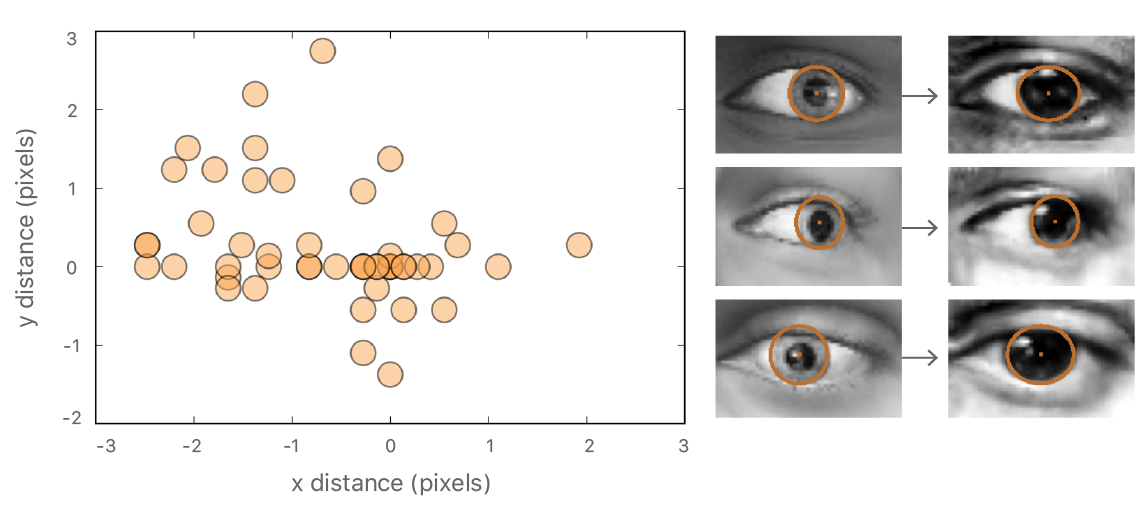
In the interest of being all scientific and sharing stuff, I read about half of the blogpost and realized some of the implications of its content. The blog specifically uses the example of human eye recognition in its explanation of machine learning and refined synthetic machine-based learning. Hmmmm, I wonder what thing Apple could be using all of this ocular information for? ;)

Assessing Gaze
Part of the blog places emphasis on knowing which direction the sampled eyes are looking. In fact, if the refinement process moves the iris too much, that output is (I think) weighted as less accurate. In the rumors leading up to the iP8 release, many commenters have voiced concern over the device's ability to understand whether or not you actually want it to unlock; it seems Apple might be attempting to address that concern.


Use of Monochrome Samples
Folks have also discussed the potential inability for iris/eye scanning technology to work in the dark, but perhaps they're not considering that your iPhone (or Android) can already see you in the dark. When held to your face during a call in a dark environment, it will shut the screen off. Next to the earpiece, there's a little IR LED that illuminates objects held close to it, and when the phone sees that particular of IR light, it shuts the screen off.


If that light were brighter, it could illuminate the user's entire face. However, because it's only IR light, it wouldn't see the full visible spectrum of light (RGB); it would only see monochrome faces in the dark. It just so happens that the sample images Apple is using are already monochrome.

Anyway, I gotta go buy more tinfoil for my hat!

Attachment Image
Score: 6 Votes (Like | Disagree)
Crzyrio Avatar
112 months ago
Wait?!

Apple launches a blog with employees talking about how they are doing their job???????

The hell froze over, Steve Jobs DEFINITIVELY wouldn’t allow THAT!
It is a must in the AI field
Score: 5 Votes (Like | Disagree)
alwaysbeincontact Avatar
112 months ago
Neat, interesting stuff, nice to Apple getting into blogging now and posting about this future tech.
Score: 4 Votes (Like | Disagree)
dabirdwell Avatar
112 months ago
Interesting! I didn't know about this partnership. I wonder how Elon Musk feels, and why Tesla hasn't joined.
He has OpenAI.

https://www.wired.com/2016/04/openai-elon-musk-sam-altman-plan-to-set-artificial-intelligence-free/
Score: 2 Votes (Like | Disagree)
Zirel Avatar
112 months ago
Wait?!

Apple launches a blog with employees talking about how they are doing their job???????

The hell froze over, Steve Jobs DEFINITIVELY wouldn’t allow THAT!
Score: 1 Votes (Like | Disagree)