Losing Two-Factor Recovery Key Could Permanently Lock Apple ID - MacRumorsOpen MenuShow RoundupsShow Forums menuVisit ForumsOpen Sidebar
Skip to Content

Losing Two-Factor Recovery Key Could Permanently Lock Apple ID

In March 2013, Apple introduced two-factor authentication to provide additional security for Apple IDs. It expanded the feature to several new countries earlier this year and introduced it to the company's iCloud.com website this September. This was after CEO Tim Cook promised to broaden use of its two-factor authentication system in the wake of a hacking incident that saw several celebrities' iCloud accounts hacked.
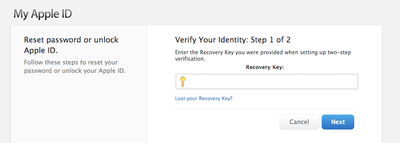
recoverykey
The system requires a user to have a second "trusted" device that is used to verify a user's identity in addition to an extra security code called the "Recovery Key". However, in a new account from The Next Web's Owen Williams, that Recovery Key also has the potential to completely lock a person out of their account if they're being hacked.

Williams found that someone had tried to hack his iCloud account. Apple's two-factor system kicked in and locked the account, denying entry to the would-be hacker while also denying entry to Williams. When he went to iForgot, Apple's account recovery service, he assumed two of his password, Recovery Key or trusted device would unlock his account, as he was led to believe by an Apple Support document.

When I headed to the account recovery service, dubbed iForgot, I discovered that there was no way back in without my recovery key. That’s when it hit me; I had no idea where my recovery key was or if I’d ever even put the piece of paper in a safe place. I’ve moved since I set up two-factor on iCloud.

Williams contends he took a screenshot of the Recovery Key and printed that out as well as taking a photo on his iPhone to keep as a backup, but could not locate either and was on the verge of losing his "digital life". He called Apple customer support and was told  that he had forfeited his Apple ID by losing his Recovery Key and that there was no way Apple could help him. He called back a second time.

When she got back on the line, the story was just as bleak. “We take your security very seriously at Apple” she told me “but at this time we cannot grant you access back into your Apple account. We recommend you create a new Apple ID.”

After a couple more days of talking to Apple customer support and even friends who worked at Apple, he continued to receive same responses: he was locked out of his account due to someone trying to hack into it and couldn't unlock it without a Recovery Key even though Apple's support document says it's possible with a trusted device. Eventually, Williams located his Recovery Key in what he calls the "depths" of his Time Machine backup, allowing him to finally unlock his account.

Williams concludes with a warning that anyone with two-factor authentication should take far greater care in protecting and remembering where they store their Recovery Keys, as losing it could permanently lock a user out of their Apple ID with Apple unable to do anything to help. The entire account, which is a fascinating and worthwhile read, can be read at The Next Web.


Popular Stories

iPhone 18 Pro Deep Red Feature

iPhone 18 Pro Launching Later This Year With These 12 New Features

Wednesday March 18, 2026 7:39 am PDT by
While the iPhone 18 Pro and iPhone 18 Pro Max are not expected to launch for another six months or so, there are already plenty of rumors about the devices. It was initially reported that the iPhone 18 Pro models would have fully under-screen Face ID, with only a front camera visible in the top-left corner of the screen. However, the latest rumors indicate that only one Face ID component...
imac video apple feature

Apple Released Yet Another New Product Today

Friday March 20, 2026 2:39 pm PDT by
Apple has unveiled a whopping nine new products so far this March, including an iPhone 17e, iPad Air models with the M4 chip, MacBook Air models with the M5 chip, MacBook Pro models with M5 Pro and M5 Max chips, the all-new MacBook Neo, an updated Studio Display, a higher-end Studio Display XDR, AirPods Max 2, and now the Nike Powerbeats Pro 2. iPhone 17e features the same overall design as...
ios 26 4 yellow

Here Are Apple's Release Notes for iOS 26.4

Wednesday March 18, 2026 11:56 am PDT by
Apple provided developers and public beta testers with the release candidate versions of iOS 26.4 and iPadOS 26.4, which means we're going to see a public launch as soon as next week. The RC versions of the software include Apple's official release notes, giving us final details on what's included in the update. Apple Music - Playlist Playground (beta) generates a playlist from your...

Top Rated Comments

kitsap2 Avatar
147 months ago
Breaking News!

System works as designed!
Score: 101 Votes (Like | Disagree)
147 months ago
I am also confused how this is news. Apple explicitly states that losing the key will make the recovery impossible. And anyway, do you want secure accounts or not? If yes, then you are personally responsible for your stuff. Putting this silly article on MacRumours is entirely pointless.
Score: 29 Votes (Like | Disagree)
lolkthxbai Avatar
147 months ago
Extra! Extra! Read all about it! Man discovers responsibility!
Score: 28 Votes (Like | Disagree)
147 months ago
Two-Factor Authentication is just that:
A user will need 2 out of the 3;
1. Password
2. Device
3. Recovery Key

The name of service describes it.
Except that it apparently doesn't work that way if Apple decides to lock your account due to hack attempts. In that case you have to have the recovery key, even if you have the 2 other factors. I think it is a bit draconian to permanently lock the account like that, given the value attached to it (you could lose not only your iTunes purchases, email, cloud documents etc., but also effectively brick your devices if you use Find my iPhone and need to restore a device for some reason).

They could perhaps release the lock after 48 hours, or unlock the account if you supply password, trusted device, and some additional verification (like showing a photo ID at an Apple store or sending a verification code to an alternate email address).
Score: 26 Votes (Like | Disagree)
147 months ago
Almost all the posts in here are incorrect about the purpose of the Recovery Key.

The Recovery Key is required if you forget your Apple ID password or lose access to a trusted device.

According to this article, the person in question knew his password and had a trusted device. He shouldn't have needed the Recovery Key.

The only thing Apple says about an account being compromised is that you need to reset your Apple ID password. And it says nothing about needing a Recovery Key to do that.
Score: 26 Votes (Like | Disagree)
147 months ago
So now they are saying Apple is too strict?
Score: 26 Votes (Like | Disagree)
Related Apple News: Health | Motoring | Lifestyle | Technology | Mac