Apple Pay Details: Apple Gets 0.15% Cut of Purchases, Higher Rates for Bluetooth Payments

Apple's ambitious new mobile payment initiative, Apple Pay, was announced on Tuesday during the company's iPhone event. Many questions still linger about the service, but information is beginning to trickle out from various sources as retailers, banks, and credit card companies prepare for the service's October launch.

According to a new report from The Financial Times, Apple stands to make quite a bit of money from its payments service. Banks and payment networks will be forking over 0.15 percent of each purchase to Apple, which equates to 15 cents out of a $100 purchase.

They are also paying hard cash for the privilege of being involved: 15 cents of a $100 purchase will go to the iPhone maker, according to two people familiar with the terms of the agreement, which are not public. That is an unprecedented deal, giving Apple a share of the payments' economics that rivals such as Google do not get for their services

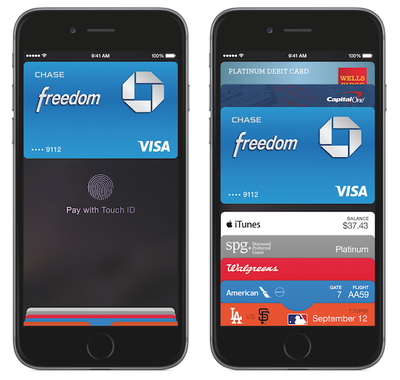
According to bank executives, Apple was able to negotiate with so many partners and receive choice deals because the industry didn't see anything threatening in Apple Pay. One executive suggested that Apple's payment model continued to put banks "at the centre of payments." Apple may also have been able to negotiate better deals due to the tight security it has in place for Apple Pay. Payments will be made via NFC with a one-time token, and also secured with a Touch ID fingerprint.

Additional details about Apple Pay's security have been unveiled by MasterCard executive Jorn Lambert, who spoke to Bank Innovation, explaining how each transaction will be secured.

Along with the cryptogram generated between a standard debit or credit card and a point of sale terminal, Apple Pay takes advantage of a token system that encrypts every step of the payment process. Tokenization is already built into the standard NFC specification, so what Apple is really doing is utilizing existing technology and further securing it with its own Touch ID fingerprint authorization system.
applepay
Every card added to Apple Pay (and located in Passbook) is assigned a token, which Apple calls a Dynamic Account Number. Each Dynamic Account Number is stored in the secure element of the iPhone and accompanied by a unique cryptogram for each transaction.

[Touch ID] authentication prompts the "secure element" to send the token and cryptogram to the merchant. The network decrypts the cryptogram and determines whether it is authentic or not. If it is deemed authentic, the network will pass it along to the issuer (i.e. the bank), which then decrypts the token. In other words, every party to the transaction decrypts something.

Once the issuer decrypts the token and determines that it is authentic, the issuer/bank authorizes the transaction. Money is then credited to the merchant and marked as an amount owed by the cardholder.

The token system essentially provides an extra layer of security to payments made through NFC, which, as mentioned earlier, allows merchants to pay a lower "card present" rate for NFC purchases. Merchants still pay the higher "card-not-present" rate when payments are made over Bluetooth LE rather than NFC, however, or when a purchase is made in-app using Apple Pay.

According to Lambert, Apple is not handling tokenization, instead leaving it up to credit card companies like Visa, MasterCard, and American Express. He describes Apple's role as a "channel and not a party," and Apple itself has confirmed that it won't store any information about transactions conducted by customers.

Apple has plans to roll out Apple Pay beginning in October, and promises the program will work with more than 220,000 U.S. retailers including Walgreens, Macy's, Nike, Bloomingdales, and more. Some stores like Walmart and Best Buy claim to have "opted out" of Apple Pay, but users should be able to make payments via the service at any location that has an NFC-capable point of sale system.

Many retailers are currently in the process of updating their point-of-sale hardware, as an upcoming change will see merchants that do not support EMV credit cards being liable for fraudulent, lost, and stolen cards. EMV credit cards, also known as "chip cards," include integrated circuits to authenticate debit and credit card purchases. The updated point of sale systems with EMV card support being adopted by retailers also generally include NFC, which means Apple Pay may work even at stores that have not specifically chosen to support the service.

Related Roundup: Apple Pay

Popular Stories

iOS 26

iOS 26.4 and iOS 27 Features Revealed in New Leak

Friday December 12, 2025 10:56 am PST by
Macworld's Filipe Espósito today revealed a handful of features that Apple is allegedly planning for iOS 26.4, iOS 27, and even iOS 28. The report said the features are referenced within the code for a leaked internal build of iOS 26 that is not meant to be seen by the public. However, it appears that Espósito and/or his sources managed to gain access to it, providing us with a sneak peek...
iOS 26

iOS 26.2 Coming Soon With These 8 New Features on Your iPhone

Thursday December 11, 2025 8:49 am PST by
Apple seeded the second iOS 26.2 Release Candidate to developers earlier this week, meaning the update will be released to the general public very soon. Apple confirmed iOS 26.2 would be released in December, but it did not provide a specific date. We expect the update to be released by early next week. iOS 26.2 includes a handful of new features and changes on the iPhone, such as a new...
iOS 26

Apple Releases iOS 26.2 With Alarms for Reminders, Lock Screen Changes, Enhanced Safety Alerts and More

Friday December 12, 2025 10:10 am PST by
Apple today released iOS 26.2, the second major update to the iOS 26 operating system that came out in September, iOS 26.2 comes a little over a month after iOS 26.1 launched. ‌iOS 26‌.2 is compatible with the ‌iPhone‌ 11 series and later, as well as the second-generation ‌iPhone‌ SE. The new software can be downloaded on eligible iPhones over-the-air by going to Settings >...
AirPods Pro Firmware Feature

Apple Releases New Firmware for AirPods Pro 2 and AirPods Pro 3

Thursday December 11, 2025 11:28 am PST by
Apple today released new firmware designed for the AirPods Pro 3 and the prior-generation AirPods Pro 2. The AirPods Pro 3 firmware is 8B30, up from 8B25, while the AirPods Pro 2 firmware is 8B28, up from 8B21. There's no word on what's include in the updated firmware, but the AirPods Pro 2 and AirPods Pro 3 are getting expanded support for Live Translation in the European Union in iOS...
macOS Tahoe 26 Thumb

Apple Releases macOS Tahoe 26.2 With Edge Light

Friday December 12, 2025 10:08 am PST by
Apple today released macOS Tahoe 26.2, the second major update to the macOS Tahoe operating system that came out in September. macOS Tahoe 26.2 comes five weeks after Apple released macOS Tahoe 26.1. Mac users can download the macOS Tahoe update by using the Software Update section of System Settings. macOS Tahoe 26.2 includes Edge Light, a feature that illuminates your face with soft...
AirTag 2 Mock Feature

Apple AirTag 2: Four New Features Found in iOS 26 Code

Thursday December 11, 2025 10:31 am PST by
The AirTag 2 will include a handful of new features that will improve tracking capabilities, according to a new report from Macworld. The site says that it was able to access an internal build of iOS 26, which includes references to multiple unreleased products. Here's what's supposedly coming: An improved pairing process, though no details were provided. AirTag pairing is already...
ipados 26 1 slide over

Apple Releases iPadOS 26.2 With Multitasking Improvements

Friday December 12, 2025 10:09 am PST by
Apple today released iPadOS 26.2, the second major update to the iPadOS 26 operating system released in September. iPadOS 26.2 comes a month after iPadOS 26.1. The new software can be downloaded on eligible iPads over-the-air by going to Settings > General > Software Update. iPadOS 26.2 continues with the multitasking improvements that were added with iPadOS 26.1. You can now drag and...
bug security vulnerability issue fix larry

Update Now: iOS 26.2 Fixes 20+ Security Vulnerabilities

Friday December 12, 2025 11:11 am PST by
Apple today released iOS 26.2, iPadOS 26.2, and macOS 26.2, all of which introduce new features, bug fixes, and security improvements. Apple says that the updates address over 20 vulnerabilities, including two bugs that are known to have been actively exploited. There are a pair of WebKit vulnerabilities that could allow maliciously crafted web content to execute code or cause memory...

Top Rated Comments

rwilliams Avatar
147 months ago
0.0015%? That sounds like the program the dudes in Office Space wrote.
Score: 28 Votes (Like | Disagree)
newagemac Avatar
147 months ago
The best thing about Apple's solution versus Google Wallet is that Apple is not storing the details of your transaction on their servers. Google is storing all your transaction data in their servers in the cloud. A big no no in my opinion. Plus there is the fact that it is using Touch ID so there is no pin you have to enter. The process of connection your cards is also easier.

So Apple Pay is more secure, more private, and is faster and easier to use. Hopefully this will be just what is needed to make contactless payments more widespread.
Score: 24 Votes (Like | Disagree)
Moriarty Avatar
147 months ago
15 cents per $100 is 0.15%, not 0.0015% as the article states.

Presuming the quotation of 15 cents per 100 dollars is correct, then Apple is charging a 0.15% cut.
Score: 19 Votes (Like | Disagree)
Moriarty Avatar
147 months ago
wrong.

There are two possible outcomes of that comment...

(1) you are trolling
(2) I just lost my faith in humanity
Score: 13 Votes (Like | Disagree)
Vertigo1 Avatar
147 months ago
wrong.
No, he's right, you're wrong. Go back to school.
Score: 13 Votes (Like | Disagree)
BruiserB Avatar
147 months ago
The fact that Apple's payment charge is based on a % cut of the purchase means I'll never use this service. That's just too greedy. It should have been a very small static fee like how VISA charges used to be. No thanks, Apple.
The banks (not the merchants) are paying Apple. It's worth it to them because it will reduce the fraud they now have to deal with. This may very well reduce their costs....not increase them. They are paying Apple for the security improvement.
Score: 11 Votes (Like | Disagree)