Intel Demonstrates Cableless Computing Made Possible by Future Skylake Platform
At Computex in Taiwan this week, Intel demonstrated a variety of wireless accessories that will be enabled by the company's future Skylake processor platform, reports CNET. Reference designs for the Broadwell successor will include the possibility of eliminating all of the cables that currently connect to a personal computer, replacing both data and power cables with wireless options.
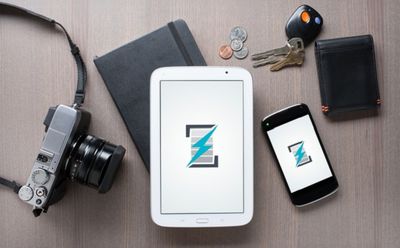
Wireless Charging concept from Rezence
The demonstration by Kirk Skaugen, Intel's senior vice president and general manager of the PC Client Group, showcased a wireless display, as well as a computer with wireless docking and charging capabilities. Intel uses technology from
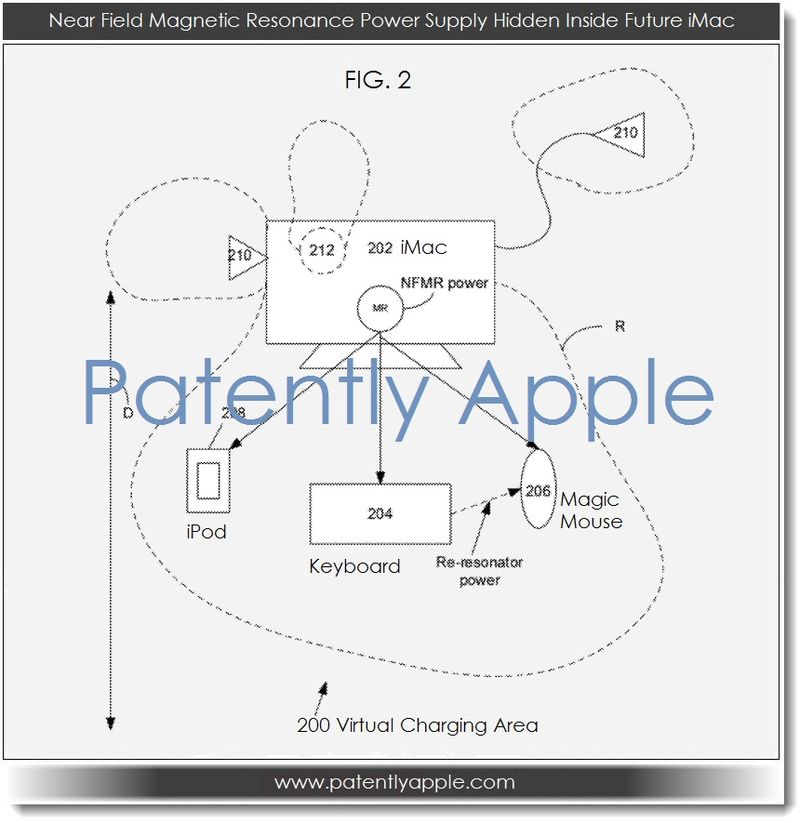
A4WP's Rezence, which transfers power wirelessly using the principles of magnetic resonance, for its wireless charging solution.
The system can be installed under a table surface, with magnetic resonance capable of charging through 2 inches of wood. It can also charge any number of devices at the same time, unlike inductive charging technologies.
Skaugen demonstrated a table that charged a laptop, phone, headset and tablet all at once.
For docking and display purposes, Intel relies on Wi-Gig to govern the wireless data transfer. First outlined in 2010, Wi-Gig is an established wireless standard that uses unlicensed 60 GHz spectrum to provide data transfer rates up to 7 Gbps.
The technology is still in the early stages, with Intel's Skylake platform expected to debut in late 2015. Products natively supporting these wireless protocols will be available publicly sometime in 2016. Apple is not currently listed as a member of the extensive A4WP consortium, but the company is undoubtedly pursuing its own potential solutions and its use of Intel's chips in Macs means that it will be able to take advantage of the technologies packaged into the future Skylake platform.
Popular Stories
Apple today confirmed to Reuters that it has acquired Q.ai, an Israeli startup that is working on artificial intelligence technology for audio.
Apple paid close to $2 billion for Q.ai, according to sources cited by the Financial Times. That would make this Apple's second-biggest acquisition ever, after it paid $3 billion for the popular headphone and audio brand Beats in 2014.
Q.ai has...
Last year, Apple launched CarPlay Ultra, the long-awaited next-generation version of its CarPlay software system for vehicles. Nearly nine months later, CarPlay Ultra is still limited to Aston Martin's latest luxury vehicles, but that should change fairly soon.
In May 2025, Apple said many other vehicle brands planned to offer CarPlay Ultra, including Hyundai, Kia, and Genesis.
In his Powe...
Apple recently updated its online store with a new ordering process for Macs, including the MacBook Air, MacBook Pro, iMac, Mac mini, Mac Studio, and Mac Pro.
There used to be a handful of standard configurations available for each Mac, but now you must configure a Mac entirely from scratch on a feature-by-feature basis. In other words, ordering a new Mac now works much like ordering an...
The calendar has turned to February, and a new report indicates that Apple's next product launch is "imminent," in the form of new MacBook Pro models.
"All signs point to an imminent launch of next-generation MacBook Pros that retain the current form factor but deliver faster chips," Bloomberg's Mark Gurman said on Sunday. "I'm told the new models — code-named J714 and J716 — are slated...
Apple is planning to launch new MacBook Pro models with M5 Pro and M5 Max chips alongside macOS 26.3, according to Bloomberg's Mark Gurman.
"Apple's faster MacBook Pros are planned for the macOS 26.3 release cycle," wrote Gurman, in his Power On newsletter today.
"I'm told the new models — code-named J714 and J716 — are slated for the macOS 26.3 software cycle, which runs from...