iPhone 5s Component Costs Estimated to Begin at $199

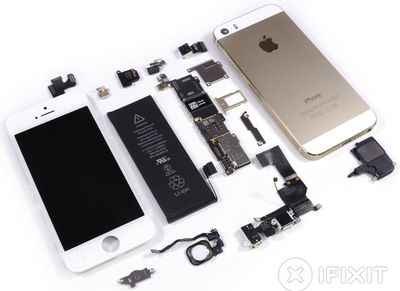
IHS Suppli has released its estimate of the component costs involved in building the iPhone 5s, performing a virtual teardown based on information revealed by Apple and industry knowledge. The estimate, which does not include numerous other costs involved in product development, manufacturing, and sales, such as research and development, software, patent licenses, marketing, and distribution expenditures, pegs the component cost of the 16 GB iPhone 5s at $199.

The full report has not yet been released but AllThingsD received early access.
5steardown

Apple spends at least $191 on components to build a 16 gigabyte iPhone 5s. The cost rises to $210 for a 64GB unit. The cost of assembly adds another $8 per unit, bringing the range to between $199 and $218.

That cost estimate is pretty close to that of the original iPhone 5, which IHS pegged at about $205 last year. Without a contract, the iPhone sells at prices ranging from $649 to $849, depending on storage capacity.

The bill of materials includes $41 for the iPhone 5s display, $32 for the RF chips, $7 for the fingerprint sensor, and $19 for the A7 chip manufactured by Samsung. The report says the cheaper iPhone 5c costs between $173 and $183, with the A6 processor costing $13.

However, from a material perspective, the iPhone 5c and 5s are very similar. With the exception of the fingerprint sensor, A7 processor and "some newer memory chips that consume less power", IHS analyst Andrew Rassweiler says they are "basically the same".

However, Apple appears to have spent "a lot of time and money combining [radio frequency] chips", says Rassweiler. "Apple seems to be pushing its RF suppliers to do things they don't do for anyone else."

Those vendors, according to IHS’s analysis, are Qualcomm, Skyworks, Avago, RF Micro Devices and TriQuint Semiconductor, all of which make chips that handle different aspects of the iPhone’s connections to various wireless networks. These efforts toward getting the radio frequency chips to work together have the effect, Rassweiler said, of allowing the phones to support more frequency bands in a single phone than before. “The iPhone 5 supported no more than five LTE bands. The 5s and 5c can support as many as 13, and that’s unique,” he said. “Unlike other phone designers, Apple has spent a lot of time collaborating with the RF chip companies to find novel solutions that its competitors don’t have.”

Some older generations of iPhones required a number of different models to cover all the different cellular frequencies, but Rassweiler says the progress Apple has made on RF chips suggests the company may soon be able to produce a single iPhone model that works on all cellular frequencies, increasing economies of scale significantly.

The full IHS Suppli report should be released tomorrow.
Popular Stories

Aston Martin CarPlay Ultra Screen

Apple's CarPlay Ultra to Expand to These Vehicle Brands Later This Year

Sunday February 1, 2026 10:08 am PST by
Last year, Apple launched CarPlay Ultra, the long-awaited next-generation version of its CarPlay software system for vehicles. Nearly nine months later, CarPlay Ultra is still limited to Aston Martin's latest luxury vehicles, but that should change fairly soon. In May 2025, Apple said many other vehicle brands planned to offer CarPlay Ultra, including Hyundai, Kia, and Genesis. In his Powe...
Apple Logo Black

Apple's Next Launch is 'Imminent'

Sunday February 1, 2026 12:31 pm PST by
The calendar has turned to February, and a new report indicates that Apple's next product launch is "imminent," in the form of new MacBook Pro models. "All signs point to an imminent launch of next-generation MacBook Pros that retain the current form factor but deliver faster chips," Bloomberg's Mark Gurman said on Sunday. "I'm told the new models — code-named J714 and J716 — are slated...
Apple MacBook Pro M4 hero

New MacBook Pros Reportedly Launching Alongside macOS 26.3

Sunday February 1, 2026 5:42 am PST by
Apple is planning to launch new MacBook Pro models with M5 Pro and M5 Max chips alongside macOS 26.3, according to Bloomberg's Mark Gurman. "Apple's faster MacBook Pros are planned for the macOS 26.3 release cycle," wrote Gurman, in his Power On newsletter today. "I'm told the new models — code-named J714 and J716 — are slated for the macOS 26.3 software cycle, which runs from...
iOS 26

iOS 26.3 and iOS 26.4 Will Add These New Features to Your iPhone

Tuesday February 3, 2026 7:47 am PST by
We are still waiting for the iOS 26.3 Release Candidate to come out, so the first iOS 26.4 beta is likely still at least a week or two away. Following beta testing, iOS 26.4 will likely be released to the general public in March or April. Below, we have recapped known or rumored iOS 26.3 and iOS 26.4 features so far. iOS 26.3 iPhone to Android Transfer Tool iOS 26.3 makes it easier...
14 inch MacBook Pro Keyboard

Apple Changes How You Order a Mac

Saturday January 31, 2026 10:51 am PST by
Apple recently updated its online store with a new ordering process for Macs, including the MacBook Air, MacBook Pro, iMac, Mac mini, Mac Studio, and Mac Pro. There used to be a handful of standard configurations available for each Mac, but now you must configure a Mac entirely from scratch on a feature-by-feature basis. In other words, ordering a new Mac now works much like ordering an...

Top Rated Comments

HatterZero Avatar
161 months ago
These articles never take into thought of R & D costs, shipping costs, and labor costs. So now we will have 30 pages of apple is ripping people off posts
Score: 56 Votes (Like | Disagree)
Tux Kapono Avatar
161 months ago
What I don't understand is the $19 cost difference between the 16GB and 64GB, and the $200 price difference. Same R&D, shipping, labor, marketing, etc. costs there.
Score: 26 Votes (Like | Disagree)
djrod Avatar
161 months ago
It's always worth mentioning. Apple does not profit $451 per device.

The component cost is only a fraction considering R&D Engineer/HR/Legal/etc hourly wages during development time at CA wages and development tools and resources, and on and on and on.
Sure, but Apple do rip us off respect storage:

"$191 on components to build a 16 gigabyte iPhone 5s. The cost rises to $210 for a 64GB unit"

They charge $200 for something that costs them $19, that's quite a profit they make there
Score: 19 Votes (Like | Disagree)
sikkinixx Avatar
161 months ago
THEN WHY DOESN'T APPLE SELL THEM FOR $250?! THAT'S PLENTY OF PROFIT THEY ARE RIPPING US ALL OFF

[/sarcasm]
Score: 14 Votes (Like | Disagree)
avanpelt Avatar
161 months ago
So, the 16 GB iPhone 5s costs $191 in parts and the 64 GB 5s costs $210 in parts? You can't tell me that there's a lot of extra time required to assemble a 64 GB version vs. a 16 GB version. So, Apple is paying an $19 premium for the 64 GB flash memory and charging the end-user $200 more. That is highway robbery plain and simple.

That said, people are continuing to pony up for the prices Apple's charging so there's really no reason for Apple to lower the prices.
Score: 13 Votes (Like | Disagree)
Curun Avatar
161 months ago
It's always worth mentioning. Apple does not profit $451 per device.

The component cost is only a fraction considering R&D Engineer/HR/Legal/etc hourly wages during development time at CA wages and development tools and resources, and on and on and on.
Score: 13 Votes (Like | Disagree)