Earlier this week, Russian security firm Dr. Web published a blog post announcing the discovery of a new OS X trojan horse known as "Trojan.SMSSend.3666". The malware masquerades as an installer for various software titles, but tricks users into signing up for subscriptions through their mobile devices.
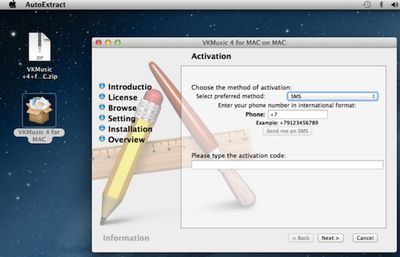
When a user starts such an installer, they see the interface that imitates the installation wizard of a corresponding application. In order to continue the "installation" fraudsters ask that the victim enter their cellphone number into an appropriate field and then specify the code found in a reply SMS. By performing these actions the user agrees to terms of a chargeable subscription and a fee will be debited from their mobile phone account on a regular basis.
Similar trojans have affected Windows and even Android platforms for some time, but the tactic is now being used to target Mac users.
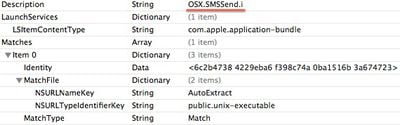
Apple has moved quickly to address the threat, adding definitions for the malware to its "Xprotect.plist" blacklist, which is part of the basic anti-malware tools Apple launched with OS X Snow Leopard in 2009. In its original incarnation, users were required to update definitions manually, but as malware threats against OS X grew, Apple last year instituted automatic daily checks to keep users' systems updated. The anti-malware tools automatically detect when a user has downloaded a file matching the signature of known malware, alerting the user of the threat and advising them to discard the downloaded file.
Sunday February 1, 2026 10:08 am PST by Joe Rossignol
Last year, Apple launched CarPlay Ultra, the long-awaited next-generation version of its CarPlay software system for vehicles. Nearly nine months later, CarPlay Ultra is still limited to Aston Martin's latest luxury vehicles, but that should change fairly soon.
In May 2025, Apple said many other vehicle brands planned to offer CarPlay Ultra, including Hyundai, Kia, and Genesis.
In his Powe...
Sunday February 1, 2026 12:31 pm PST by Joe Rossignol
The calendar has turned to February, and a new report indicates that Apple's next product launch is "imminent," in the form of new MacBook Pro models.
"All signs point to an imminent launch of next-generation MacBook Pros that retain the current form factor but deliver faster chips," Bloomberg's Mark Gurman said on Sunday. "I'm told the new models — code-named J714 and J716 — are slated...
Tuesday February 3, 2026 7:47 am PST by Joe Rossignol
We are still waiting for the iOS 26.3 Release Candidate to come out, so the first iOS 26.4 beta is likely still at least a week or two away. Following beta testing, iOS 26.4 will likely be released to the general public in March or April.
Below, we have recapped known or rumored iOS 26.3 and iOS 26.4 features so far.
iOS 26.3
iPhone to Android Transfer Tool
iOS 26.3 makes it easier...
Sunday February 1, 2026 5:42 am PST by Joe Rossignol
Apple is planning to launch new MacBook Pro models with M5 Pro and M5 Max chips alongside macOS 26.3, according to Bloomberg's Mark Gurman.
"Apple's faster MacBook Pros are planned for the macOS 26.3 release cycle," wrote Gurman, in his Power On newsletter today.
"I'm told the new models — code-named J714 and J716 — are slated for the macOS 26.3 software cycle, which runs from...
Tuesday February 3, 2026 8:55 am PST by Joe Rossignol
In 2022, Apple introduced a new Apple Home architecture that is "more reliable and efficient," and the deadline to upgrade and avoid issues is fast approaching.
In an email this week, Apple gave customers a final reminder to upgrade their Home app by February 10, 2026. Apple says users who do not upgrade may experience issues with accessories and automations, or lose access to their smart...
And people always defended OSX for being virus/spyware free... LOL. Welcome to reality. Hopefully Apple can keep up with the variations that are no doubt going to be roaming out in the wild based on this.
LOL welcome to reality - this isn't a virus at all. It's a fake installer that asks for your cell phone number. It's not an infection - it's a poor phishing attempt.
Again, like I always say, the only virus you can get on OSX is one you install yourself. This just prevents the user from hurting him/herself. This isn't a "virus" like everyone is saying - it's a program that phishes your personal info. It can't escalate itself privelidge-wise like with a Windows virus and become "above" your system to prevent removal or uninstallation. Nothing can do that in OSX due to it's unix base.
Also, great job Apple for staying so on top of this :D
And people always defended OSX for being virus/spyware free... LOL. Welcome to reality. Hopefully Apple can keep up with the variations that are no doubt going to be roaming out in the wild based on this.
Since this application is neither a virus nor spyware I'd say people are quite right.
And people always defended OSX for being virus/spyware free... LOL. Welcome to reality. Hopefully Apple can keep up with the variations that are no doubt going to be roaming out in the wild based on this.
From wikipedia:
A computer virus is a computer program that can replicate itself[1] and spread from one computer to another.
Spyware is a type of malware (malicious software) installed on computers that collects information about users without their knowledge.
Anything that requires me launching an installer and than requiring me to type in my password and cell phone number is not scary at all - its a lame phishing attempt that I laugh about.
I would be worried if it installs automatically in the background and than accesses my address book to get my cell phone number - but even than I would not respond to that SMS to get charged money.
Honestly, I don't get the people that did type in their cell phone number - it is almost impossible to protect those people from their own stupidity.
Anyway, glad to see that Apple is trying to protect people from their own stupidity.
But really, it seems to me this is an issue phone service providers should handle. Why is the money that they handle handled so insecurely? Shouldn't our provider send us some sort of message for us to confirm that some company is going to start leaching money via our phone bill and shouldn't they block companies that they find frequently commit this kind of fraud?