Web Versions of Notes and Reminders Go Live on iCloud.com - MacRumorsOpen MenuShow RoundupsShow Forums menuVisit ForumsOpen Sidebar
Skip to Content

Web Versions of Notes and Reminders Go Live on iCloud.com

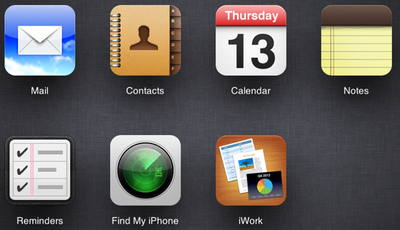
Apple has added the web versions of Reminders and Notes to the public iCloud.com website for access from desktop Macs and PCs. These web apps have been live for developers in beta for several months.
Notification Center
Notes is a fairly faithful reproduction of the skeuomorphic notepad on the iPhone. Users can create, edit, and delete notes, with updates reflecting on iOS devices in near-real time. Reminders works the same way.

The iCloud website has been updated in time for the iPhone preorder launch tomorrow, as well as the release of iOS 6 for all iOS users next Wednesday.

Popular Stories

iOS 27 on iPhone 17 1

iOS 27 Will Add These New Features to Your iPhone

Saturday May 2, 2026 8:43 am PDT by
Apple is expected to unveil iOS 27 during its WWDC 2026 keynote on June 8, and there are already many rumored features and changes for iPhones. The first developer beta of iOS 27 will likely be available immediately following the keynote, and a public beta typically follows in July. Following beta testing, the software update should be released to all users with a compatible iPhone in...
Apple Event Logo

Apple Just Released a New Accessory

Monday May 4, 2026 8:13 am PDT by
Apple today released a new Pride Edition Sport Loop for the Apple Watch. The band features a rainbow design with 11 colors of woven nylon yarns. The new Pride Edition Sport Loop is available to order now on Apple.com and in the Apple Store app in 40mm, 42mm, and 46mm sizes, and it will be available at Apple Store locations starting later this week. In the U.S., the band costs $49. There...
Apple Announces 2026 Pride Band Watch Face and iPhone Wallpaper Article 2

iOS 26.5 Coming Soon With These New Features

Monday May 4, 2026 8:40 am PDT by
iOS 26.5 is expected to be released next week, following more than a month of beta testing. The update is relatively minor, but there are a couple of new features and changes across the operating system that we have recapped below. iOS 26.5 lays the groundwork for end-to-end encryption for RCS in the Messages app and ads in the Apple Maps app, and it will include a new Pride wallpaper and a...


Top Rated Comments

178 months ago
I still cannot believe how fast and fluid these web apps are. I usually don't expect this from websites unfortunately :/
Score: 11 Votes (Like | Disagree)
chaosconan Avatar
178 months ago
I just don't understand Apple. All the icons are consistent between iPod touch, iPhone, iPad, and iCloud but they decided to revamp the icons on iPod nano. It just does not make logical sense. It just really bugs me not understanding why they did it!!! :mad:
Score: 10 Votes (Like | Disagree)
kjs862 Avatar
178 months ago
Okay now add maps and imessage!
Score: 8 Votes (Like | Disagree)
178 months ago
Email addresses ending with @icloud.com are also active.
If you have, let's say, example@me.com, how do you get example@icloud.com?
Score: 6 Votes (Like | Disagree)
RobertMartens Avatar
178 months ago

Notes is a fairly faithful reproduction of the skeuomorphic notepad on the iPhone.
I managed to make it fifty years without ever having to need the word skeuomorphic. Now I find it in news articles almost everyday. I better start using it or I'll fall out of fashion.

OK here goes...

Two guys and a skeuomorphic walk into a bar last week and the bartender says "Get the @#@@ out of here"

Not bad for a first try.

You should really read this:

4 Skeuomorphs in Evolutionary Computing

Evolutionary computing is now used as an umbrella term to cover more specific variations such as evolutionary programming, genetic algorithms, and genetic programming, as well as others. I have gone through the foregoing critique of skeuomorphs, because it is clear that they play a large role in the way we constitute our practice. We have learning systems based upon neural nets, which to some extent model neurons. We have evolutionary systems based upon genetic algorithms and genetic programming, which to some extent model genetics. We have evolving cultural systems based upon a hybrid of genetics and shared memory. Failing a comprehensive theory explaining why these systems should operate in silicon in the same way as they do in carbon, we have a mixed metaphor, a scrambled skeuomorphic system par excellence.

If we had wanted to develop reliable models of real neurons, we might have gone in the direction of Gerald Edelman's neuronal group selection. If we had wanted to develop reliable models of genotype-phenotype interaction, we might have gone in the direction of protein folding. However, for our purposes, we want general working models of wider application, or failing that at least clear sets of models more suited to one purpose than another. At this juncture we are more interested in optimization than in simulation.

In the branch of evolutionary computation specifically interested in general problem solving and optimization, it is not clear why we have embraced the precise evolutionary models we currently use. We seem to be of two minds, simultaneously exploring biological processes for ideas and then extending them in non-biological realms. Genetic algorithms have been a successful hybrid of biology and machine. Moreover, they conjure up the cachet of being founded on real biology. David Fogel has repeatedly made the case that the phenotypic algorithms of evolutionary programming may be more effective than genetic algorithms for certain problem classes, even though the former lack the hallmark of biological fidelity [4]. After all, why should biological fidelity be an issue in a non-biological, silicon world? This push and pull between real biology and fanciful experiment is a healthy dynamic, since by challenging the universality of processes taking place in carbon-based life, we explore not only that which is unique about natural life, but concurrently the space of possibilities in artificial life occupied by evolutionary computation. Our agent populations already deviate quite markedly from normative (human) behaviors: they are sexual hermaphrodites. They transcend great distances on fitness landscapes to mate with others of similar accomplishment and to spawn descendants in places neither parent has visited. It is refreshing to see further bendings of the rules, like the comedic seriousness with which Gusz Eiben [5] has experimented with agent "orgiastic" sexual recombination. By this he meant sexual recombination from more than two parents. In humans this will likely be among the first kinds of gene therapy practiced. Diseases inherited from mitochondrial DNA may be obviated by replacing the cytoplasm of the "contaminated" egg with that from another mother or by transplanting the nucleus to a second mother's egg. The result would be three genetic parents: two mothers and one father. The natural world should be mined for ideas and inspirations, but these need to be tested in the artificial worlds in which we work because they offer different constraints and possibilities.
Score: 5 Votes (Like | Disagree)
178 months ago
Okay now add maps and imessage!

ESPECIALLY iMessage for all the poor PC users</3

P.S. just as I was typing this, my comma key popped off. not kidding.
Score: 5 Votes (Like | Disagree)
Related Apple News: Iphone | Education | Mac | Entertainment | Motoring