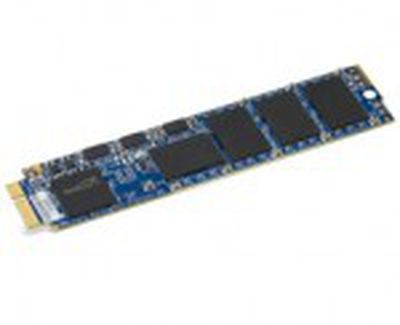
prod merc aura pro express6gOther World Computing, which offers many customization and upgrade options for Macs, today released an SSD upgrade for 2011 MacBook Airs that takes advantage of the MBA's SATA Revision 3.0 abilities and offers 6 Gigabits of potential throughput.

The factory SSD from Apple only supports SATA Revision 2.0, which maxes out at 3 Gbps, half the speed of Revision 3.0.

The new OWC Mercury Aura Pro Express 6G SSDs combine award-winning SandForce technologies and Tier 1/Grade A Toggle Synchronous NAND to deliver data rates that are more than 3x faster and capacities that are up to 4x greater than factory available SSD options. Currently available in two sizes–120GB and 240GB–the new 6Gb/s SATA 3.0 Revision models continue OWC’s position as the only alternative to factory SSD options for the 2010-2011 MacBook Air.

The upgrades don't come cheap, however. The 120GB version is $349.99 and the 240GB version is $599.99.

The MacBook Air comes standard with 64GB, 128GB or 256GB of storage.

Top Rated Comments

Heavertron Avatar
186 months ago
How ironic that your own comment is "ill informed." From the OWC Blog itself...

"Wear Leveling technologies are able to eliminate virtually any reduction in data transfer speeds over heavy, long-term usage without dependency on less-than-effective OS TRIM management."

Read it yourself here:
http://blog.macsales.com/11900-owc-announces-mercury-aura-pro-express-6g-industrys-first-6gbs-solid-state-drives-for-2011-apple-macbook-air

Huh? I think you misunderstand my post. The blog says:

"Utilizing SandForce DuraClass technology".

Therefore my statement was correct. These drives use the SandForce controller, so have their own 'housekeeping' mechanisms, so TRIM is not required to maintain performance.
Score: 3 Votes (Like | Disagree)
ShortArc Avatar
186 months ago
What worries me about these SSD 6G drives is the power consumption spec.
Active 3W & Idle 1.2W. This I believe compares to less than .5W for idle for the stock SSD. In other words, these SSDs will drain your battery pretty quick!
Score: 3 Votes (Like | Disagree)
ShortArc Avatar
186 months ago
I hate to break up the SandForce love train, but these claims are simply not true. While wear-leveing is important in the long run, in the short run it is not what causes SSD's to slow down, and claiming that the SandForce controller's garbage collection is on par with TRIM is simply wrong.

An SSD cannot overwrite a block with data, and therefore needs to empty it before new data can be written to the block. Because of how SSD's can write to the smaller pages but can only erase blocks, the "overwrite" process involves copying all relevant pages from an old block to a new block and then filling out the rest of the blank pages in a block. This is a slow process, and is best done during idle, instead of on-demand during a write, so the industry needed to come up with a solution to this and the answer was TRIM.

This whole problem arises because of the way traditional magnetic media worked: it had no overwrite penalty, so when something was deleted, the only thing that happened was that it's entry was removed from the directory (a pointer to its actual location) while the actual bits of data were left untouched sitting in whichever block they were residing in. Again, with no overwrite penalty for magnetic media, this worked great because you could just overwrite the block when the time came and nobody was the wiser. Since this isn't true for SSD's, TRIM came along to manually clear out blank pages/blocks and consolidate what was left for faster performance. The HUGE benefit of TRIM is that OS knows which allocated pages/blocks are still being used and which can be discarded, since it is in control of file management and knows what's been deleted and what hasn't been.

SandForce and it's ilk arose because both Apple and Microsoft were a little slow implementing TRIM support in their OS's and people wanted to use SSD's in their computers as soon as they were available without waiting for Lion or Windows 7, so HD-based "garbage collection" arose as a stopgap. The problem with it is that the HD can't know which allocated blocks are still in use and which aren't, so it only does it's best to consolidate all active pages and hope for the best. You'll notice the decreased long-term optimization of SandForce when you are running a mostly full drive, because it won't have as much space to get lucky with. This is why SandForce drives come with "scratch" areas pre-cordoned off (i.e. reported capacity of 240GB despite having 256GB), because it uses that extra area for write operations and then performs a deletes what is has now learned is an inactive page/block.

SandForce puts a lot of marketing into their controller, and it is pretty fast, partly because it does a lot of compression of your data when it can (which worries me a little bit anyway when using it with a non-integrity checking file system like HFS+). But nearly full drives that are TRIM-compatible are going to stay quicker throughout the life of the drive, while others will not simply because they can't know as much about what they are trying to organize as an OS-based routine like TRIM will.

And you don't necessarily want to pay for space on your drive which you can't use: this means you're losing about 7% capacity on top of the 7% you need to leave free for the OS's maintenance routines (like on-the-fly defragging, which is also part of at least Apple's TRIM implementation, so it's actually more efficient to do both at the same time anyway). With TRIM enabled, you can reuse the scratch space for both tasks, since the OS can see both, but not with SandForce.


This is mostly a marketing claim, because Sandforce is quicker at doing the easy garbage collection that it is capable of, while it's a longer route with more components involved for the OS to get the easy consolidation commands out of the way. Thus, more efficiency means slightly faster operations with only one component involved. Conversely, the SandForce controller is incapable of doing all the things that TRIM does, but I guess you could argue that doing less is also more efficient in the short-run.


Also, there are those failure rates. If you look up the Vertex 2 reviews on any site, you'll see nothing but complaints about their failure rates, enough so that OCZ listed increased reliability as a feature of the Vertex 3 (which uses a newer generation of the SandForce controller). Is your data something you want to trust to marketing promises, especially when combined with all the aforementioned data compression going on?

aristokrat:

Thanks for your great post.
Over the last year or so I pretty much read everything you mention (in various articles, online tests, blogs, etc). Nice to see it summarized.
My only non-technical comment would be, that regardless of the "shortcomings" the SandForce controller may have, if you want a 6G SSD in you 2011 MBA now, there is no other choice!?
Also unless someone has a convincing technical arguments, I would agree that TRIM is the way to go....
Score: 1 Votes (Like | Disagree)
aristokrat Avatar
186 months ago
These drives use the SandForce controller, so have their own 'housekeeping' mechanisms, so TRIM is not required to maintain performance.
I hate to break up the SandForce love train, but these claims are simply not true. While wear-leveing is important in the long run, in the short run it is not what causes SSD's to slow down, and claiming that the SandForce controller's garbage collection is on par with TRIM is simply wrong.

An SSD cannot overwrite a block with data, and therefore needs to empty it before new data can be written to the block. Because of how SSD's can write to the smaller pages but can only erase blocks, the "overwrite" process involves copying all relevant pages from an old block to a new block and then filling out the rest of the blank pages in a block. This is a slow process, and is best done during idle, instead of on-demand during a write, so the industry needed to come up with a solution to this and the answer was TRIM.

This whole problem arises because of the way traditional magnetic media worked: it had no overwrite penalty, so when something was deleted, the only thing that happened was that it's entry was removed from the directory (a pointer to its actual location) while the actual bits of data were left untouched sitting in whichever block they were residing in. Again, with no overwrite penalty for magnetic media, this worked great because you could just overwrite the block when the time came and nobody was the wiser. Since this isn't true for SSD's, TRIM came along to manually clear out blank pages/blocks and consolidate what was left for faster performance. The HUGE benefit of TRIM is that OS knows which allocated pages/blocks are still being used and which can be discarded, since it is in control of file management and knows what's been deleted and what hasn't been.

SandForce and it's ilk arose because both Apple and Microsoft were a little slow implementing TRIM support in their OS's and people wanted to use SSD's in their computers as soon as they were available without waiting for Lion or Windows 7, so HD-based "garbage collection" arose as a stopgap. The problem with it is that the HD can't know which allocated blocks are still in use and which aren't, so it only does it's best to consolidate all active pages and hope for the best. You'll notice the decreased long-term optimization of SandForce when you are running a mostly full drive, because it won't have as much space to get lucky with. This is why SandForce drives come with "scratch" areas pre-cordoned off (i.e. reported capacity of 240GB despite having 256GB), because it uses that extra area for write operations and then performs a deletes what is has now learned is an inactive page/block.

SandForce puts a lot of marketing into their controller, and it is pretty fast, partly because it does a lot of compression of your data when it can (which worries me a little bit anyway when using it with a non-integrity checking file system like HFS+). But nearly full drives that are TRIM-compatible are going to stay quicker throughout the life of the drive, while others will not simply because they can't know as much about what they are trying to organize as an OS-based routine like TRIM will.

And you don't necessarily want to pay for space on your drive which you can't use: this means you're losing about 7% capacity on top of the 7% you need to leave free for the OS's maintenance routines (like on-the-fly defragging, which is also part of at least Apple's TRIM implementation, so it's actually more efficient to do both at the same time anyway). With TRIM enabled, you can reuse the scratch space for both tasks, since the OS can see both, but not with SandForce.

The question at this stage is, just how much more efficient is the clean-up algorithms of the SandForce chip versus OS-based TRIM?
This is mostly a marketing claim, because Sandforce is quicker at doing the easy garbage collection that it is capable of, while it's a longer route with more components involved for the OS to get the easy consolidation commands out of the way. Thus, more efficiency means slightly faster operations with only one component involved. Conversely, the SandForce controller is incapable of doing all the things that TRIM does, but I guess you could argue that doing less is also more efficient in the short-run.


Also, there are those failure rates. If you look up the Vertex 2 reviews on any site, you'll see nothing but complaints about their failure rates, enough so that OCZ listed increased reliability as a feature of the Vertex 3 (which uses a newer generation of the SandForce controller). Is your data something you want to trust to marketing promises, especially when combined with all the aforementioned data compression going on?
Score: 1 Votes (Like | Disagree)
cluthz Avatar
186 months ago
It's good that there is an aftermarket alternative to the Apple SSD,
but am I the only one that feel the standard SSD is the only thing in the MBA that isn't a bottle neck?
Score: 1 Votes (Like | Disagree)
FloatingBones Avatar
186 months ago
What worries me about these SSD 6G drives is the power consumption spec. Active 3W & Idle 1.2W. This I believe compares to less than .5W for idle for the stock SSD. In other words, these SSDs will drain your battery pretty quick!

I asked OWC to comment on the impact their high-performance SSD would have on battery life. Look on their blog for a response -- hopefully tomorrow.
Score: 1 Votes (Like | Disagree)

Popular Stories

iOS 26

iOS 26.4 and iOS 27 Features Revealed in New Leak

Friday December 12, 2025 10:56 am PST by
Macworld's Filipe Espósito today revealed a handful of features that Apple is allegedly planning for iOS 26.4, iOS 27, and even iOS 28. The report said the features are referenced within the code for a leaked internal build of iOS 26 that is not meant to be seen by the public. However, it appears that Espósito and/or his sources managed to gain access to it, providing us with a sneak peek...
Apple Logo Top Half

Early iOS 26 Software Leak Uncovers Dozens of Upcoming Apple Features

Monday December 15, 2025 3:05 pm PST by
Software from an iPhone prototype running an early build of iOS 26 leaked last week, giving us a glimpse at future Apple devices and iOS features. We recapped device codenames in our prior article, and now we have a list of some of the most notable feature flags that were found in the software code. In some cases, it's obvious what the feature flags are referring to, while some are more...
apple beta 26 lineup

Apple Leak Confirms Work on Foldable iPhone, AirTag 2, and Dozens More Devices

Monday December 15, 2025 2:05 pm PST by
Last week, details about unreleased Apple devices and future iOS features were shared by Macworld. This week, we learned where the information came from, plus we have more findings from the leak. As it turns out, an Apple prototype device running an early build of iOS 26 was sold, and the person who bought it shared the software. The OS has a version number of 23A5234w, and the first...
Apple Foldable Thumb

Leak Reveals Foldable iPhone Details

Monday December 15, 2025 9:09 am PST by
The first foldable iPhone will feature a series of design and hardware firsts for Apple, according to details shared by the Weibo leaker known as Digital Chat Station. According to a new post, via machine translation, Apple is developing what the leaker describes as a "wide foldable" device, a term used to refer to a horizontally oriented, book-style foldable with a large internal display....
iOS 26

iOS 26.3 Beta 1 Features: What's New So Far

Monday December 15, 2025 4:23 pm PST by
Apple is testing iOS 26.3, the next version of iOS 26 that will launch around January. Since iOS 26.3's testing is happening over the holidays, it is a smaller update with fewer features than we've seen in prior betas. We've rounded up what's new so far, and we'll add to our list with subsequent betas if we come across any other features. Transfer to Android Apple is making it simpler...
iOS 26

Apple Releases iOS 26.2 With Alarms for Reminders, Lock Screen Changes, Enhanced Safety Alerts and More

Friday December 12, 2025 10:10 am PST by
Apple today released iOS 26.2, the second major update to the iOS 26 operating system that came out in September, iOS 26.2 comes a little over a month after iOS 26.1 launched. ‌iOS 26‌.2 is compatible with the ‌iPhone‌ 11 series and later, as well as the second-generation ‌iPhone‌ SE. The new software can be downloaded on eligible iPhones over-the-air by going to Settings >...
iOS 26

iOS 26.2 Coming Soon With These 8 New Features on Your iPhone

Thursday December 11, 2025 8:49 am PST by
Apple seeded the second iOS 26.2 Release Candidate to developers earlier this week, meaning the update will be released to the general public very soon. Apple confirmed iOS 26.2 would be released in December, but it did not provide a specific date. We expect the update to be released by early next week. iOS 26.2 includes a handful of new features and changes on the iPhone, such as a new...
airpods max 2024 colors

AirPods Max 2 Likely to Offer These 10 New Features

Monday December 15, 2025 7:41 am PST by
Apple released the AirPods Max on December 15, 2020, meaning the over-ear headphones launched five years ago today. While the AirPods Max were updated with a USB-C port and new color options last year, followed by support for lossless audio and ultra-low latency audio this year, the headphones lack some of the features that have been introduced for newer generations of the regular AirPods and the ...