Zoom Updates iOS App to Stop Sending Data to Facebook
Zoom, a video conferencing app that many people are using at the current time to keep in touch with coworkers while working from home, was sending data to Facebook without disclosing the data sharing to customers.
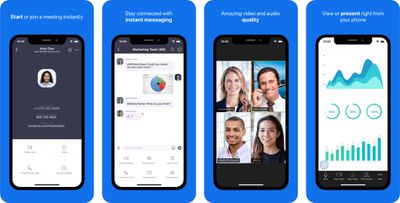
As of today, Zoom has updated its iOS app to remove the SDK that was providing data to Facebook through the Login with Facebook feature, according to Motherboard, the site that first discovered Zoom's data sharing practices.
Zoom was providing Facebook with data that included when a user opened the app, plus their timezone, city, and device details. Zoom's privacy policy did not make it clear that the data was shared with Facebook.
In a statement, a spokesperson for Zoom said that Zoom was unaware that the Facebook SDK was collecting unnecessary device data.
"Zoom takes its users' privacy extremely seriously. We originally implemented the 'Login with Facebook' feature using the Facebook SDK in order to provide our users with another convenient way to access our platform. However, we were recently made aware that the Facebook SDK was collecting unnecessary device data."
"The data collected by the Facebook SDK did not include any personal user information, but rather included data about users' devices such as the mobile OS type and version, the device time zone, device OS, device model and carrier, screen size, processor cores, and disk space."
"We will be removing the Facebook SDK and reconfiguring the feature so that users will still be able to login with Facebook via their browser. Users will need to update to the latest version of our application once it becomes available in order for these changes to take hold, and we encourage them to do so. We sincerely apologize for this oversight, and remain firmly committed to the protection of our users' data."
Motherboard has since verified that the iOS app is no longer sending data to Facebook when it is opened.
Popular Stories
Last year, Apple launched CarPlay Ultra, the long-awaited next-generation version of its CarPlay software system for vehicles. Nearly nine months later, CarPlay Ultra is still limited to Aston Martin's latest luxury vehicles, but that should change fairly soon.
In May 2025, Apple said many other vehicle brands planned to offer CarPlay Ultra, including Hyundai, Kia, and Genesis.
In his Powe...
The calendar has turned to February, and a new report indicates that Apple's next product launch is "imminent," in the form of new MacBook Pro models.
"All signs point to an imminent launch of next-generation MacBook Pros that retain the current form factor but deliver faster chips," Bloomberg's Mark Gurman said on Sunday. "I'm told the new models — code-named J714 and J716 — are slated...
Apple is planning to launch new MacBook Pro models with M5 Pro and M5 Max chips alongside macOS 26.3, according to Bloomberg's Mark Gurman.
"Apple's faster MacBook Pros are planned for the macOS 26.3 release cycle," wrote Gurman, in his Power On newsletter today.
"I'm told the new models — code-named J714 and J716 — are slated for the macOS 26.3 software cycle, which runs from...
We are still waiting for the iOS 26.3 Release Candidate to come out, so the first iOS 26.4 beta is likely still at least a week or two away. Following beta testing, iOS 26.4 will likely be released to the general public in March or April.
Below, we have recapped known or rumored iOS 26.3 and iOS 26.4 features so far.
iOS 26.3
iPhone to Android Transfer Tool
iOS 26.3 makes it easier...
In 2022, Apple introduced a new Apple Home architecture that is "more reliable and efficient," and the deadline to upgrade and avoid issues is fast approaching.
In an email this week, Apple gave customers a final reminder to upgrade their Home app by February 10, 2026. Apple says users who do not upgrade may experience issues with accessories and automations, or lose access to their smart...