WSJ Examines Apple's Reliance on China Amid Coronavirus Outbreak - MacRumorsOpen MenuShow RoundupsShow Forums menuVisit ForumsOpen Sidebar
Skip to Content

WSJ Examines Apple's Reliance on China Amid Coronavirus Outbreak

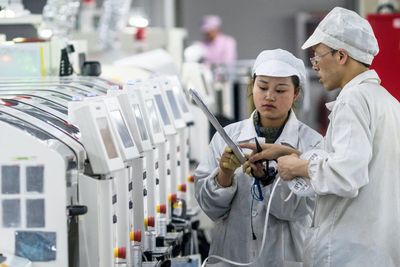
Production on Apple's devices has been stymied in recent weeks due to delays caused by the coronavirus outbreak in China. Many of Apple's China-based suppliers had to shut down for two weeks or more in February, and there are still staffing issues as factories work to ramp up production around travel bans, quarantines, and other problems.
chinafoxconn
Amid the China coronavirus outbreak, which has caused Apple to announce that it won't make its March quarter revenue goals, The Wall Street Journal has taken a look at Apple's reliance on China and why Apple is likely to continue to be dependent on China for the foreseeable future.

Apple's operations team has been raising concerns about the company's reliance on China, and as early as 2015, there were suggestions that Apple relocate assembly of one or more products to Vietnam, allowing Apple to start training workers and creating component providers outside of China.

Senior managers shot down the idea at the time, and transitioning away from China has been "too challenging to undertake." Apple has, however, begun to move some production outside of China. Apple has moved AirPods Pro assembly to Vietnam due to tariffs, and now produces some iPhones in India, but a complete break "is impossible."

As The ‌Wall Street Journal‌ points out, Apple CEO Tim Cook has been downplaying the need for changes in the supply chain. On Friday, Cook said in an interview that if there are supply chain changes because of the coronavirus, it will be "adjusting some knobs, not some kind of wholesale fundamental change."

Apple is not able to break away from China because China has hundreds of thousands of employees, both skilled and unskilled, that have expertise in manufacturing Apple's devices.

Finding a comparable amount of unskilled and skilled labor is impossible, said Dan Panzica, a former Foxconn executive. The population in China has allowed suppliers to build factories with a capacity for more than 250,000 people. The number of migrant workers in China, who do much of Apple's production, exceed Vietnam's total population of 100 million. India is the closest comparison, but its roads, ports and infrastructure lag far behind those in China.

"You're not going to be able to have mega-factories anywhere else," Mr. Panzica said. "You're going to have to break them up."

Should Apple decide to move production out of China, that could impact device sales in the country. China is responsible for close to a fifth of Apple's total revenue.

Apple's relationship with China began many years ago, when Foxconn began making iPods in 2001 and the iPhone in 2007. As Apple device sales have grown, the factories that assemble Apple devices have also grown in tandem, resulting in what The ‌Wall Street Journal‌ describes as a "triangle of interdependency."

Apple grew to depend on Foxconn to make devices and Chinese consumers to buy them. Foxconn built its business by leaning on China's vast workforce and control over land to construct factories. And China became beholden to Foxconn as the nation's largest private-sector employer and Apple as a trainer of new technology suppliers.

Apple did plan to assemble some iPhone 11 models in India, but the effort was halted before a single manufacturing line was set up, as Apple believed India was not ready to supply the skilled labor or robust infrastructure that Apple expects. iPhone 11 models were produced in China instead.

That's not likely to change in 2020 because there's no supply chain in place and workers in India aren't ready to produce the high-end iPhones that are expected to be released in 2020. As for U.S. production, Apple is manufacturing some Mac Pro models in the United States (those sold in the United States), but ‌Mac Pro‌ models sold in the rest of the world are still manufactured in China because the U.S. also doesn't have the skilled labor force that China has available.

The ‌Wall Street Journal‌'s full report on Apple's dependence on China can be read on The Wall Street Journal website.

Note: Due to the political nature of the discussion regarding this topic, the discussion thread is located in our Political News forum. All forum members and site visitors are welcome to read and follow the thread, but posting is limited to forum members with at least 100 posts.

Popular Stories

imac video apple feature

Apple Released Yet Another New Product Today

Friday March 20, 2026 2:39 pm PDT by
Apple has unveiled a whopping nine new products so far this March, including an iPhone 17e, iPad Air models with the M4 chip, MacBook Air models with the M5 chip, MacBook Pro models with M5 Pro and M5 Max chips, the all-new MacBook Neo, an updated Studio Display, a higher-end Studio Display XDR, AirPods Max 2, and now the Nike Powerbeats Pro 2. iPhone 17e features the same overall design as...
ios 26 4 pastel

iOS 26.4: Top 10 New Features Coming to Your iPhone

Friday March 20, 2026 2:44 pm PDT by
iOS 26.4 isn't the major update with new Siri features that we hoped for, but there are some useful quality of life improvements, and a little bit of fun with an AI playlist generator and new emoji characters. Playlist Playground - Apple Music has a Playlist Playground option that lets you generate playlists from text-based descriptions. You can include moods, feelings, activities, or...
HomePod mini and Apple TV Sage

New Apple TV and HomePod Mini Remain 'Ready' to Launch

Sunday March 22, 2026 6:33 am PDT by
Apple has unveiled nine new products this month, but the wait continues for the next-generation Apple TV 4K and HomePod mini models. In his Power On newsletter today, Bloomberg's Mark Gurman said new versions of the Apple TV and HomePod mini have been "ready" since last year, but he reiterated that Apple has held off on releasing them until the more personalized version of Siri and other...

Top Rated Comments

gugy Avatar
79 months ago
Not only Apple but almost all large corporations rely on China. The Chinese got the USA by the balls.
Score: 16 Votes (Like | Disagree)
jjs_nv Avatar
79 months ago
I got a crazy idea. Bring home the troops. Call it a national security emergency. Invest the roughly $1 Trillion per year saved building infrastructure, investing in supply chain and other savings to rebuild our intellectual capital and stop policing the world. Maybe, I don't know, start reinvesting in semiconductor fabs, like the Chionese, South Korean and Taiwan governments all do.

We have a choice, police the world and fail, or invest in our people and succeed.
Score: 15 Votes (Like | Disagree)
hagjohn Avatar
79 months ago

Senior managers shot down the idea at the time, and transitioning away from China has been "too challenging to undertake." Apple has, however, begun to move some production outside of China. Apple has moved AirPods Pro assembly to Vietnam due to tariffs, and now produces some iPhones in India, but a complete break "is impossible."
💩 on it being impossible... Anything can be moved. You just need to invest in it.
Score: 14 Votes (Like | Disagree)
calzon65 Avatar
79 months ago
Not saying Apple should make a complete break from China, but they better use this as a wake-up call to reevaluate their production supply chain and manufacturing plan.
Score: 10 Votes (Like | Disagree)
simonmet Avatar
79 months ago
No comment on Apple being named as a company using forced labour from the persecuted Uyghur minority, who’ve been sent to “reeducation” and indoctrination camps that look more like detention centres or prisons (with guard towers and barbed-wire fencing); brainwashed; and then deported from their homelands in Western China to work in Western factories?

"The Uyghurs had to come because they didn't have an option. The government sent them here," a local businessperson told the [Washington] Post.

"Chinese factories and Chinese media think it's a positive thing that these Uyghurs are being moved away and are working under semi-military conditions and management". China is one of only a handful of countries that have not ratified the International Labour Organisation's Forced Labour Convention (Australian Broadcasting Corp).

Nike has been particularly implicated.

https://www.abc.net.au/news/2020-03-02/aspi-uyghur-china-forced-labour-report/12017650
https://www.bbc.com/news/world-asia-china-51697800
https://www.washingtonpost.com/world/asia_pacific/china-compels-uighurs-to-work-in-shoe-factory-that-supplies-nike/2020/02/28/ebddf5f4-57b2-11ea-8efd-0f904bdd8057_story.html

Tim Cook naturally came out to defend their hiring practices, working conditions and suppliers, but if this is true (as seems likely) it’s a very bad stain on Apple’a Chinese manufacturing addiction.

The report claims it's the biggest persecution based on religion since the Holocaust, and that the aim is to ethnically "cleanse" the far-Western province.
Score: 9 Votes (Like | Disagree)
JPack Avatar
79 months ago
As the manufacturing engine of the world, China also makes the upstream materials used in the manufacturing of products.

If you're manufacturing an LCD, you need the chemical substrates, glass, optical films, and backlight modules, all of which come from China. The idea that you can separate it and suddenly manufacture in India or the U.S. is just silly.

Tim Cook has talked about the skills available in China. This is exactly what he's referring to. Workers in other countries don't suddenly gain the skills to make and research the above mentioned items. It requires decades of government investment and focus on education.
Score: 9 Votes (Like | Disagree)
Related Apple News: Buyers Guide | South Africa | Motoring | Health | Iphone