Geekbench 5 Released With Improved Benchmark Tests, Dark Mode Support, and More

Primate Labs today announced the release of Geekbench 5, the latest major version of its popular benchmark software.
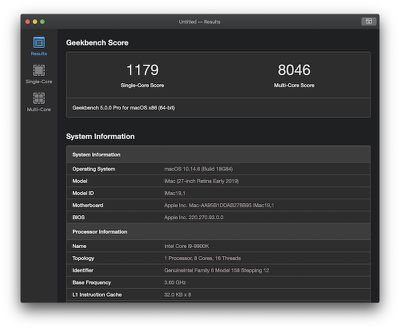
Geekbench 5 Dark Mode
For CPUs, Geekbench 5 features new benchmark tests and it also increases the memory footprint of existing workloads to more accurately account for the effect memory performance has on CPU performance:

The Geekbench 5 CPU Benchmark includes new benchmark tests that model the challenges your system faces when running the latest applications. These tests use cutting-edge technologies, including machine learning, augmented reality, and computational photography.

Geekbench 5 also increases the memory footprint of existing workloads to more accurately account for the effect memory performance has on CPU performance.

Finally, the Geekbench 5 CPU Benchmark includes new modes of multi-threaded benchmarks, allowing threads to work co-operatively on one problem rather than separately on different problems. With the addition of different threading models, Geekbench 5 better captures the performance of different multi-threaded applications on personal computing devices.

As for GPUs, the Compute benchmark now supports Vulkan in addition to Metal, CUDA, and OpenCL.

Geekbench 5 also has a refreshed user interface with full support for Dark Mode on macOS Mojave and later. Support for ‌Dark Mode‌ on iOS 13 will be available later this year, according to Primate Labs.

Geekbench 5 is available now for macOS, iOS, Windows, and Linux, with an Android version coming later this week. The software is 64-bit only, dropping support for 32-bit processors and operating systems.

Through September 10, Geekbench 5 and Geekbench 5 Pro for Mac are on sale for $7.49 and $49.99 respectively, down from $14.99 and $99.99. Geekbench 5 for iOS is also free until that time, while Geekbench 5 Pro for iOS has introductory pricing of $4.99, which will rise to $9.99 after the sale ends.
Popular Stories

Aston Martin CarPlay Ultra Screen

Apple's CarPlay Ultra to Expand to These Vehicle Brands Later This Year

Sunday February 1, 2026 10:08 am PST by
Last year, Apple launched CarPlay Ultra, the long-awaited next-generation version of its CarPlay software system for vehicles. Nearly nine months later, CarPlay Ultra is still limited to Aston Martin's latest luxury vehicles, but that should change fairly soon. In May 2025, Apple said many other vehicle brands planned to offer CarPlay Ultra, including Hyundai, Kia, and Genesis. In his Powe...
iOS 26

iOS 26.3 and iOS 26.4 Will Add These New Features to Your iPhone

Tuesday February 3, 2026 7:47 am PST by
We are still waiting for the iOS 26.3 Release Candidate to come out, so the first iOS 26.4 beta is likely still at least a week or two away. Following beta testing, iOS 26.4 will likely be released to the general public in March or April. Below, we have recapped known or rumored iOS 26.3 and iOS 26.4 features so far. iOS 26.3 iPhone to Android Transfer Tool iOS 26.3 makes it easier...
Apple Logo Black

Apple's Next Launch is 'Imminent'

Sunday February 1, 2026 12:31 pm PST by
The calendar has turned to February, and a new report indicates that Apple's next product launch is "imminent," in the form of new MacBook Pro models. "All signs point to an imminent launch of next-generation MacBook Pros that retain the current form factor but deliver faster chips," Bloomberg's Mark Gurman said on Sunday. "I'm told the new models — code-named J714 and J716 — are slated...
Apple MacBook Pro M4 hero

New MacBook Pros Reportedly Launching Alongside macOS 26.3

Sunday February 1, 2026 5:42 am PST by
Apple is planning to launch new MacBook Pro models with M5 Pro and M5 Max chips alongside macOS 26.3, according to Bloomberg's Mark Gurman. "Apple's faster MacBook Pros are planned for the macOS 26.3 release cycle," wrote Gurman, in his Power On newsletter today. "I'm told the new models — code-named J714 and J716 — are slated for the macOS 26.3 software cycle, which runs from...
iOS 26 Home Feature

Apple Gives Final Warning to Home App Users

Tuesday February 3, 2026 8:55 am PST by
In 2022, Apple introduced a new Apple Home architecture that is "more reliable and efficient," and the deadline to upgrade and avoid issues is fast approaching. In an email this week, Apple gave customers a final reminder to upgrade their Home app by February 10, 2026. Apple says users who do not upgrade may experience issues with accessories and automations, or lose access to their smart...

Top Rated Comments

simonmet Avatar
84 months ago
Wouldn’t mind a MacRumors dark mode...
Score: 36 Votes (Like | Disagree)
topgunn Avatar
84 months ago
With each version of the software, they choose a baseline machine and set the score to some number. Your device scores relative to that baseline device. With Geekbench 4, it was a Microsoft Surface Book with an Intel Core i7-6600U and the score was 4000. If you scored 2000, it was approximately half the processing power as that Surface Book. Likewise, 8000 would be twice as much computational horsepower.

Geekbench 5 scores are calibrated against a baseline score of 1000 (which is the score of an Intel Core i3-8100). Higher scores are better, with double the score indicating double the performance.

I use Geekbench to quickly relate potential performance between machines. For example, I see Apple has a new MacBook Air with a dual-core 1.6GHz 8th generation CPU. Well, how does that compare to my 2012 MacBook Pro with a 2.5GHz quad-core processor. With the Geekbench results, I can get a quick idea of the difference.
Score: 10 Votes (Like | Disagree)
GreenPixel Avatar
84 months ago
I think they have butchered the scores or something.
[doublepost=1567516101][/doublepost]
I am facing this similar problem too. Unusually low benchmarks.
Score calculations change between app versions. You can't compare to version 4. Only compare to other devices also tested on version 5.
Score: 9 Votes (Like | Disagree)
justin216 Avatar
84 months ago
Does anyone really base their purchases off a benchmark?

Lets see some tests for what people really are waiting for, a better, longer lasting battery.
It's useful in-so-far as to compare two machines within the bubble that the test itself represents. Generation-over-generation performance improvement being one of the most common.

Ultimately, however, the individual's use cases have to be called into consideration, because a user with a primary application of Mail.app probably wouldn't see much difference between a dual-core machine and a 20-core machine.
Score: 7 Votes (Like | Disagree)
realtuner Avatar
84 months ago
Just so much BS. Apple uses the ARM aritecteture for it's processors. Yes they give them sexy names (A-series!, Bionic-series!. Matrix-series!) but all Apple does is take a reference design (an ARM chip that has to do everything) and REMOVE the parts that Apple has no business in.

BTW "compared to Samsung" it's a chip everbody can use; it's f@@k all to do with Samsung
Apple DOES NOT use ARM architecture. Samsung and Qualcomm do that (using ARM cores like the A76 or A53). Apple designs 100% custom cores (micro-architecture). They have a license from ARM to use the ARMv8 instruction set architecture (ISA).

Only BS is your post which shows a complete lack of understanding of "architecture".
Score: 5 Votes (Like | Disagree)
realtuner Avatar
84 months ago
Don't get me wrong for my simple response with that fake word.
I'm sure a13 will be a nice processor, but, apple can't have something much better than arm designed. It can have something within 5-10%. But judging how greedy and lazy they are, I think it's with minus - 5-10% AIso Apple can't have something that arm has not designed yet. That will be like traveling into the future.
I'll suggest you look deeper into the arm thing. Yes, arm cores are nice processors, but nowhere near x86.
This is the dumbest thing I’ve seen posted today regarding Apple processors.
Score: 4 Votes (Like | Disagree)