DisplayPort 2.0 Supports Up to Two 8K Displays or One 16K Display, Rollout Expected to Begin in Late 2020 - MacRumorsOpen MenuShow RoundupsShow Forums menuVisit ForumsOpen Sidebar
Skip to Content

DisplayPort 2.0 Supports Up to Two 8K Displays or One 16K Display, Rollout Expected to Begin in Late 2020

VESA today announced the release of DisplayPort 2.0, the first major update to the standard since DisplayPort 1.4 in March 2016.

macbook pro displayport 2 0
DisplayPort 2.0 has a max effective bandwidth of 77.4 Gbps, nearly triple that of DisplayPort 1.4, enabling support for displays with up to 16K resolution, higher refresh rates, HDR support at higher resolutions, improved support for multiple display configurations, and more.

The increased bandwidth is the result of VESA leveraging Thunderbolt 3's physical layer. DisplayPort 2.0 is the first standard to support 8K resolution at a 60Hz refresh rate with full-color 4:4:4 resolution and HDR-10 support.
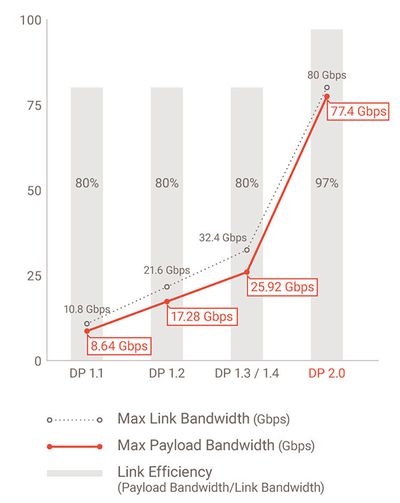
displayport 2 0 bandwidth
DisplayPort 2.0 configuration examples via DisplayPort, USB-C, or Thunderbolt 3 ports, which will all support the new specification:

Single display resolutions
- One 16K (15360x8460) display @60Hz and 30 bpp 4:4:4 HDR (with DSC)
- One 10K (10240x4320) display @60Hz and 24 bpp 4:4:4 (no compression)

Dual display resolutions
- Two 8K (7680x4320) displays @120Hz and 30 bpp 4:4:4 HDR (with DSC)
- Two 4K (3840x2160) displays @144Hz and 24 bpp 4:4:4 (no compression)

Triple display resolutions
- Three 10K (10240x4320) displays @60Hz and 30 bpp 4:4:4 HDR (with DSC)
- Three 4K (3840x2160) displays @90Hz and 30 bpp 4:4:4 HDR (no compression)

DisplayPort 2.0 also supports VESA's new Panel Replay capability for improved power efficiency when connecting to high-resolution displays.

VESA has made the DisplayPort 2.0 specification available to manufacturers and expects the first products incorporating the standard to appear on the market by late 2020. DisplayPort 2.0 is backward compatible with previous versions of the standard and incorporates all of the key features of DisplayPort 1.4a.

DisplayPort 2.0 will certainly be beneficial to Apple's high-resolution products like the upcoming Pro Display XDR, and it will likely be supported on future Macs, but it is unclear when the company will adopt the standard.

Popular Stories

imac video apple feature

Apple Released Yet Another New Product Today

Friday March 20, 2026 2:39 pm PDT by
Apple has unveiled a whopping nine new products so far this March, including an iPhone 17e, iPad Air models with the M4 chip, MacBook Air models with the M5 chip, MacBook Pro models with M5 Pro and M5 Max chips, the all-new MacBook Neo, an updated Studio Display, a higher-end Studio Display XDR, AirPods Max 2, and now the Nike Powerbeats Pro 2. iPhone 17e features the same overall design as...
iPhone 18 Pro Deep Red Feature

iPhone 18 Pro Launching Later This Year With These 12 New Features

Wednesday March 18, 2026 7:39 am PDT by
While the iPhone 18 Pro and iPhone 18 Pro Max are not expected to launch for another six months or so, there are already plenty of rumors about the devices. It was initially reported that the iPhone 18 Pro models would have fully under-screen Face ID, with only a front camera visible in the top-left corner of the screen. However, the latest rumors indicate that only one Face ID component...
ios 26 4 pastel

iOS 26.4: Top 10 New Features Coming to Your iPhone

Friday March 20, 2026 2:44 pm PDT by
iOS 26.4 isn't the major update with new Siri features that we hoped for, but there are some useful quality of life improvements, and a little bit of fun with an AI playlist generator and new emoji characters. Playlist Playground - Apple Music has a Playlist Playground option that lets you generate playlists from text-based descriptions. You can include moods, feelings, activities, or...

Top Rated Comments

Zdigital2015 Avatar
88 months ago
Serious, MacRumors editors...the most important, well, relevant part of the Press Release was left out of this article.

From the Press Release:

When using only two lanes on the USB-C connector via DP Alt Mode to allow for simultaneous SuperSpeed USB data and video, DP 2.0 can enable such configurations as:

• Three 4K (3840×2160) displays @144Hz and 30 bpp 4:4:4 HDR (with DSC)
• Two 4Kx4K (4096×4096) displays (for AR/VR headsets) @120Hz and 30 bpp 4:4:4 HDR (with DSC)
• Three QHD (2560×1440) @120Hz and 24 bpp 4:4:4 (no compression)
• One 8K (7680×4320) display @30Hz and 30 bpp 4:4:4 HDR (no compression)

The above specs are much more relevant to most of the computing public in the near-term. The market penetration of 4K and subsequently 4K gaming and AR/VR applications is something we should all be paying attention to for the foreseeable future. Whoever in the Marketing Department at VESA came up with 10K as a bullet point gets props for creating it out of whole cloth, unless they know something we don’t know. Sure, a Medical Imaging monitor may hit 10K shortly, but consumers are still wrapping their head around 4K, much less 8K and higher. The 16K resolution is just absurd for almost every consumer front facing application. I love future proofing and high end specs as much as the next person, but driving a 4K display @144Hz or 4K VR@120Hz with full color and HDR is incredibly important in the immediate future. Hell, Digital Cinema Projectors are only pushing 4096x2160.

Of course, this sort of support is only going to be relevant to us (Mac users) when Intel revs the next Thunderbolt 3 controller to support DP 2.0. Alpine Ridge (2016-2017 MBP, 2017 iMac and iMac Pro) has DP 1.2 and Titan Ridge (2018-2019 MBP, 2018 Mac mini, 2019 iMac and 2019 Mac Pro) have DP 1.4, but DP 1.4 support is limited to Coffee Lake and above on is limited to the eDP connector for an LCD panel.

The most important thing is how the morass of USB-C 3.2, 3.2+2, USB 4.0 will interoperate (or not) with Thunderbolt 3 and when and if Thunderbolt 4 becomes a real thing or not and move users to DisplayPort 2.0 (or not). Certainly this connectivity will be integrated into PCIe-based AIB GPUs first and motherboards and controllers, CPUs second. This is where the rubber meets the road in terms of PCIe 4.0+ being relevant for most of us, aside from the possibilities of PCIe 4.0-based SSD controllers and NAND pushing into 5–7GBps Read/Write speeds on an m.2 NVMe stick.

The future is always just around the corner.

Source: https://www.displayport.org/pr/vesa-publishes-displayport-2-0-video-standard-enabling-support-for-beyond-8k-resolutions-higher-refresh-rates-for-4k-hdr-and-virtual-reality-applications/
Score: 21 Votes (Like | Disagree)
millerlite Avatar
88 months ago
16K? Seriously? Unless your screen is as big as a house, I don't see how people benefit. Your eyes can only detect so much.
Score: 15 Votes (Like | Disagree)
88 months ago
I want Firewire 200.000
Score: 12 Votes (Like | Disagree)
DHagan4755 Avatar
88 months ago
The 16K Apple Pro Display XDR monitor stand will cost $2,000.
Score: 6 Votes (Like | Disagree)
kemal Avatar
88 months ago
Super. Will need active cables to get 1m length.
Score: 5 Votes (Like | Disagree)
88 months ago
Awesome, I suppose? I'm guessing most laptops, Mac or PC, won't really benefit without a serious update to graphics chip, which itself brings about a new set of thermal challenges. On the desktop side, I suppose that likely just leaves the Mac Pro, and PC towers seriously capable of driving so many pixels?
Score: 5 Votes (Like | Disagree)
Related Apple News: Mac | Health | Sport | Iphone | Ipad