Apple Working With TSMC to Develop MicroLED Panels for Future Apple Watch and Augmented Reality Wearable Device

Apple has plans in place to develop MicroLED panels for both small-size and large-size devices, with Taiwan Semiconductor Manufacturing Company (TSMC) providing support for producing smaller form factor applications, which could include future Apple Watch models and AR wearables, according to DigiTimes senior analyst Luke Lin.
microled

Apple is working with TSMC to develop micro LED panels on silicon-based backplanes for use in the Apple Watch and an augmented reality (AR) wearable device, Lin noted.

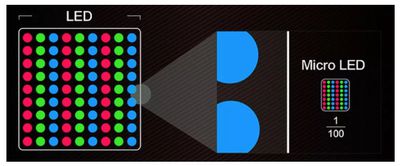
MicroLED panels use different light-emitting compounds than the current OLED displays and should help to make future devices slimmer, brighter, and less power-hungry. Citing sources in the upstream supply chain, Lin claims Apple is preparing two sizes of MicroLED panel for small devices. They are said to include a 1.3 to 1.4-inch panel for future Apple Watch iterations and a 0.7 to 0.8-inch panel for an AR wearable device, potentially AR glasses.

Lin also believes Apple is working on developing large-size MicroLED panels on TFT-based backplates for use in products much larger than those in its current MacBook lineup, although he offered no specifics on what they might be.

Based on Lin's sources, the MicroLED panel destined for a future Apple Watch may enter mass production in the second half on 2018 or in 2019, which would suggest its use in Series 4 or 5 models. The large-size panel could see production in 2019 or later, while the panel for the AR device is yet to have a production schedule, according to the analyst.

The cost of the new MicroLED panels are said to be 400-600 percent higher than OLED panels used in the current Apple Watch. As such, Lin believes Apple will initially only use the MicroLED panel in future "top-of-the-line" versions of Apple Watch, although whether that refers specifically to iterations of the Apple Watch Edition remains unclear.

Apple is understood to own a manufacturing facility in Santa Clara, California, where it is designing and producing test samples of its own MicroLED displays, with a view to eventually replacing largely Samsung-made OLED displays currently used across its product range.

Apple's interest in the technology was revealed in its acquisition of MicroLED firm LuxVue back in 2014 and previous reports have also claimed Apple will introduce MicroLED technology in the Apple Watch first, with some rumors pointing to that happening as soon as this year.

However, Bloomberg believes that it will likely be a few years before Apple's MicroLED displays will appear in shipping products – perhaps two years for the Apple Watch and three to five years for the iPhone.

Related Roundups: Apple Watch 11, Apple Vision Pro
Related Forum: Apple Vision Pro

Popular Stories

Aston Martin CarPlay Ultra Screen

Apple's CarPlay Ultra to Expand to These Vehicle Brands Later This Year

Sunday February 1, 2026 10:08 am PST by
Last year, Apple launched CarPlay Ultra, the long-awaited next-generation version of its CarPlay software system for vehicles. Nearly nine months later, CarPlay Ultra is still limited to Aston Martin's latest luxury vehicles, but that should change fairly soon. In May 2025, Apple said many other vehicle brands planned to offer CarPlay Ultra, including Hyundai, Kia, and Genesis. In his Powe...
Apple Logo Black

Apple's Next Launch is 'Imminent'

Sunday February 1, 2026 12:31 pm PST by
The calendar has turned to February, and a new report indicates that Apple's next product launch is "imminent," in the form of new MacBook Pro models. "All signs point to an imminent launch of next-generation MacBook Pros that retain the current form factor but deliver faster chips," Bloomberg's Mark Gurman said on Sunday. "I'm told the new models — code-named J714 and J716 — are slated...
Apple MacBook Pro M4 hero

New MacBook Pros Reportedly Launching Alongside macOS 26.3

Sunday February 1, 2026 5:42 am PST by
Apple is planning to launch new MacBook Pro models with M5 Pro and M5 Max chips alongside macOS 26.3, according to Bloomberg's Mark Gurman. "Apple's faster MacBook Pros are planned for the macOS 26.3 release cycle," wrote Gurman, in his Power On newsletter today. "I'm told the new models — code-named J714 and J716 — are slated for the macOS 26.3 software cycle, which runs from...
iOS 26

iOS 26.3 and iOS 26.4 Will Add These New Features to Your iPhone

Tuesday February 3, 2026 7:47 am PST by
We are still waiting for the iOS 26.3 Release Candidate to come out, so the first iOS 26.4 beta is likely still at least a week or two away. Following beta testing, iOS 26.4 will likely be released to the general public in March or April. Below, we have recapped known or rumored iOS 26.3 and iOS 26.4 features so far. iOS 26.3 iPhone to Android Transfer Tool iOS 26.3 makes it easier...
14 inch MacBook Pro Keyboard

Apple Changes How You Order a Mac

Saturday January 31, 2026 10:51 am PST by
Apple recently updated its online store with a new ordering process for Macs, including the MacBook Air, MacBook Pro, iMac, Mac mini, Mac Studio, and Mac Pro. There used to be a handful of standard configurations available for each Mac, but now you must configure a Mac entirely from scratch on a feature-by-feature basis. In other words, ordering a new Mac now works much like ordering an...

Top Rated Comments

fokmik Avatar
102 months ago
Since oled has burn-in issue...on glasses any tiny issue of that matter is seen..so microLED is the future for this and for anything, at least for the upcoming 20 years
[doublepost=1522751786][/doublepost]
I'm just so curious to see how much better this is compare to OLED.
it has no cons from oled or lcd...only pros
Score: 13 Votes (Like | Disagree)
kmanmx Avatar
102 months ago
I'm just so curious to see how much better this is compare to OLED.
Much. It does not rely on inorganic compounds which means several things:

1) No burn in issues
2) No life span issues (blue OLED pixels have a shorter life than red/green, which is an issue for obvious reasons)
3) No colour or brightness uniformity issues. There will be very slight variances in per-LED pixel brightness, but each individual microscopic LED will be individually controllable. In theory you could calibrate each LED with a +/- voltage offset to get perfect brightness and color uniforminity. In reality it will probably be completely unnecessary, as typical monitors offer 30% brightness differences across the panel, whereas each LED in a MicroLED display would have low single digit brightness variation.
4) You can go MUCH brighter with MicroLED. Think 5000 nits vs 1000 nits with OLED.
5) Resolution and panel size is just a function of the size of your MicroLED printing process. If you have a 10 meter printer, you can effectively print a single 10 meter screen. Of course the larger you go the more likely you are to print a dead pixel or duff circuitry, so there may still realistically be yield issues when you get too big.

However it is important to note MicroLED is not just one technology, it is an umberlla that encompasses many different display technologies, though all revolve around the core concept of microscopic inorganic LEDs. However, the MicroLED technology Apple are developing is very different to that being developed by Samsung, which is very different to what is being developed by Oculus..etc etc. To the end consumer they should all appear basically the same in terms of image quality, but look at the technologies by each manufacturer under the microscope and you would see they are all very different. It will be interesting to see which technology process is superior, in terms of cost, scalability, simplicity etc. It is similar in vain to how the fabrication process technologies for CPU's and SOC's varies quite significantly between TSMC, Global Foundries, Intel etc.
Score: 12 Votes (Like | Disagree)
maflynn Avatar
102 months ago
Actual Apple TV confirmed?
I see zero benefit from apple rolling out an actual Television set at this point. I think the market has changed enough, that instead of supplying a device like a TV, they're better off providing content.

Margins on TVs are razor thin, and Apple has a reputation of being over-priced, so its to see them making a dent in that product category.
Score: 7 Votes (Like | Disagree)
SuprUsrStan Avatar
102 months ago
Micro LED Macbook Pro? Bring it. My wallet is ready.
Score: 7 Votes (Like | Disagree)
44267547 Avatar
102 months ago
I'm just so curious to see how much better this is compare to OLED.
These are some of the core Benefits with Micro-Led advancements over OLED: Once Micro LED reaches production on a mass level, I think it will be fairly significant.


* It can greatly improve battery power.
* It can eliminate the need for backlighting unlike traditional LCDs.
* It will allow for higher-resolution screens with improved color gamut than other display technology.
* Micro-LED provide two/three times the brightness of their OLED counterparts under the same power consumption.
Score: 6 Votes (Like | Disagree)
BvizioN Avatar
102 months ago
I'm just so curious to see how much better this is compare to OLED.
Score: 6 Votes (Like | Disagree)