Apple Watch Able to Detect Abnormal Heart Rhythm With 97% Accuracy - MacRumorsOpen MenuShow RoundupsShow Forums menuVisit ForumsOpen Sidebar
Skip to Content

Apple Watch Able to Detect Abnormal Heart Rhythm With 97% Accuracy

The Apple Watch's built-in heart rate monitor is 97 percent accurate when detecting the most common form of an abnormal heart rhythm when paired with an algorithm to sort through the data, according to a new study conducted by the University of California, San Francisco and the team behind the Cardiogram app (via TechCrunch).

There were 6,158 participants in the study, all of whom used the Cardiogram app on the Apple Watch to monitor their heart rate. Most were known to have normal EKG readings, but 200 suffer from paroxysmal atrial fibrillation (an occasional irregular heartbeat).
cardiogramalgorithm
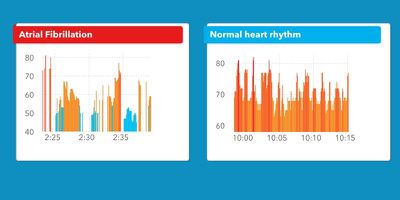
Data from these participants, along with data taken from normal Cardiogram users, was used to build a neural network that could recognize the abnormal heart rhythms solely from data collected by the Apple Watch. As of today, Cardiogram says its algorithm can almost always successfully determine when a patient is in atrial fibrillation.

In order to validate the model, we obtained gold-standard labels of atrial fibrillation from cardioversions. In a cardioversion, a patient experiencing atrial fibrillation is converted back to normal sinus rhythm, either chemically or with a shock to the heart. 51 patients at UCSF agreed to wear an Apple Watch during their cardioversion.

We obtained heart rate samples before the procedure, when the patient was in atrial fibrillation, and after, when patient's heart was restored to a normal rhythm. On this validation set, our model performed with an AUC of 0.97, beating existing methods.

Cardiogram is a startup that's aiming to garner more information from the data collected by the Apple Watch. The study, which Cardiogram has raised funding for, started in March of 2016 and will continue as UCSF and Cardiogram work to refine the neural network and detect other conditions beyond atrial fibrillation.

Cardiogram plans to put in additional work before using its algorithm to start notifying Cardiogram users of arrhythmias. The company needs to conduct further testing to make sure the algorithm works in a variety of conditions and it needs to work on scaling it so it can be used continuously by all Cardiogram users.

The Cardiogram app can be downloaded from the App Store for free. [Direct Link]

Related Roundup: Apple Watch 11
Buyer's Guide: Apple Watch (Neutral)

Popular Stories

imac video apple feature

Apple Released Yet Another New Product Today

Friday March 20, 2026 2:39 pm PDT by
Apple has unveiled a whopping nine new products so far this March, including an iPhone 17e, iPad Air models with the M4 chip, MacBook Air models with the M5 chip, MacBook Pro models with M5 Pro and M5 Max chips, the all-new MacBook Neo, an updated Studio Display, a higher-end Studio Display XDR, AirPods Max 2, and now the Nike Powerbeats Pro 2. iPhone 17e features the same overall design as...
ios 26 4 pastel

iOS 26.4: Top 10 New Features Coming to Your iPhone

Friday March 20, 2026 2:44 pm PDT by
iOS 26.4 isn't the major update with new Siri features that we hoped for, but there are some useful quality of life improvements, and a little bit of fun with an AI playlist generator and new emoji characters. Playlist Playground - Apple Music has a Playlist Playground option that lets you generate playlists from text-based descriptions. You can include moods, feelings, activities, or...
iPhone 18 Pro Deep Red Feature

iPhone 18 Pro Launching Later This Year With These 12 New Features

Wednesday March 18, 2026 7:39 am PDT by
While the iPhone 18 Pro and iPhone 18 Pro Max are not expected to launch for another six months or so, there are already plenty of rumors about the devices. It was initially reported that the iPhone 18 Pro models would have fully under-screen Face ID, with only a front camera visible in the top-left corner of the screen. However, the latest rumors indicate that only one Face ID component...

Top Rated Comments

PBRsg Avatar
116 months ago
You can program it to delete your browser history if it detects that you are about to die.
Score: 36 Votes (Like | Disagree)
116 months ago
Siri: "Looks like you're having a heart attack"
Me: "Call an ambulance"
Siri: "I'm sorry, Dave. I'm afraid I can't do that."
Score: 26 Votes (Like | Disagree)
JaySoul Avatar
116 months ago
Potentially awesome.

I think a lot of people are waiting on two big things:

1) Really accurate heart-rate monitoring (getting there)

2) Blood sugar analysis for diabetics.

I have a feeling Apple will get there within a decade, fingers crossed.
Score: 19 Votes (Like | Disagree)
brandonballinger Avatar
116 months ago
It'll be a long time before this comes to market. And from what it looks like, Apple doesn't want to have to go through the hassle of FDA approval for its devices.
(Cardiogram co-founder here)

The Cardiogram app itself is already on the app store (https://itunes.apple.com/us/app/cardiogram/id1000017994?ls=1&mt=8) and the deep learning to screen for conditions are coming sooner than you might think. :)
Score: 18 Votes (Like | Disagree)
brandonballinger Avatar
116 months ago
does this work with series 1 too? Looking into buying one soon.
(Cardiogram developer here) Yes—we're compatible with all Apple Watch hardware as long as you're on watchOS 3.
[doublepost=1494535132][/doublepost]
Using a device (A-watch) to tell you when you're heart is skipping beats is like having a device to tell you when you're getting cramps. Every missed heart beat is is easily felt and unpleasant enough as it is without some damn device reminding you of it.
Atrial fibrillation is often asymptomatic—Circulation (the top cardiology journal) just published a big report on the evidence for device-based screening of AF:
circ.ahajournals.org/content/135/19/1851.full?ijkey=StzSPk8eljGaP2G&keytype=ref
Score: 17 Votes (Like | Disagree)
116 months ago
I'm an Emergency doctor at UCSF and this could be super useful. We regularly get patients coming to the hospital with atrial fibrillation, and while some swear they know exactly when it started several studies have shown that this just isn't all that successful. Current guidelines allow for electrical cardioversion within 24 hours of onset of atrial fibrillation. If the onset is unknown we have to place a patient on long term anticoagulation (expensive and risk of bleeding with trauma) or do an invasive heart ultrasound with anticoagulation for a few days prior to cardioversion. If we were able to look back at app data/ heart rate monitoring this could save patients and the system a lot of money and time! Glad to see my home institution doing such great work.
Score: 13 Votes (Like | Disagree)
Related Apple News: Education | Technology | Opinion | Culture | Iphone