

Intel this week announced plans to usher in the adoption of an audio USB Type-C connector that would replace the standard 3.5 millimeter analog jack and eventually be capable of digital audio transmission (via Anandtech).
The plans were announced during the Intel Developers Forum (IDF) in Shenzhen, China, where the semiconductor manufacturer set out its project to develop USB Type-C Digital Audio. Intel remained vague about the digital conversion, but set out broad aims to update the USB Audio Device 2.0 protocol specifications to include up-to-date audio features, while simplifying discovery and improving power management, with plans to release the revised specification in the second quarter this year.
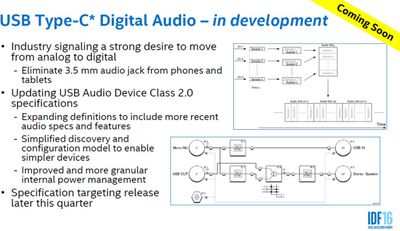
Intel hopes that the improved USB-C audio specification would eventually amount to a standardized connector replacement and eliminate the traditional audio jack from laptops, smartphones and tablets, eventually ushering in a transition to fully digital audio.
From a consumer perspective, this could mean higher-quality audio output, more remote control possibilities on headsets, potential biometric health data tracking (such as in-ear heart-rate monitoring), and supplied power for features like active noise-cancelling without the need for dedicated batteries.
The news comes amid iPhone 7 rumors suggesting Apple is also looking to remove the 3.5mm headphone jack on its future mobile devices, however speculation gravitates towards Apple replacing it with a proprietary Lightning port capable of transmitting audio. With no headphone jack, wired headphones would connect to the iPhone 7 using its Lightning port and Bluetooth headphones would connect wirelessly.
Apple could theoretically implement Intel's USB-C digital audio protocol in future Macs, although details remain unknown. Either way, given that LeEco already offers smartphones with USB-C-only audio, and JBL sells noise-cancelling USB-C headphones, the 3.5mm audio jack appears to be nearing the end of its life in the consumer technology market.













Top Rated Comments
Besides, while I appreciate your point about evolving USB, why do you have faith that Lightning will persist for more than about 2 more iterations of iPhone? Look at it's thickness vs. iPhone now. How many more cuts of "thinner" before it proves too thick to remain THE jack for iDevices? I predict 2 more iterations. Then we'll get the "thinner" Lightning 2 and get to rebuy all this again.
Good point but don't forget it doesn't actually move the DAC out to the headphones, it creates a redundancy of a second DAC. iPhones will still have to have a DAC inside to work as a phone without headphones/earbuds. There's no way around that if an iPhone is going to continue to be a phone. So what this is doing is just duplicating that bit of hardware, shifting when a digital audio signal becomes an analog signal we can actually hear by as little as a few inches further down the pipe (toward the headphone speakers).
I still think the better overall option would be to stick with a universal, ubiquitous standard with virtually nill licensing fees (if any???) instead of embracing a proprietary one owned & controlled by a single company that we all know won't cut the licensing fees low enough to give it any chance to become THE standard on every other kind of device to which one might also want to connect their headphones. So now we get iPhones with "tails" (adapters) and will need to carry around adapters (and yes, that's plural) if we want to use one set of headphones with the various kinds of jacks that will now be in play. Or we can carry around multiple sets of headphones. Either way, we carry around more accessories. For what gain?
Think about the business trip and carry along only one set of headphones:
* Client wants you to plug into their equipment for the conf call. Not lightning, probably 3.5mm.
* Want to jack in to listen to the airplane's audio while the movie plays. Not lightning, probably 3.5mm
* Need to listen to something on your own Mac? Not lightning, probably 3.5mm or maybe USB.
* Step forward a little bit when this push for USB-C with other hardware takes hold. Hook into that. Not lightning, USB3C.
Adapters, adapters, adapters... even to share headphones between your new iPhone and the Macs you already own.
If the argument is for better quality audio, the 3.5mm jack is NOT the problem. Build a better quality DAC inside the iPhone. Analog is analog. Moving the DAC an inch or three further along the pipe is not going to make any difference we can hear... unless a better quality DAC is doing the conversion and then some of us MIGHT be able to hear some difference. However, the phone will still have to have a DAC inside it too. It's not the couple of inches that would make the difference in quality, it's the quality of the DAC.
The Bluetooth alternative argument seems weak to me too. Even if one can set aside the obvious tradeoff in audio quality for the convenience of wireless, again, take the Bluetooth headphone on the business trip. How to wirelessly jack into the airplane's audio to hear the movie? Can you count on every client having a bluetooth setup and willingness to connect you so you can participate in the conf call? Etc.
So again, adapters, adapters, adapters. Or maybe multiple kinds of headphones to lug along. For what exactly that can't be covered much more ubiquitously with a perfectly fine, perfectly functional, everywhere option paired with a better-quality DAC inside the next iPhone?
This is not about replacing "old, outdated" analog with "new, "the future" digital. Audio must be converted to analog for us to hear it. Based on how some of us are trying to rationalize this, perhaps Apple should bottle Water as a product- replace the old, outdated standard of H2O now with Apple's newer, proprietary, somehow "thinner" H2O proprietary blend... a far superior incarnation of water because it's newer... and Apple says so. ;)
IMO, even if they do achieve the same pricing- which frankly, I don't see with headphones terminating a proprietary (lightning) jack- the choice of which to buy is complicated. Do you get the ones that terminate for your Apple equipment even though that means you'll need an adapter(s) to use them with just about anything else? And if so, how do you connect them to your Macs when you need to tap into that audio via headphones?
Do you get the USB3C-terminated headphones which will probably have the better chance of being the next audio standard jack if 3.5mm really must be rejected. If so, you might have some phones that can directly connect to one kind of Mac but not the others... and of course, it can't directly connect to iDevices without an adapter.
Do you carry more than one kind of headphone/earbud around to cover these multiple bases? Is "thinner & lighter" now about the device only... not how much extra we have to carry around because traditional utility is getting pushed OUTSIDE of the new "thinner & lighter" devices (but that external weight doesn't get counted)? If one just about MUST carry adapters to cover bases traditionally covered by hardware INSIDE devices, I think the weight should count. In other words, eventually, Apple could push the battery OUTSIDE of an iDevice in the name of "thinner & lighter". Yes, that would make it a lot thinner and a lot lighter but one would need a battery case to make it work as it has traditionally worked. Since one would have to carry that case around, is that battery-less iPhone actually "thinner & lighter"? While extreme, is this much different?
Even the maximum Apple fan must encounter non-Apple audio hookups sometime. Maybe you do want to watch the movie on the plane and thus need to jack into the plane's system (definitely not lightning nor likely to be lightning)? Maybe you need to be able to jack into a client's hardware and that client doesn't already worship at the alter of Apple (definitely not lightning nor likely to be lightning)? Maybe bluetooth will be available and accessible but maybe not?
I see this as a big mess- a solution in search of what is nobody's problem, though, of course, there's a number of "us" here trying our best to spin what Apple has decided it wants to do as the ONE and only right way forward. We'll make up stuff (like how eliminating this hole might support waterproofing while ignoring the much bigger hole in the same device). We'll spin how it's about "better quality audio" and then bluetooth wireless in the same pitch, ignoring how one is basically the opposite of the other. We'll spin "the future" vs. "antiquated"- even share dates of standards- while ignoring that our ears can only hear audio as analog and the distance of headphone cable is not so great that preserving an audio signal another inch or three before converting it to analog will make some huge difference.
My opinions are these:
* another solution in search of nobody's problem
* since Intel has decided USB3C, the vast majority of future computers will embrace USB3C, not lightning, far outnumbering all future Macs that might add a lightning port
* since lightning is proprietary and will thus be much more expensive to embrace than USB3C, all the fence-sitters who want to support one of the other will likely support the non-proprietary, cheaper option. That means about everything else to which one might connect headphones with a wire will likely adopt USB3C if THEY choose to embrace anything other than 3.5mm
* lightning as is is already almost as thick as current gen iDevices. When near-term generations want to thin- and we all know Apple will want to thin them- it won't be long until Lightning 1 must become the thinner Lightning 2, at which point investments in proprietary will require rebuying and/or buying new adapters.
* The implication that getting rid of the 3.5mm jack may mean bigger battery is just spin- Apple always spins "same great battery life". It seems when they get the chance to free up some space, they fill that space with "thinner" instead of "more battery"
* if the big brains at Apple and Intel actually believe that the world needs to drop 3.5mm for a "better standard", I wish Apple would embrace USB3C too so that us consumers could adopt a new standard without necessarily having to grapple with adapters.
Do we really want lightning ports in future Macs? In the space allocated for a lightning port to support these future headphones on Macs (too), another USB3C/Thunderbolt 3 could be added, bringing much more utility for us consumers (while also being able to be a "better", "the future" headphone jack). Of course, Apple embracing USB3C is not as profitable as sticking with proprietary Lightning, so who cares about utility for us consumers?