

The new documentary Steve Jobs: The Man in the Machine today sees its wide release into theaters and onto video on demand platforms. The film first debuted at SXSW in March and met a bit of controversy thanks to its depiction of Jobs as a merciless force, with less time spent on his greater contributions to Apple and his impact on the world. Subsequently, Apple senior executive Eddy Cue called the film "an inaccurate and mean-spirited view of my friend" and "not a reflection of the Steve I knew."
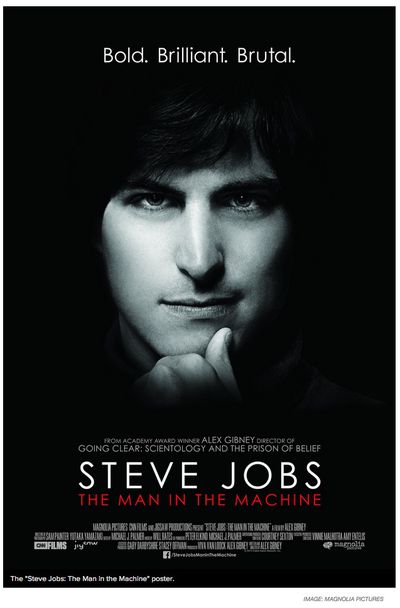 Now that the film has seen a slightly wider release in critic screenings before its launch today, a few more opinions have been gathered on the review aggregate website Rotten Tomatoes. The film currently sits at a 75% with 30 fresh and 10 rotten reviews, with an overall consensus calling the film "absorbing" but lacking any deep understanding of Jobs himself. The movie's theatrical run is pretty limited to start, with it only hitting 65 screens in 50 markets, according to Deadline. The usual cities of New York, Los Angeles, and San Francisco will more heavily serve viewing of the documentary.
Fortunately, Steve Jobs: The Man in the Machine is seeing a simultaneous theatrical and VOD release. Users can watch the movie at home on services like iTunes, VUDU, Xbox Video, and The PlayStation Store. Its price varies drastically between each service, with the cheapest HD rental coming from iTunes for $4.99 and the highest option coming from VUDU for an $8.99 HDX version of the film.



















Top Rated Comments
It is hard to defend (especially as a father myself) SJ denial of his own daughter. That, to me, is some seriously messed up stuff. It is also hard to deny that he accomplished great things in the world of technology. In addition to the complexities of humanity that creates a man like this, it also provide some insight into what makes him, him, and what he values more.
Dre is much the same. He screwed up pretty bad in his youth but seems to have done better as he has matured. Do we judge him for ever based on his past actions? Do we ignore those actions? Or do we recognize the complexities of his humanity that has evolved over the years.
I for one, cannot judge someone based on a single fact or based on something from long ago. I include that in my judgement, but it is not the exclusive reason for the judgement. This carries into politics. All too often people vote based on a single issue such as abortion or gay marriage or whatever. The world is just too complex for me, and to simplify it to a single issue, makes no sense.
Okay, sorry, that turned into a bit of a rant, which was not my intention.
What bothers me about such binary thinking is that it can send a message to someone who has done something bad that there is no forgiveness or redemption. And that can lead someone with an unstable mind to go down a very dark path. Giving someone a second chance and helping to guide them to better actions in the future is far more beneficial to society as a whole then shunning people the second they step out of line.
[SPOILER="Long rant with spoilers"]Music score, interviewees, aspects of his life, all meticulously chosen to paint a very particular picture of SJ, and not a flattering one at all. Not that the man wasn't an ******, of course, as there is a plethora of evidence to that assertion. Stealing from Woz in the Breakout deal, denying paternity, throwing Fred Anderson and Nancy Heinen under the bus in the backdating scandal are some of the most poignant examples, to be sure.
But then you see Bob Belleville's testimony, a heartwrenching interview with so much grief and sorrow. His reading of the text he published when Steve died almost drove me to tears, so much sadness, hurt, love, hate, despair was packed in the feelings he was projecting as he read those lines. My first reaction was to think something along the lines of "how could Steve have willingly or simply casually have caused so much pain to this man (and, by induction, to so many others)? But the deeper understanding that has to come from this is the fact that Mr. Belleville never had a gun to his head preventing him from leaving Apple and Steve at any moment he chose. He always had a choice, and he made the choice over and over to stay aboard. Yes, Steve, it seems, was charming, and could supposedly charm people into doing his bidding with an almost Jedi "these are not the droids you are looking for" ability. And yet, in the end, there is always the choice to put on a scale everything that is happening—on one hand, the unique opportunity to work on a revolutionary computer, on the other, the damage it is causing to one's personal life—and choose a different path. Personally, I have been submitted to a similar treatment, by a mercurial boss—albeit one admittedly a couple of orders of magnitude less intense than Steve Jobs—and I somewhat know how it feels. I learned a lot, I got tons of experience, I got hurt a lot. I am a better professional today because of such experiences, but in the end I decided to leave, when balancing everything out I found it wasn't worth it. And that extremely important facet of what happened to Bob Belleville is never even touched in the documentary. Neither are told the stories of Bob Mansfield, Scott Forstall, Jon Rubinstein, Eddy Cue,Tim Cook, Jony Ive and several other Apple executives who worked under Jobs for several years and were able not only to "endure" it, but to thrive.
And then there the blatant double standards: working conditions in China, that every single company that designs in their own country and outsource manufacturing incurs; tax dodging schemes that every single multinational company avidly seeks and implements; and the most absurd and pernicious of all: the sense of alienation supposedly provoked in the users of modern electronic equipment. All of these traits are by no means exclusive to Apple, but they are treated as if Apple is not their sole perpetrator, but also their inventor. That approach is simply not fit for a documentary aiming at the truth.
On that last point, the thesis that Apple's products foster alienation, it's particularly pernicious because it aims to vilify what actually is one of the best characteristics of Apple products: they are exceedingly good at their jobs. We want to use these products—and supposedly alienate ourselves while doing it—because they make our lives so much easier. I can do my job better; I can be in better contact professionally and personally with people around me; I can be more productive; I can be more well informed; I can be more creative. The list goes on and on. Alienated? I never had the opportunity to be in so much contact with so many people before I started carrying a smartphone with me all the time. I constantly message friends and family that live hundreds and sometimes thousands of kilometers away at a negligible cost, thanks to modern communication technology. Is Apple better at all of these things than the competition? Although I have an opinion on the matter, of course the subject is absolutely debatable. And if, say, Android's users aren't so much into their own devices as Apple users, that is not an advertisement point for Android. "Our products are better because they are crappier and you won't be drawn to them so much" is not a viable campaign motto.
If we use the "bicycle for the mind" analogy, it's as if Apple invented the best possible bicycle (to date), and the critics are ranting about how nobody walks anymore. Yes, everybody is getting everywhere faster and more efficiently, but very few people are going out for strolls anymore! Not a valid complaint at all, IMHO.
[/SPOILER]
OK, this is a long rant, and I apologize for it. Go see the documentary for yourself and reach your own conclusions.