Apple Replaces Problematic 'Discoveryd' Process With mDNSresponder in 10.10.4 Beta 4
In today's fourth OS X 10.10.4 beta, Apple made a significant behind-the-scenes change that could result in improved networking performance for some users -- the removal of the "discoveryd" process. As noted by MacRumors forum members and 9to5Mac, in OS X 10.10.4 beta 4, the discoveryd process has been replaced by mDNSresponder.
Since OS X Yosemite debuted in October, there have been ongoing complaints about discoveryd consuming CPU resources, draining battery life, and causing issues with Wi-Fi. These problems have lingered for several months, even after multiple bug fixes and performance improvements included in OS X 10.10.1, 10.10.2, and 10.10.3.
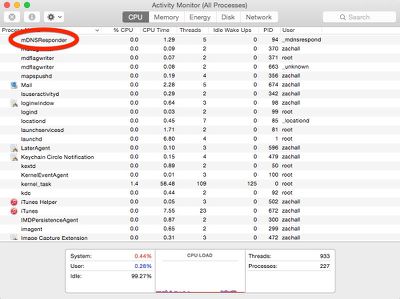
Discoveryd was introduced with OS X Yosemite, replacing mDNSResponder for managing Mac networking tasks, but it's led to a host of problems like those listed above along with issues like slow wake from sleep, failures to resolve DNS names, duplicate machine names, and more, as detailed in a post earlier this year by Ars Technica. Several developers have also complained about discoveryd in Yosemite, including Instapaper's Marco Arment and Iconfactory's Craig Hockenberry.
It's no secret in the tech community that discoveryd is the root cause of so many problems. There are even crazy workarounds. With so many issues, you'd expect some information from Apple explaining ways to mitigate the problems.
The removal of the unstable discoveryd process in OS X 10.10.4 beta 4 may improve network stability problems for many users who have been experiencing continual issues. With the removal of discoveryd, Apple has reverted back to using the earlier mDNSresponder process that was used before discoveryd was implemented with OS X Yosemite.
Popular Stories
Last year, Apple launched CarPlay Ultra, the long-awaited next-generation version of its CarPlay software system for vehicles. Nearly nine months later, CarPlay Ultra is still limited to Aston Martin's latest luxury vehicles, but that should change fairly soon.
In May 2025, Apple said many other vehicle brands planned to offer CarPlay Ultra, including Hyundai, Kia, and Genesis.
In his Powe...
Apple today confirmed to Reuters that it has acquired Q.ai, an Israeli startup that is working on artificial intelligence technology for audio.
Apple paid close to $2 billion for Q.ai, according to sources cited by the Financial Times. That would make this Apple's second-biggest acquisition ever, after it paid $3 billion for the popular headphone and audio brand Beats in 2014.
Q.ai has...
The calendar has turned to February, and a new report indicates that Apple's next product launch is "imminent," in the form of new MacBook Pro models.
"All signs point to an imminent launch of next-generation MacBook Pros that retain the current form factor but deliver faster chips," Bloomberg's Mark Gurman said on Sunday. "I'm told the new models — code-named J714 and J716 — are slated...
Apple recently updated its online store with a new ordering process for Macs, including the MacBook Air, MacBook Pro, iMac, Mac mini, Mac Studio, and Mac Pro.
There used to be a handful of standard configurations available for each Mac, but now you must configure a Mac entirely from scratch on a feature-by-feature basis. In other words, ordering a new Mac now works much like ordering an...
Apple is planning to launch new MacBook Pro models with M5 Pro and M5 Max chips alongside macOS 26.3, according to Bloomberg's Mark Gurman.
"Apple's faster MacBook Pros are planned for the macOS 26.3 release cycle," wrote Gurman, in his Power On newsletter today.
"I'm told the new models — code-named J714 and J716 — are slated for the macOS 26.3 software cycle, which runs from...