Apple Preparing for Massive Production of Devices with Sapphire Displays

GT Advanced, the company that has partnered with Apple to open a sapphire plant in Mesa Arizona, has purchased and received a total of 518 sapphire furnace and chamber systems with another 420 machines on order, according to analyst Matt Margolis (via 9to5Mac). The company has also purchased multiple "Sapphire Display Inspection Tools" from Intego.

The sheer amount of equipment purchased indicates that a massive sapphire production operation is being installed at the Arizona factory, and as rumors have hinted, the large amounts of sapphire being produced, along with the tools ordered, could hint at a future ultra-durable iPhone display.

Matt Margolis believes that with the current equipment the factory has, it could produce between 103 and 116 million displays per year, with an additional 84 to 94 million possible when taking into account the 420 furnaces on order. Apple could, in total, produce 100 to 200 million ~5-inch sapphire displays, enough for its entire line of devices. In 2013, Apple sold approximately 150 million iPhones.

In documentation, GT Advanced itself suggests the aforementioned Sapphire Inspection Tools are aimed at device displays.

sapphiredisplaytool

Lowering manufacturing and fabrication costs of sapphire is a key driver for accelerating the adoption of its use in new market segments such as cover screens for smartphones and mobile devices. GT Advanced Technologies is working with key downstream technology providers to optimize fabrication processes and technologies to lower the cost of sapphire cover screen material.

GT is partnering with Intego GmbH to develop a series of automated sapphire inspection tools that will increase the yield of high quality sapphire material from each boule and ensure that only high quality material enters the value stream. The SIRIUS Slab automated sapphire inspection tool begins a new level of repeatability and performance throughput to the production of sapphire material intended for high volume markets such as mobile and touch screen devices.

In November, shortly after the partnership between GT Advanced and Apple was announced, it became clear that GT Advanced, with Apple's help, was aiming to drastically increase its sapphire production.

A recent patent pointed to Apple's interest in using sapphire as a display cover on future iPhones and shortly after, a report suggested Apple partner Foxconn had already began a small trial production of 100 devices with a sapphire display.

Those rumors, along with today's report, indicate that Apple is almost certainly aiming to use sapphire as a major component in an upcoming product such as the next-generation iPhone or the company's much-rumored iWatch. Currently, the company uses limited quantities of sapphire to protect the camera on recent iPhones and to cover the Touch ID fingerprint sensor on the iPhone 5s.

Sapphire, as the second hardest mineral after diamond, is incredibly durable and scratch resistant, as can be seen in the video below. An iPhone with a sapphire display would be almost impossible to scratch in day-to-day use.

Video courtesy of Pocketnow

Apple and GT Advanced are said to be aiming to take the Mesa, Arizona plant live by February in order to begin immediate production of a "critical new sub-component" for iOS devices.
Related Roundup: Apple Watch 11
Buyer's Guide: Apple Watch (Buy Now)
Related Forum: iPhone

Popular Stories

iOS 26

iOS 26.4 and iOS 27 Features Revealed in New Leak

Friday December 12, 2025 10:56 am PST by
Macworld's Filipe Espósito today revealed a handful of features that Apple is allegedly planning for iOS 26.4, iOS 27, and even iOS 28. The report said the features are referenced within the code for a leaked internal build of iOS 26 that is not meant to be seen by the public. However, it appears that Espósito and/or his sources managed to gain access to it, providing us with a sneak peek...
apple beta 26 lineup

Apple Leak Confirms Work on Foldable iPhone, AirTag 2, and Dozens More Devices

Monday December 15, 2025 2:05 pm PST by
Last week, details about unreleased Apple devices and future iOS features were shared by Macworld. This week, we learned where the information came from, plus we have more findings from the leak. As it turns out, an Apple prototype device running an early build of iOS 26 was sold, and the person who bought it shared the software. The OS has a version number of 23A5234w, and the first...
Apple Logo Top Half

Early iOS 26 Software Leak Uncovers Dozens of Upcoming Apple Features

Monday December 15, 2025 3:05 pm PST by
Software from an iPhone prototype running an early build of iOS 26 leaked last week, giving us a glimpse at future Apple devices and iOS features. We recapped device codenames in our prior article, and now we have a list of some of the most notable feature flags that were found in the software code. In some cases, it's obvious what the feature flags are referring to, while some are more...
Apple Foldable Thumb

Leak Reveals Foldable iPhone Details

Monday December 15, 2025 9:09 am PST by
The first foldable iPhone will feature a series of design and hardware firsts for Apple, according to details shared by the Weibo leaker known as Digital Chat Station. According to a new post, via machine translation, Apple is developing what the leaker describes as a "wide foldable" device, a term used to refer to a horizontally oriented, book-style foldable with a large internal display....
iOS 26

Apple Releases iOS 26.2 With Alarms for Reminders, Lock Screen Changes, Enhanced Safety Alerts and More

Friday December 12, 2025 10:10 am PST by
Apple today released iOS 26.2, the second major update to the iOS 26 operating system that came out in September, iOS 26.2 comes a little over a month after iOS 26.1 launched. ‌iOS 26‌.2 is compatible with the ‌iPhone‌ 11 series and later, as well as the second-generation ‌iPhone‌ SE. The new software can be downloaded on eligible iPhones over-the-air by going to Settings >...
iOS 26

iOS 26.2 Coming Soon With These 8 New Features on Your iPhone

Thursday December 11, 2025 8:49 am PST by
Apple seeded the second iOS 26.2 Release Candidate to developers earlier this week, meaning the update will be released to the general public very soon. Apple confirmed iOS 26.2 would be released in December, but it did not provide a specific date. We expect the update to be released by early next week. iOS 26.2 includes a handful of new features and changes on the iPhone, such as a new...
iOS 26

iOS 26.3 Beta 1 Features: What's New So Far

Monday December 15, 2025 4:23 pm PST by
Apple is testing iOS 26.3, the next version of iOS 26 that will launch around January. Since iOS 26.3's testing is happening over the holidays, it is a smaller update with fewer features than we've seen in prior betas. We've rounded up what's new so far, and we'll add to our list with subsequent betas if we come across any other features. Transfer to Android Apple is making it simpler...
airpods max 2024 colors

AirPods Max 2 Likely to Offer These 10 New Features

Monday December 15, 2025 7:41 am PST by
Apple released the AirPods Max on December 15, 2020, meaning the over-ear headphones launched five years ago today. While the AirPods Max were updated with a USB-C port and new color options last year, followed by support for lossless audio and ultra-low latency audio this year, the headphones lack some of the features that have been introduced for newer generations of the regular AirPods and the ...

Top Rated Comments

pixelpro Avatar
155 months ago

Is that all of the benefits? I barely saw any scratches ever since iPhone 3/4 came out.

Don't say it too loud, or them keys in your pocket might get jingly. To be frank, it takes just one scratch to ruin the look of such an expensive device. Kudos to Apple that they are going the extra mile.
Score: 18 Votes (Like | Disagree)
Klae17 Avatar
155 months ago
> Sapphire, as the second hardest mineral after diamond, is incredibly durable and scratch resistant, as can be seen in the video below. An iPhone with a sapphire display would be almost impossible to scratch in day-to-day use.

Is that all of the benefits? I barely saw any scratches ever since iPhone 3/4 came out.

What about the width and weight? Can it be just as durable while being thinner than the current panel?

You barely saw any scratches does not mean no one else did.
Score: 14 Votes (Like | Disagree)
kdarling Avatar
155 months ago
Sapphire, as the second hardest mineral after diamond,
Sapphire is NOT REPEAT NOT the "second hardest mineral after diamond".

What confuses people is that they often refer to the Mohs hardness scale, which rates hardness in relation to ten common minerals. In that list, yes, sapphire is reference mineral #9, and diamond is reference #10.

But that does not mean there's nothing in-between them.

Materials such as silicon carbide (carborundum aka the mineral moissanite), tungsten carbide, titanium carbide, boron, boron nitride, rhenium diboride, stishovite, and titanium diboride ARE HARDER THAN SAPPHIRE. That is, they are 9+ on the Mohs scale.

For that matter, there are now materials harder (10+ on the scale) than diamond .

What about the width and weight? Can it be just as durable while being thinner than the current panel?
I don't think thinner will work. As I keep pointing out, to prevent easy breakage, sapphire watch crystals are from 3-6 times as thick as what's used for Gorilla Glass phone covers. And watches are a small area.

Sapphire also weighs about 60% more than GG.

This is no doubt why we see Apple patents on joining very thin sapphire sheets to glass. That way, you get the scratch resistance of sapphire on top, and the structural strength and weight savings of the glass substrate.
Score: 6 Votes (Like | Disagree)
rydewnd2 Avatar
155 months ago
I personally would like to hear from everyone who said a sapphire iphone 6 was impossible and the Mesa facility was definitely for iWatch screens.

Since when were you allowed to brag about how you were right based on a rumor?
Score: 6 Votes (Like | Disagree)
Ieo Avatar
155 months ago
I personally would like to hear from everyone who said a sapphire iphone 6 was impossible and the Mesa facility was definitely for iWatch screens.
Score: 6 Votes (Like | Disagree)
3282868 Avatar
155 months ago
Wow. So we should be hesitant to increase the quality and durability of a product because it may increase the energy usage in recycling? You're joking, right?
No, I'm not.

Ok, here we go.

I pass this along as I am passionate on this matter, I do not want to leave a caustic planet to my children, nor do I want to destroy the oceans and wildlife that are negatively impacted by our out of control consumerism and waste. I know this is a long post, but it's a quick read and so important to all of us. Please take the moment :)

Every year, Americans throw away enough paper and plastic cups, forks, and spoons to circle the equator 300 times (http://www.cleanair.org/Waste/wasteFacts.html). Plastic produces more waste from recycling and general consumer discard. Recycling produces more pollutants, including chemical stews when breaking down different products.

Recycling is not cost-efficient and annually results in a net loss. It costs $50-60 to landfill a ton versus $150+/- to recycle. Only the recycling of aluminum really makes any money. Reclaiming metals is feasible and fairly easy, whereas plastics and paper are expensive, wasteful and overly difficult. The biggest disadvantage to recycling is that it gives the consuming public a false sense of 'security'; a sense that they're doing something to benefit the environment. recycling can be bad for the environment. In fact, except for materials like metal and some glass, recycling is almost always bad for the environment. One of the best places to start is with a report from Perc.org, called the Eight Great Myths of Recycling (http://perc.org/sites/default/files/ps28.pdf). "One argument made for recycling notes that we live on a finite planet. With a growing population, we must, it seems, run out of resources."


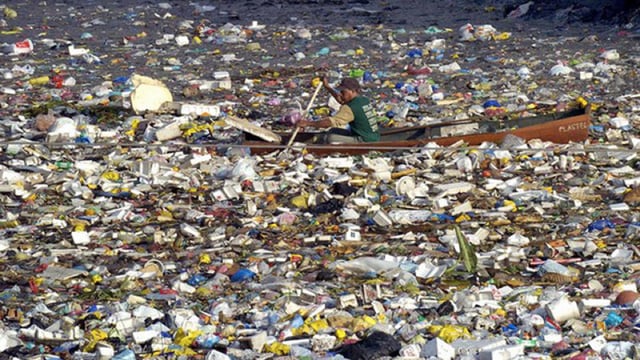
E-waste is a major issue, especially with plastics. There are 2 plastic islands the size of Texas, one in the Pacific Ocean - the "Great Pacific garbage patch" (http://en.wikipedia.org/wiki/Great_Pacific_garbage_patch)and one in the Indian Ocean (http://en.wikipedia.org/wiki/Indian_Ocean_garbage_patch) and more being discovered almost monthly.

The patch is characterized by exceptionally high concentrations of pelagic plastics, chemical sludge and other debris that have been trapped by the currents of the North Pacific Gyre. Despite its size and density, the patch is not visible from satellite photography, since it consists primarily of suspended particulates in the upper water column. Since plastics break down to even smaller polymers, concentrations of submerged particles are not visible from space, nor do they appear as a continuous debris field.
Charles Moore - TED discussion on plastic (//www.youtube.com/watch?v=en4XzfR0FE8) - 7 minutes but alarming facts on plastic toxicity and huge annual increases in waste.

As Japan has serious garbage issues, a Japanese scientist invented a machine that breaks any plastic down into oil! I've mentioned the on MacRumors before as it is an issue the tech industry needs to take into serious consideration. This device is no larger than a microwave and uses less energy than a coffee maker. Read and watch the short 5 min video, if for nothing else than the tech as it's amazing. Hoping quick mainstream adoption lowers the $10k price tag quickly enough for residential use and can make up for its price by reusing the oil. Used in large industrial recycling centers would be amazing!

Plastic to oil fantastic (http://ourworld.unu.edu/en/plastic-to-oil-fantastic/)

Aluminum is currently the best material for mass production in products, especially tech due to e-waste. Bauxite being the most common aluminum ore. Refinement uses much less energy to produce, and is improving with recent advancements, especially compared to the Hall-Héoult Process (the major industrial process aluminum extraction). Aluminum is theoretically 100% recyclable without any loss of its natural qualities and requires only 5% of the energy used to produce aluminum from ore, though a significant part (up to 15% of the input material) is lost as dross (ash-like oxide). Recycled aluminum is known as secondary aluminum, but maintains the same physical properties as primary aluminum. Secondary aluminum is produced in a wide range of formats and is employed in 80% of alloy injections. The process produces aluminum billets, together with a highly complex waste material, which can be reused as a filler in asphalt and concrete.

To answer your question, that is why it is important. I mean this sincerely, not sarcastically, read up on the matter, do some research - the statistics are alarming but hopeful if all of us work together.

If you got this far, thank you. Collectively we can make a difference in plastic usage by "voting with our dollars". We don't need more waste; plastic in tech produces much more waste (and chemical waste from wires, displays, etc) than other naturally occurring metals and smelting. It's great Apple is trying to produce a lower cost iPhone, however plastic shouldn't be much cheaper than smelting aluminum, especially as Apple has dedicated plants for product shells using green energy.
Score: 5 Votes (Like | Disagree)