Apple Interested in Liquidmetal Alloys for Home Buttons, Touch Sensors, and Tamper-Resistant Screws

Back in 2010, Apple signed an exclusive agreement with Caltech spinoff Liquidmetal Technologies, providing Apple with the rights to use Liquidmetal's advanced metal alloys for consumer electronics purposes. Liquidmetal's amorphous metal alloys or bulk metallic glasses posses a number of characteristic properties such as high strength and corrosion resistance while remaining relatively light and able to be cast into a variety of forms.

Apple quietly tested Liquidmetal's alloys in the SIM card eject tool for the iPhone 3G, but the materials have otherwise not been confirmed to have appeared in any other Apple products, as one of alloys' inventors noted in 2012 that their use as major design materials was still several years in the future.

Evidence of Apple's continued interest with Liquidmetal alloys has surfaced a number of times over the past several years, including in a granted patent from July covering a process for mass producing thin sheets of the Liquidmetal alloys and a series of technical patent applications published in November describing methods of working with the alloys to create products.

A number of patent applications addressing additional innovations with Liquidmetal alloys have been published since that time, including a batch of 17 applications published just this past Thursday. Many of these applications are not yet listed as being assigned to Apple, but the inventors listed on the patents are Apple employees who have routinely been associated with the company's work on Liquidmetal alloys in the past.

One of these patent applications proposes using Liquidmetal alloys in pressure sensors such as those found in buttons and switches on mobile devices, offering greater durability under repeated use. Figures accompanying the patent application closely resemble the iconic home button found on Apple's iOS devices.

Because switches on consumer electronic devices are operated frequently, the materials used to fabricate the switch must be capable of repeated deformation and return to their original configuration. The ability of a material to deform reversibly under stress is known as the material's elasticity. Above a certain stress, known as the elastic limit of a material or the yield strength, the metal material may deform irreversibly, becoming inelastic, exhibiting plasticity and adversely affecting the function and utility of the switch. [...]

A proposed solution according to embodiments herein for pressure sensors is to use bulk-solidifying amorphous alloys as the deformable material, and to measure the pressure based on the physical changes of the bulk-solidifying amorphous alloy as it is deformed.
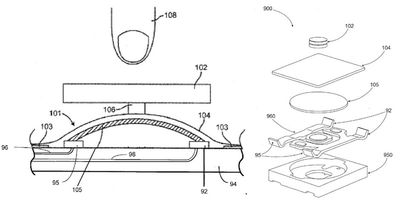
liquidmetal_button

Button or switch using Liquidmetal alloy as deformable material

Another application published in mid-December describes how Liquidmetal alloys could be used as material for tamper-resistant screws to help secure devices against unauthorized access.

A proposed solution according to embodiments herein for tamper resistance is a fastener having a head portion and a tamper resistant bulk-solidifying amorphous alloy interlock portion, wherein the fastener and the substrate into which the fastener is fitted into are permanently fastened via an interlock formed from the interlock portion during the fastening process.
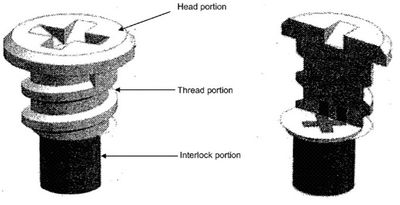
liquidmetal_screw

Tamper-resistant screw made of Liquidmetal alloys

A third patent application addresses the use of Liquidmetal alloys as a substrate for touch sensors found in displays such as in Apple's iOS devices. Apple describes how discrete areas of crystallinity can be created on the amorphous metal substrate, allowing for greater control and higher density of touch sensing arrays, thus giving greater positional precision for touch sensing.
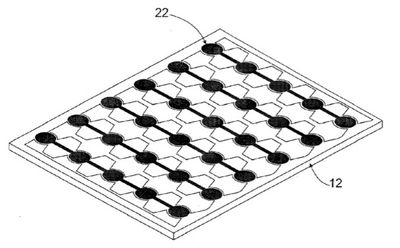
liquidmetal_touch_sensor

Touch sensor grid using Liquidmetal alloy as substrate

Most of the remaining patents are more technical in nature, addressing methods for working with Liquidmetal alloys or assessing their characteristics. One such patent application does, however, address methods for applying or transforming coatings to an amorphous material, allowing for increased durability and strength by protecting the underlying metal.

All of these patent applications were filed in June or July of 2012, suggesting that Apple may have made significant progress on these disclosed inventions since that time. It is unclear, however, whether any of the techniques or proposed components have made their way into shipping products or if they remain in the research or prototyping phase.

(Thanks, David!)

Tag: Patent

Popular Stories

iOS 26

iOS 26.4 and iOS 27 Features Revealed in New Leak

Friday December 12, 2025 10:56 am PST by
Macworld's Filipe Espósito today revealed a handful of features that Apple is allegedly planning for iOS 26.4, iOS 27, and even iOS 28. The report said the features are referenced within the code for a leaked internal build of iOS 26 that is not meant to be seen by the public. However, it appears that Espósito and/or his sources managed to gain access to it, providing us with a sneak peek...
apple beta 26 lineup

Apple Leak Confirms Work on Foldable iPhone, AirTag 2, and Dozens More Devices

Monday December 15, 2025 2:05 pm PST by
Last week, details about unreleased Apple devices and future iOS features were shared by Macworld. This week, we learned where the information came from, plus we have more findings from the leak. As it turns out, an Apple prototype device running an early build of iOS 26 was sold, and the person who bought it shared the software. The OS has a version number of 23A5234w, and the first...
Apple Logo Top Half

Early iOS 26 Software Leak Uncovers Dozens of Upcoming Apple Features

Monday December 15, 2025 3:05 pm PST by
Software from an iPhone prototype running an early build of iOS 26 leaked last week, giving us a glimpse at future Apple devices and iOS features. We recapped device codenames in our prior article, and now we have a list of some of the most notable feature flags that were found in the software code. In some cases, it's obvious what the feature flags are referring to, while some are more...
Apple Foldable Thumb

Leak Reveals Foldable iPhone Details

Monday December 15, 2025 9:09 am PST by
The first foldable iPhone will feature a series of design and hardware firsts for Apple, according to details shared by the Weibo leaker known as Digital Chat Station. According to a new post, via machine translation, Apple is developing what the leaker describes as a "wide foldable" device, a term used to refer to a horizontally oriented, book-style foldable with a large internal display....
iOS 26

Apple Releases iOS 26.2 With Alarms for Reminders, Lock Screen Changes, Enhanced Safety Alerts and More

Friday December 12, 2025 10:10 am PST by
Apple today released iOS 26.2, the second major update to the iOS 26 operating system that came out in September, iOS 26.2 comes a little over a month after iOS 26.1 launched. ‌iOS 26‌.2 is compatible with the ‌iPhone‌ 11 series and later, as well as the second-generation ‌iPhone‌ SE. The new software can be downloaded on eligible iPhones over-the-air by going to Settings >...
iOS 26

iOS 26.2 Coming Soon With These 8 New Features on Your iPhone

Thursday December 11, 2025 8:49 am PST by
Apple seeded the second iOS 26.2 Release Candidate to developers earlier this week, meaning the update will be released to the general public very soon. Apple confirmed iOS 26.2 would be released in December, but it did not provide a specific date. We expect the update to be released by early next week. iOS 26.2 includes a handful of new features and changes on the iPhone, such as a new...
iOS 26

iOS 26.3 Beta 1 Features: What's New So Far

Monday December 15, 2025 4:23 pm PST by
Apple is testing iOS 26.3, the next version of iOS 26 that will launch around January. Since iOS 26.3's testing is happening over the holidays, it is a smaller update with fewer features than we've seen in prior betas. We've rounded up what's new so far, and we'll add to our list with subsequent betas if we come across any other features. Transfer to Android Apple is making it simpler...
airpods max 2024 colors

AirPods Max 2 Likely to Offer These 10 New Features

Monday December 15, 2025 7:41 am PST by
Apple released the AirPods Max on December 15, 2020, meaning the over-ear headphones launched five years ago today. While the AirPods Max were updated with a USB-C port and new color options last year, followed by support for lossless audio and ultra-low latency audio this year, the headphones lack some of the features that have been introduced for newer generations of the regular AirPods and the ...

Top Rated Comments

ouimetnick Avatar
156 months ago
I hope those tamper resistant screws don't ever appear in any Apple product.
Score: 20 Votes (Like | Disagree)
anubis Avatar
156 months ago
Right. Thanks for clarifying.

Any idea how the heck interlock screws are supposed to be removed? How does apple service these devices?

I think the point is that with the tamper resistant screws, you DON'T service them. Neither does Apple. The device is permanently sealed and if you need to repair the device, you throw the device away and get a new one.

I think out of all of the patents in this story, the tamper resistant screw should set off the most alarm bells.
Score: 18 Votes (Like | Disagree)
goobot Avatar
156 months ago
I remember how the SIM Card tray was liquidmetal on the 3G. For whatever reason.

Sim card tray remover was liquid metal. Pretty sure the tray was plastic.
Score: 10 Votes (Like | Disagree)
KazKam Avatar
156 months ago
I think the point is that with the tamper resistant screws, you DON'T service them. Neither does Apple. The device is permanently sealed and if you need to repair the device, you throw the device away and get a new one.

I think out of all of the patents in this story, the tamper resistant screw should set off the most alarm bells.

I'm confused by the method of tamper resistant screw outlined here too, but I don't think this means it's not serviceable as you suggest. Tamper resistant means just that... not to be tampered with, casually. If the point is for it not to be serviceable at all, why even use a fastener with a head? Why not a rivet or a weld?
Score: 8 Votes (Like | Disagree)
unagimiyagi Avatar
156 months ago
Are you saying my wife should push my home button less to make me more responsive?

----------


To all concerned about the temper resistant screws:

If it is made by humans it can be solved by humans.

So, no matter what these screws will be defeated by us.

Worst case we re-drill and put in another kind of screw or we'll check the 526,917 possibilities on You Tube.
Not to worry. Anybody who tinkers will not be distraught by this.

You're right--the tamper resistant screws can be defeated (how I don't know, just going by precedent). But the real question is how the tamper resistant screws enable apple to make even more money, which is what they care about. This fanatical control has got to stop and the question has to be asked, why support these types of practices at all as consumers? Answer: only if apple's products are just that much better to be worth all of this control and premium pricing. The answer for me is becoming "no, it's just worth all of this" anymore. When I look back, my iphones have been no more durable, or even less durable than my android phones. The manufacturing is all pretty much even now, except that I've paid twice as much for my phones and even had them serviced. $260 to replace a power button that has been the target of class action lawsuits already? Please. I could just buy a new phone at that price. Oh wait, that's what Apple store told me I had to do in order to fix a broken power button whose cause is the very definition of a manufacturer defect.
Score: 6 Votes (Like | Disagree)
ElTorro Avatar
156 months ago
Temper resistant screws = one more level of control and a way to make it impossible to repair the products.
I hope they won't start putting them into the macs.
Score: 4 Votes (Like | Disagree)