

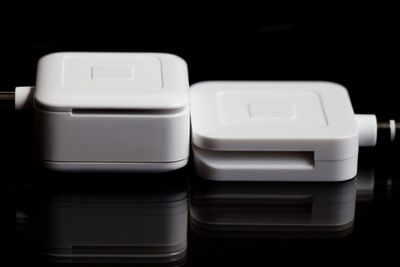
Square today unveiled a newly redesigned Square Reader, which is approximately 45 percent thinner than the previous version and more accurate at reading credit and debit cards thanks to a new slightly wider but tapered design.
As noted by Wired, Square's new ultra thin card reader was developed under the direction of Jesse Dorogusker, who was Apple's Director of Engineering for iPhone, iPod, and iPad Accessories up until 2011, when he left to become Square's VP of Hardware.
Before leaving Apple, Dorogusker headed the development of Apple's Lightning connector, the two-way plug that replaced the 30-pin connector in Apple products beginning with the iPhone 5.
To develop the thinner card reader for Square, Dorogusker was forced to move away from stock components and develop proprietary hardware such as a new custom read head that is able to read two bands of data from the magnetic stripes on credit cards, resulting in greater swipe accuracy.
Dorogusker and his team concentrated on improving the "feel" of swiping, incorporating additional tension in a spring that attaches to the read head for a more satisfying credit card swiping experience. They also developed a custom chip, allowing the team to shrink the Reader's size while improving its performance.
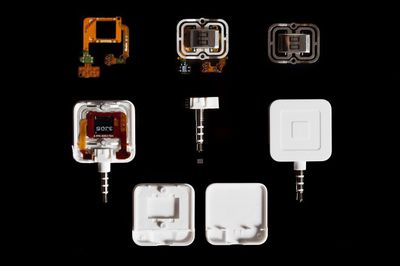
In terms of the design of the internals, though, the chip offered another fantastic advantage: an opportunity to ditch the Reader's battery. The old version relied on a coin cell, which added around two millimeters to the overall thickness of the device. With their own chip, though, Square was able to be much more efficient in their use of power, to the point that they could draw all they needed from the smartphone via the audio jack. As a result, the new Reader dropped the battery and two millimeters along with it. "For the nerds on the team, that is crazy awesome," Dorogusker says.
It shows how a smart approach to a single component can yield all sorts of advantages. "It cascades through," Dorogusker says. "Designing our own electronics got us better performance, got rid of the battery and got rid of our biggest field issue all in one go."
Wired has a full rundown on the design process behind the new Square Reader, which is well worth reading.
The new Square Reader can be purchased from retail stores beginning next year, but it is immediately available for free from the Square website. The accompanying Square Register app can be downloaded from the App Store for free. [Direct Link]
















Top Rated Comments
In the U.S. the banks who issue credit cards can deduct 1/2 their credit card theft amounts from their tax payments and then the other half is passed along directly to the consumer in increased costs (and secondarily through the government and the tax break) - this way the U.S. banks don't have to worry about trying to prevent credit card theft because the costs associated with it don't affect their bottom line - as a result credit card theft in the U.S. has exploded and we just keep doing the same thing. There is some talk of chip cards coming in the U.S. years down the line - but its just the chip part of the card not the PIN part, so it won't provide any more security than the current magnetic strip and possibly less if the chip can be read at a distance (this way U.S. banks don't do the pin part which provides the additional security and would demand a slightly more expensive card and reader). This enhances shareholder value for U.S. banks and is much more advanced than the European way of doing things (chip and pin, which reduced theft at the store level by a large amount after it was implemented long ago).
Its much like mobile network infrastructure in Europe vs. the U.S., and again here the U.S. shows its foresight and looks out in the best interests of its citizens. In most of Europe, each country just has one mobile network that all carriers share the cost of and then they must compete on price and service. Here in the U.S. we decided to have each carrier build its complete own mobile network infrastructure (for many given areas this results in 3 or 4 complete duplicate mobile infrastructures for the same area that had to be built and payed for with costs passed on to the consumer). This results in much higher costs for U.S. consumers (than if we just had one network where costs were shared) as we have to pay for each independent infrastructure through our bills (and is why U.S. mobile costs are so much higher than most of Europe) and cannot easily move to another provider as the networks (phones) are often locked and not compatible and exemplifies the foresight and intelligence with which the U.S. does nearly all its business related planning (often called "The Special Interests doctrine").
Oh, did I mention much of this is a result of the superior way the U.S. lets its businesses pay for politician's election campaigns and as a result they often literally write the legislation that regulates them - this is often known as "The Fox guarding the Hen House doctrine" and is practiced with great enthusiasm by both parties, some call it ugly names like official corruption, but multinational companies love it. U.S. president's often appoint former lobbyists for a particular industry to regulate that same industry, obviously because of their superior knowledge of that same industry sector - the banking industry for the last 20 years is a great example that shows how well that works and the new head of the FCC who regulates media/cable and in particular ensures that the network neutrality law is protected, was a former lobbyist for the media and cable companies (probably looking forward to returning to that industry after his stint serving the general citizenry as a government official) and was just quoted as saying he thought it'd be great for companies to have to pay to get good performance on a cable companies internet line to the consumer after the consumer just paid to get access to the internet on that same line - collecting revenue from the consumer as well as the company on the internet to get to the consumer is known as the "Double Billing doctrine" and enhances shareholder value as well).
These examples show the obvious advantages of the U.S. way of doing things (and there are so many others, the U.S. Medical Industry is another great one - a $7 inhaler in Europe is over $300 here in the U.S. because the U.S. govt gave that company a new patent since they changed the type of propellent used in the inhaler which is non-reactionary and doesn't affect the medicine's interaction with the patient - talk about enhancing shareholder value and watching out for the general citizen).
Chip and Pin isn't a panacea but its much better security than what we have in the U.S., but there isn't a chance we'll see it here because it costs a little more and banks here are insulated from the costs of credit card fraud...this is the superior U.S. way of doing things... ;)
Why don't you focus some effort on your horrendous e-commerce? It's severely lacking and has cost my lots of money. How? First, you can't do partial refunds on orders. It's either all or none. Second, the e-commerce orders EXPIRE. What? Yes, so if you are out of stock on something or run into an issue, the order will expire and automatically refund the customer even while you are trying to complete the order. I was looking for a way to do a partial refund and finally decided to send the customer a check. We were then able to ship the product, but the stupid order expired AFTER the shipment was made which meant we GAVE the user money AND sent him a product for FREE. Now we are trying to beg the customer to pay for what we shipped.
Seriously people, don't use square for e-commerce. It's terrible.
The UK is light years ahead of the US in this regard. I remember a few years ago my old boss had to special order a card with a chip in it for his trip to the UK. I've started seeing some terminals that have wireless icons on them (I guess this is for the RFID) but I've never seen someone use it.