Intel today previewed the next generation of Thunderbolt, which would enable ultra-fast data transfer speeds and improved external display support on future Macs that incorporate the standard when it launches in 2023 or later.
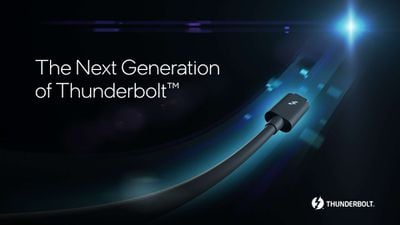
The next generation of Thunderbolt will deliver up to 80 Gbps of bandwidth in each direction, allowing for up to 2× faster data transfer speeds between future Macs and external storage drives that support the standard compared to current speeds. The next generation of Thunderbolt will also have a mode that allows for up to 120 Gbps bandwidth for external displays, which would allow a Mac to support up to dual 8K displays at 60Hz.
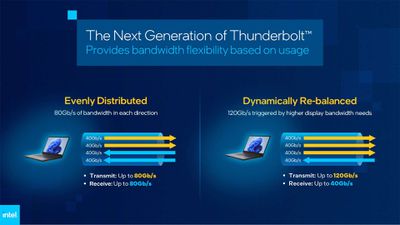
The latest 14-inch and 16-inch MacBook Pro models are equipped with Thunderbolt 4/USB4 ports with up to 40 Gbps of bandwidth in each direction.
Currently, no Macs support 8K displays on a plug-and-play basis. The latest 14-inch and 16-inch MacBook Pro models support up to two or three external displays at up to 6K@60Hz depending on whether the laptop is configured with the M1 Pro or M1 Max chip.
The next generation of Thunderbolt is based on the newly released USB4 version 2.0 and DisplayPort 2.1 specifications, and it is backwards compatible with previous versions of Thunderbolt, USB, and DisplayPort. Intel plans to share more details about the next generation of Thunderbolt's official name, features, and capabilities in 2023.
Sunday February 1, 2026 10:08 am PST by Joe Rossignol
Last year, Apple launched CarPlay Ultra, the long-awaited next-generation version of its CarPlay software system for vehicles. Nearly nine months later, CarPlay Ultra is still limited to Aston Martin's latest luxury vehicles, but that should change fairly soon.
In May 2025, Apple said many other vehicle brands planned to offer CarPlay Ultra, including Hyundai, Kia, and Genesis.
In his Powe...
Thursday January 29, 2026 10:07 am PST by Joe Rossignol
Apple today confirmed to Reuters that it has acquired Q.ai, an Israeli startup that is working on artificial intelligence technology for audio.
Apple paid close to $2 billion for Q.ai, according to sources cited by the Financial Times. That would make this Apple's second-biggest acquisition ever, after it paid $3 billion for the popular headphone and audio brand Beats in 2014.
Q.ai has...
Sunday February 1, 2026 12:31 pm PST by Joe Rossignol
The calendar has turned to February, and a new report indicates that Apple's next product launch is "imminent," in the form of new MacBook Pro models.
"All signs point to an imminent launch of next-generation MacBook Pros that retain the current form factor but deliver faster chips," Bloomberg's Mark Gurman said on Sunday. "I'm told the new models — code-named J714 and J716 — are slated...
Saturday January 31, 2026 10:51 am PST by Joe Rossignol
Apple recently updated its online store with a new ordering process for Macs, including the MacBook Air, MacBook Pro, iMac, Mac mini, Mac Studio, and Mac Pro.
There used to be a handful of standard configurations available for each Mac, but now you must configure a Mac entirely from scratch on a feature-by-feature basis. In other words, ordering a new Mac now works much like ordering an...
Sunday February 1, 2026 5:42 am PST by Joe Rossignol
Apple is planning to launch new MacBook Pro models with M5 Pro and M5 Max chips alongside macOS 26.3, according to Bloomberg's Mark Gurman.
"Apple's faster MacBook Pros are planned for the macOS 26.3 release cycle," wrote Gurman, in his Power On newsletter today.
"I'm told the new models — code-named J714 and J716 — are slated for the macOS 26.3 software cycle, which runs from...
If im in the Apple Store and I move the pointer on a Mac Studio with Pro Display XDR and compare it to moving the pointer on a M1 MacBook Pro, the XDR feels like the pointer is underwater- slow and sluggish. Same for all 4k screens I try and exacerbated if MacOS is performing scaling. Now we're cueing up 8k.
Wonder if that will ever be worked out? "Supporting" a screen is one thing, but I still have to pass if it feels sluggish. Is it just me?
An M1 MacBook Pro has a 120Hz display, while the Pro Display XDR is 60Hz. Could that make the difference?