EU Mobile Operators Want Apple's iCloud Private Relay Service to Be Outlawed Over Concerns of 'Digital Sovereignty'

Major EU mobile operators are reportedly looking for Apple's iCloud Private Relay service to be outlawed because it allegedly infringes upon EU "digital sovereignty," according to a report from The Telegraph.
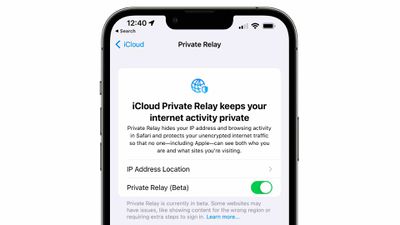
icloud private relay ios 15
‌iCloud‌ Private Relay was a feature announced with iOS 15 that encrypts data so that neither Apple nor a third-party can see users' browsing activity in Safari. With ‌iCloud‌ Private Rely enabled, a user's internet requests are sent through two separate internet relays, with the first relay being operated by Apple.

The second relay, operated by a third-party company, means no-one, including Apple, can see what website a user visits. More information on how ‌iCloud‌ Private Relay works can be found on Apple's website.

In August 2021, less than two months after ‌‌iCloud‌‌ Private Relay was announced, Vodafone, Telefonica, Orange, and T-Mobile sent a joint letter to the European Commission regarding their concerns over the service. As per the report:

Mobile operators have become locked in a power struggle with Apple after urging regulators to outlaw the iPhone maker's encryption technology over claims it will undermine "digital sovereignty." Some of Europe's biggest mobile operators want the European Commission to stop Apple using "private relay" on the grounds that it will also prevent them from managing their networks.

In the letter seen by The Telegraph, the operators said that while ‌iCloud‌ Private Relay "purports to enhance users' privacy when connecting to and browsing the internet by encrypting and redirecting traffic," it also cuts off "networks and servers from accessing vital network data and metadata, including those operators in charge of the connectivity."

The letter claimed that ‌iCloud‌ Private Relay will have "significant consequences in terms of undermining European digital sovereignty."

In the letter, the operators also called upon the European Commission to label Apple as a "digital gatekeeper" under the EU Digital Markets Act. According to the report, such a label "has the potential to stop services such as Private Relay."

Outside the EU, some network operators in the UK are also concerned. In its own letter, TalkTalk claimed that ‌iCloud‌ Private Relay would "make it more difficult to block dangerous content." In a statement to The Telegraph, TalkTalk said it is "assessing how to respond to this shift and maintain our commitments to keeping our customers safe."

‌iCloud‌ Private Relay is currently available in beta form for users on iOS 15, iPadOS 15, and macOS Monterey, and it's still unclear when Apple plans to bring it out of beta. According to The Telegraph, the European Commission has not responded to the letter from the EU's largest mobile operators. We've reached out to Apple to comment on the concerns raised in the letter.

Note: Due to the political or social nature of the discussion regarding this topic, the discussion thread is located in our Political News forum. All forum members and site visitors are welcome to read and follow the thread, but posting is limited to forum members with at least 100 posts.
Popular Stories

Aston Martin CarPlay Ultra Screen

Apple's CarPlay Ultra to Expand to These Vehicle Brands Later This Year

Sunday February 1, 2026 10:08 am PST by
Last year, Apple launched CarPlay Ultra, the long-awaited next-generation version of its CarPlay software system for vehicles. Nearly nine months later, CarPlay Ultra is still limited to Aston Martin's latest luxury vehicles, but that should change fairly soon. In May 2025, Apple said many other vehicle brands planned to offer CarPlay Ultra, including Hyundai, Kia, and Genesis. In his Powe...
iOS 26

iOS 26.3 and iOS 26.4 Will Add These New Features to Your iPhone

Tuesday February 3, 2026 7:47 am PST by
We are still waiting for the iOS 26.3 Release Candidate to come out, so the first iOS 26.4 beta is likely still at least a week or two away. Following beta testing, iOS 26.4 will likely be released to the general public in March or April. Below, we have recapped known or rumored iOS 26.3 and iOS 26.4 features so far. iOS 26.3 iPhone to Android Transfer Tool iOS 26.3 makes it easier...
Apple Logo Black

Apple's Next Launch is 'Imminent'

Sunday February 1, 2026 12:31 pm PST by
The calendar has turned to February, and a new report indicates that Apple's next product launch is "imminent," in the form of new MacBook Pro models. "All signs point to an imminent launch of next-generation MacBook Pros that retain the current form factor but deliver faster chips," Bloomberg's Mark Gurman said on Sunday. "I'm told the new models — code-named J714 and J716 — are slated...
Apple MacBook Pro M4 hero

New MacBook Pros Reportedly Launching Alongside macOS 26.3

Sunday February 1, 2026 5:42 am PST by
Apple is planning to launch new MacBook Pro models with M5 Pro and M5 Max chips alongside macOS 26.3, according to Bloomberg's Mark Gurman. "Apple's faster MacBook Pros are planned for the macOS 26.3 release cycle," wrote Gurman, in his Power On newsletter today. "I'm told the new models — code-named J714 and J716 — are slated for the macOS 26.3 software cycle, which runs from...
iOS 26 Home Feature

Apple Gives Final Warning to Home App Users

Tuesday February 3, 2026 8:55 am PST by
In 2022, Apple introduced a new Apple Home architecture that is "more reliable and efficient," and the deadline to upgrade and avoid issues is fast approaching. In an email this week, Apple gave customers a final reminder to upgrade their Home app by February 10, 2026. Apple says users who do not upgrade may experience issues with accessories and automations, or lose access to their smart...

Top Rated Comments

thewhitehart Avatar
53 months ago
All the carriers are against it because it impedes them from collecting data on their users. Surprise.
Score: 136 Votes (Like | Disagree)
Saturnine Avatar
53 months ago
I could ramble for days about a person’s right to privacy and how wrong I think potential regulation would be.

The biggest issue I see here is that outlawing Private Relay could be viewed as a precedent against encryption in general. If the network operators are unhappy about having no visibility about the types or destinations of traffic traversing their networks, how is that different from a user opting to use a VPN service? A user opting to use iCloud Private Relay is no different to using, for example, NordVPN. The effects are the same even if the underlying technologies differ.

This is not about network operators “wanting to keep their customers safe.” This is all about money and control.
Score: 79 Votes (Like | Disagree)
revanmj Avatar
53 months ago
I wonder if they will want to outlaw VPNs too?

Let's be honest, they do it simply because Apple can entice many average users to enable it, thus hiding their browsing history from those companies. Those that find VPNs and/or encrypted DNSes on their own are minority and thus not a threat like this.
Score: 51 Votes (Like | Disagree)
a m u n Avatar
53 months ago
More likely, they intend to scrape and sell all DNS records, site access, and metadata to third-party agencies for $$$.
Score: 35 Votes (Like | Disagree)
827538 Avatar
53 months ago

Without being open source or having some sort of auditability or blockchain implementation, Apple’s stances on privacy are not very meaningful. You’re still centralizing your trust. And the average user has no idea what is possible with software….
Did you even read the article?

Also blockchain? Are you serious? You obviously have no idea how blockchain works if you think it relates in anyway to privacy.
Score: 28 Votes (Like | Disagree)
BulkSlash Avatar
53 months ago

Haven't tried this yet. Can someone explain how it works in detail. Is it for hiding your porn history?
It's basically like a simplified version of Tor. You type Macrumors.com into Safari and iOS will encrypt that request into a package and then wrap that encrypted package inside another one which is sent to Apple. Apple then decrypt the outer package and forward the inner package along to the "third party" (I'm not sure who they are). The third party then decrypts the request and actually performs the fetch of the website data.

Then the same process basically happens in reverse with the data sent back to the user being double encrypted and then decoded when it reaches the user's iOS device. So the third party theoretically can't discern who requested the website, Apple can't see any of it, and the user's privacy is retained.
Score: 25 Votes (Like | Disagree)