Apple Wins Patent for iPhone Display With Variable Refresh Rates Up to 240Hz

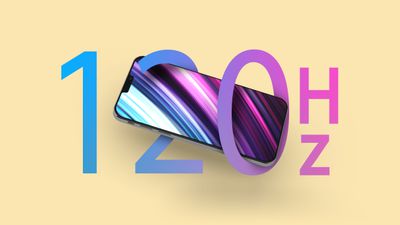
A new Apple patent published today by the U.S. Patent and Trademark Office describes an iPhone display that, with high refresh mode enabled, may be capable of updating content at two times, three times, or even four times the native refresh rate, as reported by Patently Apple. For example, an ‌iPhone‌ with a 60Hz display would be able to increase its variable refresh rate to 120Hz, 180Hz, or 240Hz automatically.
iphone 12 120hz thumbnail feature
For those unfamiliar, refresh rate refers to how many times a display refreshes every second. (The higher the refresh rate, the smoother the content on the display will be.) All current iPhones have a refresh rate of 60Hz, but since 2017, all iPad Pro models have featured ProMotion technology, enabling a variable refresh rate of up to 120Hz.

Rumors of 120Hz coming to the ‌iPhone‌ 12 proved to be untrue, but there is renewed confidence that ProMotion will make an appearance on the ‌iPhone‌ 13. During the rumor cycle last year, some claimed that the ‌iPhone‌ 12 would automatically switch between 60Hz and 120Hz depending on what the user was doing on their device in an effort to preserve battery life. While the ability for a device to switch between 60Hz and 120Hz is not new, the patent describing the ability for an ‌iPhone‌ to push the refresh rate to as high as 180Hz or 240Hz is.

The lack of a 120Hz refresh rate on the ‌iPhone‌ so far could be linked to the fact that Apple tends to treads carefully when adding features such as ProMotion that could be detrimental to battery life or systemwide performance. Rumors suggest that Apple will overcome this power consumption dilemma by adopting low-power LTPO display technology for iPhone 13 models, allowing for 120Hz without a significant impact on battery life.

A higher refresh rate could be beneficial for several use cases, such as gaming and augmented reality. If a user is simply watching a movie or messaging a friend, the display could switch back to its 60Hz native refresh rate as a means to save battery life.

This week, new rumors claimed that alongside a 120Hz refresh rate, the ‌iPhone‌ 13 lineup will also have an always-on-display. Always-on displays allow users to see certain information, such as the time, date, or battery life, at all times. All high-end iPhones since the ‌iPhone‌ X have featured OLED displays, meaning each pixel is individually controlled, allowing the device to only light up the pixels needed to show users limited information, preserving battery life.

Related Forum: iPhone

Popular Stories

Aston Martin CarPlay Ultra Screen

Apple's CarPlay Ultra to Expand to These Vehicle Brands Later This Year

Sunday February 1, 2026 10:08 am PST by
Last year, Apple launched CarPlay Ultra, the long-awaited next-generation version of its CarPlay software system for vehicles. Nearly nine months later, CarPlay Ultra is still limited to Aston Martin's latest luxury vehicles, but that should change fairly soon. In May 2025, Apple said many other vehicle brands planned to offer CarPlay Ultra, including Hyundai, Kia, and Genesis. In his Powe...
Apple Logo Black

Apple's Next Launch is 'Imminent'

Sunday February 1, 2026 12:31 pm PST by
The calendar has turned to February, and a new report indicates that Apple's next product launch is "imminent," in the form of new MacBook Pro models. "All signs point to an imminent launch of next-generation MacBook Pros that retain the current form factor but deliver faster chips," Bloomberg's Mark Gurman said on Sunday. "I'm told the new models — code-named J714 and J716 — are slated...
Apple MacBook Pro M4 hero

New MacBook Pros Reportedly Launching Alongside macOS 26.3

Sunday February 1, 2026 5:42 am PST by
Apple is planning to launch new MacBook Pro models with M5 Pro and M5 Max chips alongside macOS 26.3, according to Bloomberg's Mark Gurman. "Apple's faster MacBook Pros are planned for the macOS 26.3 release cycle," wrote Gurman, in his Power On newsletter today. "I'm told the new models — code-named J714 and J716 — are slated for the macOS 26.3 software cycle, which runs from...
iOS 26

iOS 26.3 and iOS 26.4 Will Add These New Features to Your iPhone

Tuesday February 3, 2026 7:47 am PST by
We are still waiting for the iOS 26.3 Release Candidate to come out, so the first iOS 26.4 beta is likely still at least a week or two away. Following beta testing, iOS 26.4 will likely be released to the general public in March or April. Below, we have recapped known or rumored iOS 26.3 and iOS 26.4 features so far. iOS 26.3 iPhone to Android Transfer Tool iOS 26.3 makes it easier...
14 inch MacBook Pro Keyboard

Apple Changes How You Order a Mac

Saturday January 31, 2026 10:51 am PST by
Apple recently updated its online store with a new ordering process for Macs, including the MacBook Air, MacBook Pro, iMac, Mac mini, Mac Studio, and Mac Pro. There used to be a handful of standard configurations available for each Mac, but now you must configure a Mac entirely from scratch on a feature-by-feature basis. In other words, ordering a new Mac now works much like ordering an...

Top Rated Comments

bobenhaus Avatar
65 months ago

I'd argue 120hz was a 2020 move, but there were only a handful of phones that launched in 2020 with 144hz. 240hz would be a big jump.

My guess is this would function similar to Auto 5G - switching to 240hz only when it really needed it (to conserve battery), and switching back to 120hz or 60hz even if not needed. Maybe even lower than 60hz if they implement an AOD.
My Samsung phone currently runes at 120hz and it is notable if I change it back down the 60hz. Smooth as butter
Score: 9 Votes (Like | Disagree)
cmaier Avatar
65 months ago
The patent really is not focussed on “240Hz.” The claims are more general than that. 240Hz is just one example (there are a couple dependent claims that refer to 120Hz and 240Hz, just because those are obviously natural choices given the ”2x” limitation):

1. A display comprising: a plurality of display pixels arranged in rows and columns; display driver circuitry configured to provide image data to the columns of display pixels; and gate driver circuitry configured to provide control signals to the rows of display pixels, wherein the gate driver circuitry includes a shift register that is operable in a native refresh rate mode at a first refresh rate and a high refresh rate mode at a second refresh rate that is twice the first refresh rate, wherein in the native refresh rate mode the shift register sequentially provides control signals to each row of all the display pixels, and wherein in the high refresh rate mode the shift register sequentially provides control signals to each pair of adjacent rows of all the display pixels.

So the headline of the original post is wrong. No “up to 240Hz.” No limit at all, in fact.
Score: 7 Votes (Like | Disagree)
Dwalls90 Avatar
65 months ago

So 2020
I'd argue 120hz was a 2020 move, but there were only a handful of phones that launched in 2020 with 144hz. 240hz would be a big jump.

My guess is this would function similar to Auto 5G - switching to 240hz only when it really needed it (to conserve battery), and switching back to 120hz or 60hz even if not needed. Maybe even lower than 60hz if they implement an AOD.
Score: 6 Votes (Like | Disagree)
Anson_431 Avatar
65 months ago
In a sense, I do like how Apple either doesn't do it, or do it and go full bonkers and overkill when they decided to go for it ?
(And yes, I know. It's just a patent at this point?)
Score: 5 Votes (Like | Disagree)
bobenhaus Avatar
65 months ago

tell us about the battery difference between the two
My battery can last 2 days with moderate to heavy use.
Score: 5 Votes (Like | Disagree)
cmaier Avatar
65 months ago

Battery life this battery life that. I still want to know why Apple is so obsessed with making a phone thin that they ignore the 99% of the world who would rather it be a little thicker with better features and battery life.
If that was the case, those people would buy phones that were designed that way. Maybe Apple has a firmer grasp on what 99% of the world wants than you do?
Score: 3 Votes (Like | Disagree)