Apple University Dean Shares Deep Dive Into Apple's Organizational Structure - MacRumorsOpen MenuShow RoundupsShow Forums menuVisit ForumsOpen Sidebar
Skip to Content

Apple University Dean Shares Deep Dive Into Apple's Organizational Structure

Apple University dean and vice president Joel Podolny today wrote an in-depth article on Apple's organizational structure for Harvard Business Review.
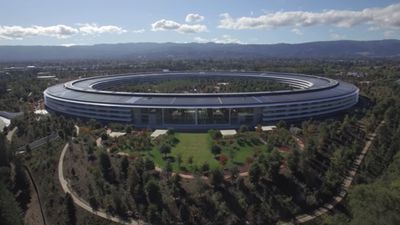
appleparknovember
Titled "How Apple is Organized for Innovation," Podolny's piece delves deep into Apple's structure and how that has helped it grow over the years. Starting back when Jobs took over the company when he returned to Apple 1997, Podolny explains how Jobs fired the managers of each individual business unit and converted Apple into "one functional organization," a setup that Apple continues to have to this day.

As was the case with Jobs before him, CEO Tim Cook occupies the only position on the organizational chart where the design, engineering, operations, marketing, and retail of any of Apple's main products meet. In effect, besides the CEO, the company operates with no conventional general managers: people who control an entire process from product development through sales and are judged according to a P&L statement.

Apple's structure dictates that the people who have the most expertise and experience in a given domain should have the decision rights for that domain, with the company relying on technical experts rather than managers to make key decisions.
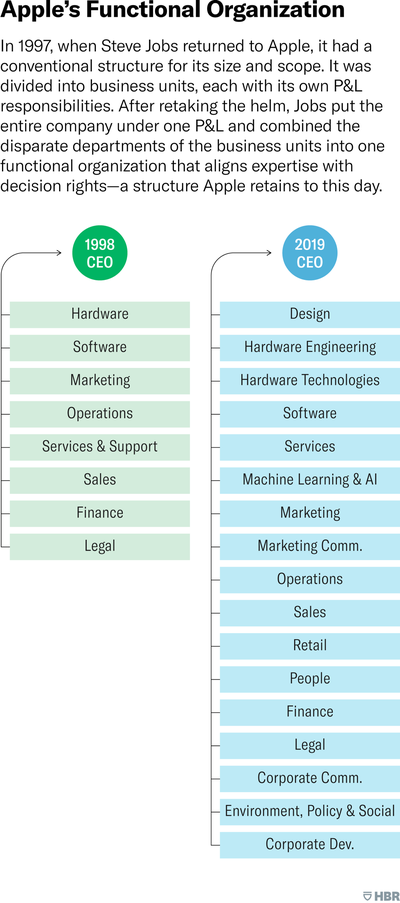
applefunctionalorganization
Apple's financial structure, where executive bonuses are based on companywide financial success rather than departmental success, also allows for more freedom when it comes to product decisions because there's not specific financial pressure on a single release. "The finance team is not involved in the product road map meetings of engineering teams, and engineering teams are not involved in pricing decisions," writes Podolny.

All of Apple's managers, from senior vice president and down, are expected to have deep expertise in their area, immersion in detail of the work being done under their leadership, and willingness to collaborate and make collective decisions. "Leaders should know the details of their organization three levels down," is one of Apple's principles.

As Apple has grown, Apple CEO Tim Cook has needed to make adjustments to the structure as Apple enters into new markets and technologies.

The adjustments Tim Cook has implemented in recent years include dividing the hardware function into hardware engineering and hardware technologies; adding artificial intelligence and machine learning as a functional area; and moving human interface out of software to merge it with industrial design, creating an integrated design function.

Podolny's full piece goes into much more detail on how Apple's internal structure works, complete with many examples of Apple's successes. It can be read in full at Harvard Business Review.


Popular Stories

iPhone 18 Pro Deep Red Feature

iPhone 18 Pro Launching Later This Year With These 12 New Features

Wednesday March 18, 2026 7:39 am PDT by
While the iPhone 18 Pro and iPhone 18 Pro Max are not expected to launch for another six months or so, there are already plenty of rumors about the devices. It was initially reported that the iPhone 18 Pro models would have fully under-screen Face ID, with only a front camera visible in the top-left corner of the screen. However, the latest rumors indicate that only one Face ID component...
ios 26 4 yellow

Here Are Apple's Release Notes for iOS 26.4

Wednesday March 18, 2026 11:56 am PDT by
Apple provided developers and public beta testers with the release candidate versions of iOS 26.4 and iPadOS 26.4, which means we're going to see a public launch as soon as next week. The RC versions of the software include Apple's official release notes, giving us final details on what's included in the update. Apple Music - Playlist Playground (beta) generates a playlist from your...
Apple Logo Sketch Feature

Apple Has Now Unveiled Eight New Products This Month

Tuesday March 17, 2026 9:25 am PDT by
Apple has unveiled a whopping eight new products so far this March, including an iPhone 17e, iPad Air models with the M4 chip, MacBook Air models with the M5 chip, MacBook Pro models with M5 Pro and M5 Max chips, the all-new MacBook Neo, an updated Studio Display, a higher-end Studio Display XDR, and now the AirPods Max 2 this week. iPhone 17e features the same overall design as the iPhone...

Top Rated Comments

az431 Avatar
71 months ago

Them writing an HBR article about innovation is the best indicator they stopped innovating.
Yeah that makes zero sense.
Score: 13 Votes (Like | Disagree)
71 months ago

Sounds great in theory, but in reality, do people really think executives aren't going to direct their attention to financially under-performing units?

If one unit is under-performing, another has to make up for the deficiency in order to maintain company-wide financial targets. Everyone ends up looking at the bottom line.

HomePod not selling well? Let's increase the mark up of iPhone accessories in response.
But there isn’t a HomePod division, that’s the point. The success of the HomePod is spread over most of those divisions, Sales, Marketing, Design, Software, Hardware Engineering etc
Score: 8 Votes (Like | Disagree)
Apple Freak Avatar
71 months ago

Never heard of Apple University
I'd love to attend but you have to be an employee first.


What's baffling is that some people want to work for that company
I'd DIE to work for Apple someday!
Score: 7 Votes (Like | Disagree)
Dekema2 Avatar
71 months ago
Never heard of Apple University
Score: 6 Votes (Like | Disagree)
TheYayAreaLiving 🎗️ Avatar
71 months ago
This will be taught in Grad College in the Business World. Case study time.
Score: 6 Votes (Like | Disagree)
JPack Avatar
71 months ago

Apple's financial structure, where executive bonuses are based on companywide financial success rather than departmental success, also allows for more freedom when it comes to product decisions because there's not specific financial pressure on a single release. "The finance team is not involved in the product road map meetings of engineering teams, and engineering teams are not involved in pricing decisions," writes Podolny.
Sounds great in theory, but in reality, do people really think executives aren't going to direct their attention to financially under-performing units?

If one unit is under-performing, another has to make up for the deficiency in order to maintain company-wide financial targets. Everyone ends up looking at the bottom line.

HomePod not selling well? Let's increase the mark up of iPhone accessories in response.
Score: 5 Votes (Like | Disagree)
Related Apple News: Opinion | Culture | Reviews | Business | South Africa