Apple Watch Likely to Adopt MicroLED Display Technology in 3-4 Years

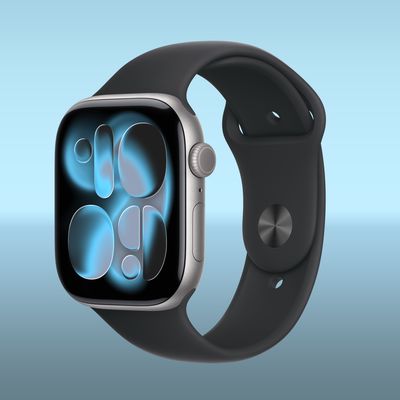
This year's Apple Watch Series 6 is expected to feature an OLED screen like previous models, but a future model is likely to be the first Apple product to adopt MicroLED display technology, albeit not for another three to four years.
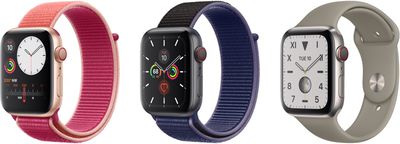
applewatch5lineup
That's the main takeaway reading between the lines of comments made by the chairman of Epistar, Taiwan's top LED producer, which is reportedly working on a factory to manufacture MicroLED displays specifically for future Apple products.

From a DigiTimes' report filed on Monday:

Smartwatches will be the first major applications for micro LED with volume adoption likely to take place 3-4 years from now, according to Epistar chairman Lee Biing-jye.

Epistar has overcome many micro LED technological difficulties, such as mass transfer, and expects to achieve reliable production capability in 2-3 years, and introduce end-market applications in 3-4 years, Lee noted.

Apple is reportedly investing $330 million in the Taiwanese MicroLED factory to manufacture displays for future iPhones, iPads, MacBooks, and other devices. MicroLEDs sized 20-50 microns are too small for PCB substrates that support minimum sizes of 50-100 microns, and therefore glass substrates are used.

Taiwanese LCD panel maker AU Optronics is understood to be supplying the glass substrates for the displays, while Epistar is said to be now focusing on improving yield rates for micro LED epitaxy and reducing cost for mass transfer.

There are several advantages of MicroLED screens over LCD and OLED displays, including being thinner and more energy efficient. For example, the power consumption of MicroLED screens is only one-tenth that of LCD displays, and the color saturation is close to OLED.
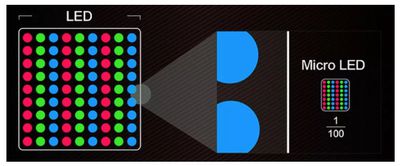
microled
In addition, MicroLED can support a higher brightness, higher dynamic range, and wider color gamut, while also achieving a faster update rate, wider viewing angle, and lower power consumption.

Owing to the difficulties involved in developing MicroLED technology, early designs are expected to rely on mini-LEDs that are somewhere in between traditional LED and MicroLED technology. However, Apple still considers MicroLED technology to be the "top priority," according to a previous report.

Apple has six mini-LED products in the works that are set to debut in 2020 and 2021, according to analyst Ming-Chi Kuo. Apple is said to be debuting the technology in a 12.9-inch ‌iPad Pro‌ for launch later this year, followed by a 27-inch iMac Pro, a 14.1-inch MacBook Pro, a 16-inch ‌‌‌‌MacBook Pro‌‌‌‌, a 10.2.-inch iPad, and a 7.9-inch ‌‌‌‌iPad‌‌‌‌ mini.

Apple has reportedly been testing prototype ‌‌Apple Watch‌‌ models with MicroLED displays since 2017. While early rumors suggested an ‌‌Apple Watch‌‌ with a microLED display could launch as early as 2020, one leaker poured cold water on that prediction in May by claiming that this year's ‌Apple Watch‌ Series 6 will use the same OLED display as previous models.

There is precedent for new screen technologies showing up in the ‌Apple Watch‌ first. When it was introduced in 2014, the ‌Apple Watch‌ had an OLED screen. The technology then migrated to the ‌iPhone‌ X three years later.
Related Roundup: Apple Watch 11
Buyer's Guide: Apple Watch (Neutral)

Popular Stories

Aston Martin CarPlay Ultra Screen

Apple's CarPlay Ultra to Expand to These Vehicle Brands Later This Year

Sunday February 1, 2026 10:08 am PST by
Last year, Apple launched CarPlay Ultra, the long-awaited next-generation version of its CarPlay software system for vehicles. Nearly nine months later, CarPlay Ultra is still limited to Aston Martin's latest luxury vehicles, but that should change fairly soon. In May 2025, Apple said many other vehicle brands planned to offer CarPlay Ultra, including Hyundai, Kia, and Genesis. In his Powe...
Apple Logo Black

Apple's Next Launch is 'Imminent'

Sunday February 1, 2026 12:31 pm PST by
The calendar has turned to February, and a new report indicates that Apple's next product launch is "imminent," in the form of new MacBook Pro models. "All signs point to an imminent launch of next-generation MacBook Pros that retain the current form factor but deliver faster chips," Bloomberg's Mark Gurman said on Sunday. "I'm told the new models — code-named J714 and J716 — are slated...
Apple MacBook Pro M4 hero

New MacBook Pros Reportedly Launching Alongside macOS 26.3

Sunday February 1, 2026 5:42 am PST by
Apple is planning to launch new MacBook Pro models with M5 Pro and M5 Max chips alongside macOS 26.3, according to Bloomberg's Mark Gurman. "Apple's faster MacBook Pros are planned for the macOS 26.3 release cycle," wrote Gurman, in his Power On newsletter today. "I'm told the new models — code-named J714 and J716 — are slated for the macOS 26.3 software cycle, which runs from...
iOS 26

iOS 26.3 and iOS 26.4 Will Add These New Features to Your iPhone

Tuesday February 3, 2026 7:47 am PST by
We are still waiting for the iOS 26.3 Release Candidate to come out, so the first iOS 26.4 beta is likely still at least a week or two away. Following beta testing, iOS 26.4 will likely be released to the general public in March or April. Below, we have recapped known or rumored iOS 26.3 and iOS 26.4 features so far. iOS 26.3 iPhone to Android Transfer Tool iOS 26.3 makes it easier...
14 inch MacBook Pro Keyboard

Apple Changes How You Order a Mac

Saturday January 31, 2026 10:51 am PST by
Apple recently updated its online store with a new ordering process for Macs, including the MacBook Air, MacBook Pro, iMac, Mac mini, Mac Studio, and Mac Pro. There used to be a handful of standard configurations available for each Mac, but now you must configure a Mac entirely from scratch on a feature-by-feature basis. In other words, ordering a new Mac now works much like ordering an...

Top Rated Comments

RamGuy Avatar
72 months ago
For example, the power consumption of MicroLED screens is only one-tenth that of LCD displays, and the color saturation is close to OLED.
This seems rather pointless to bring up? One-tenth when compared to LCD displays? But how is it when compared to OLED? The Apple Watch has been using OLED all along, OLED is where it's currently at. Why compare it with LCD? And the colour saturation is close to OLED. In other word it's almost as good, but not quite? How is this any improvement?

In addition, MicroLED can support a higher brightness, higher dynamic range, and wider color gamut, while also achieving a faster update rate, wider viewing angle, and lower power consumption.

Compared to what? Still comparing to LCD?
Score: 8 Votes (Like | Disagree)
SharkeyStormcrow Avatar
72 months ago
Still struggling to find a reason to upgrade from my Series 4
Score: 7 Votes (Like | Disagree)
Nozuka Avatar
72 months ago
That's what they said 3-4 years ago.... :(
Score: 6 Votes (Like | Disagree)
rowanmmcdonald Avatar
72 months ago
Didn’t we hear this exact rumour like 3-4 years ago?
Score: 4 Votes (Like | Disagree)
arvinsim Avatar
72 months ago
I just want the Apple Watch to have at least a week of battery life like some other smartwatches.
Score: 4 Votes (Like | Disagree)
fokmik Avatar
72 months ago
microLED the best from LCD and OLED but not one draw back..perfect blacks, high brightness etc etc, no burn image, no backlight bleed ,no blue pixels fading etc
But again, microLED will come first on the bigger displays this time, because shrinking the microLED pixels is way too hard...thats why we started to see big TV with microLED...because the pixels are 1:1
Score: 3 Votes (Like | Disagree)