Sprint today at Mobile World Congress announced that its commercial 5G network will launch in May, starting in Chicago, Atlanta, Dallas, and Kansas City. The carrier plans to expand service to Houston, Los Angeles, New York City, Phoenix, and Washington D.C. in the first half of 2019.
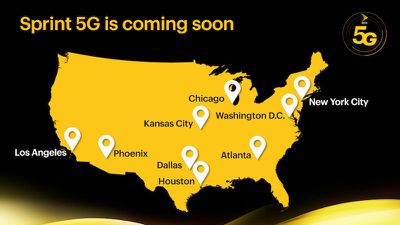
5G coverage will initially be limited to select areas of each city:
At launch, Sprint's highly mobile, on-the-go customers can expect mobile 5G coverage ranging from nearly 30 square miles covering Midtown and lower Manhattan, to approximately 230 square miles spanning the greater Dallas Fort Worth area, for a total initial 5G coverage footprint of more than 1,000 square miles across all nine cities.
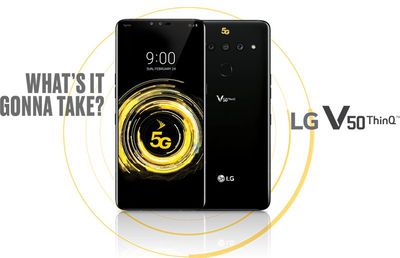
Sprint said its first 5G smartphone will be the new dual-screen LG V50 ThinQ 5G unveiled at Mobile World Congress this week, followed by the HTC 5G Hub hotspot in the spring and the Samsung Galaxy S10 5G in the summer.
Sprint also announced that it will offer 5G service to Google Fi customers with a compatible device, but there is no timeframe for the rollout.
Sprint's network will operate on the 2.5GHz spectrum and use Massive MIMO radio equipment supplied by Samsung, rather than use millimeter wave technology. Sprint chief technology officer John Saw said the carrier saw speeds of 430 Mbps in one demo, according to The Verge, significantly faster than LTE.
Tuesday February 3, 2026 7:47 am PST by Joe Rossignol
We are still waiting for the iOS 26.3 Release Candidate to come out, so the first iOS 26.4 beta is likely still at least a week or two away. Following beta testing, iOS 26.4 will likely be released to the general public in March or April.
Below, we have recapped known or rumored iOS 26.3 and iOS 26.4 features so far.
iOS 26.3
iPhone to Android Transfer Tool
iOS 26.3 makes it easier...
Sunday February 1, 2026 10:08 am PST by Joe Rossignol
Last year, Apple launched CarPlay Ultra, the long-awaited next-generation version of its CarPlay software system for vehicles. Nearly nine months later, CarPlay Ultra is still limited to Aston Martin's latest luxury vehicles, but that should change fairly soon.
In May 2025, Apple said many other vehicle brands planned to offer CarPlay Ultra, including Hyundai, Kia, and Genesis.
In his Powe...
Sunday February 1, 2026 12:31 pm PST by Joe Rossignol
The calendar has turned to February, and a new report indicates that Apple's next product launch is "imminent," in the form of new MacBook Pro models.
"All signs point to an imminent launch of next-generation MacBook Pros that retain the current form factor but deliver faster chips," Bloomberg's Mark Gurman said on Sunday. "I'm told the new models — code-named J714 and J716 — are slated...
Sunday February 1, 2026 5:42 am PST by Joe Rossignol
Apple is planning to launch new MacBook Pro models with M5 Pro and M5 Max chips alongside macOS 26.3, according to Bloomberg's Mark Gurman.
"Apple's faster MacBook Pros are planned for the macOS 26.3 release cycle," wrote Gurman, in his Power On newsletter today.
"I'm told the new models — code-named J714 and J716 — are slated for the macOS 26.3 software cycle, which runs from...
Tuesday February 3, 2026 8:55 am PST by Joe Rossignol
In 2022, Apple introduced a new Apple Home architecture that is "more reliable and efficient," and the deadline to upgrade and avoid issues is fast approaching.
In an email this week, Apple gave customers a final reminder to upgrade their Home app by February 10, 2026. Apple says users who do not upgrade may experience issues with accessories and automations, or lose access to their smart...
with 5G having a more limited range than LTE and a good LTE signal is already faster than most home internet/cable/DSL wired internet connections, I can't see the average cell phone user being able to utilize or notice any of the supposed faster speeds of 5G when most stuff that requires a lot of bandwidth gets throttled by the carriers anyway (unless you purchase their most expensive plan).
My guess is 5G will be nothing but a marketing blitz for 99% of the end users on cell phones because they won't be able to tell the difference except when running an artificial speed test