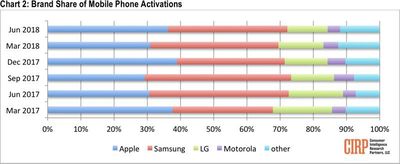
During the second quarter of 2018, spanning from April to June, Apple's iPhones accounted for 36 percent of total U.S. smartphone activations, an improvement over last year's numbers where iPhone activations accounted for just over 30 percent of total activations, according to new numbers shared today by Consumer Intelligence Research Partners [PDF].

More customers are choosing iPhone over Samsung devices this year, and Apple's higher number of activations came at Samsung's expense. During the quarter, Samsung devices were also responsible for 36 percent of new activations, but for Samsung, that's a solid decline from last year.
applesamsungactivations

"Apple improved in part at Samsung's expense, whose share of activations declined relative to both last quarter and last year," said Mike Levin, Partner and Co-Founder of CIRP. "In a quarter without any significant phone launches, Samsung had market share only equal to Apple's. A year ago, Samsung had a considerably greater share of sales."

Apple devices and Samsung devices are the dominant brands, due to ongoing consolidation of the U.S. market. LG and Motorola, for example, have lost ground to Apple and Samsung over the course of the last year.

When it comes to operating systems, iOS and Android are, by far, the dominant operating systems in use. iOS accounted for 36 percent of activations during the quarter, while Android, which runs on an array of different smartphones from multiple manufacturers, accounted for 63 percent of U.S. activations.
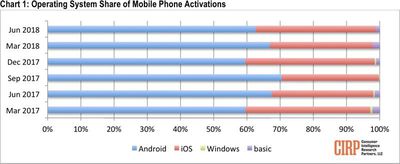
iosandroidmobileactivations
Compared to last year, iOS's share of activations grew, with CIRP citing increased customer loyalty to their operating system of choice. Given the sheer number of Android devices compared to iOS devices, it's not surprising Android devices are responsible for approximately two thirds of activations.

Consumer Intelligence Research Partners regularly shares these surveys to monitor the state of the smartphone market. Findings are based on a survey of 500 subjects who activated new or used phones during the April to June 2018 period.
Top Rated Comments

KPandian1 Avatar
99 months ago
The colors are reversed in the second graph - had me stumped for a bit.
Score: 6 Votes (Like | Disagree)
fairuz Avatar
99 months ago
Wow, that’s really rough for Samsung who literally JUST released the s9. No surprises though since it was practically the same phone as the s8. Also a lot of other Android phones like the pixel 2 are quickly becoming more attrative options than anything Samsung is putting out these days. It seems that gimmicks aren’t selling as well as they once were
Funny thing is the Samsung phone upgrades are more important than the iPhone ones because you get stuck on an old, vulnerable Android version pretty quickly if you don't get a new phone.
Score: 3 Votes (Like | Disagree)
acorntoy Avatar
99 months ago
Only 500 people were interviewed? That’s a ridiculously small sample size for something they then try to translate to millions.
Score: 2 Votes (Like | Disagree)
Jakewilk Avatar
99 months ago
Wow, that’s really rough for Samsung who literally JUST released the s9. No surprises though since it was practically the same phone as the s8. Also a lot of other Android phones like the pixel 2 are quickly becoming more attrative options than anything Samsung is putting out these days. It seems that gimmicks aren’t selling as well as they once were
Score: 1 Votes (Like | Disagree)
69Mustang Avatar
99 months ago
First of all chill out, this was not meant to be an argument. Second of all the title of the article is literally “Apple Increases share of of US Smartphone Activations in Q2”. Also the data table you’re referring to is mislabeled, as stated by an above commenter. Samsung and Apple should be switched, or else it would be saying that the s9 launch was stronger than the s8 launch, which is definitely not true by any means
It's a discussion. One which you may discontinue at any time. No one is forcing you to reply. No one claimed the data is mislabeled. Please go back and read what KPandian1 actually stated. He said the colors are reversed in the second graph - making it a confusing read. I hope you realize that switching the Apple and Samsung data would mean Samsung had more December quarter activations than Apple. December. In the US. Apple's largest quarter every year. That would be darn near impossible.
Score: 1 Votes (Like | Disagree)
69Mustang Avatar
99 months ago
Wow, that’s really rough for Samsung who literally JUST released the s9. No surprises though since it was practically the same phone as the s8. Also a lot of other Android phones like the pixel 2 are quickly becoming more attrative options than anything Samsung is putting out these days. It seems that gimmicks aren’t selling as well as they once were
Hmmm. Did Sammy really just release the S9 or did it go a little more like this:
Samsung had 42% activations in the Mar QTR - the quarter where they released the S9. Apple had 31% during that QTR. The next QTR when they had nothing new, Sammy lost 6% share of activations while Apple gained 5%. What that tells me is Apple has more stable sales year round. I think both companies know that. Probably why Apple typically has a single Fall intro and Samsung has a Spring and a Fall intro approx 6 mths apart to keep sales from ebbing and flowing too much.

Google's Pixels are akin to Microsoft's Surfaces. High brand awareness, low actual sales. Neither has ever been out of the "Other" categories. Neither probably will be either... at least for a long time. I personally like both brands, but that doesn't change the fact that they are more brand than sales.

tl;dr Samsung and Apple lead. Sammy didn't have it as rough as you seem to think.
Score: 1 Votes (Like | Disagree)

Popular Stories

Aston Martin CarPlay Ultra Screen

Apple's CarPlay Ultra to Expand to These Vehicle Brands Later This Year

Sunday February 1, 2026 10:08 am PST by
Last year, Apple launched CarPlay Ultra, the long-awaited next-generation version of its CarPlay software system for vehicles. Nearly nine months later, CarPlay Ultra is still limited to Aston Martin's latest luxury vehicles, but that should change fairly soon. In May 2025, Apple said many other vehicle brands planned to offer CarPlay Ultra, including Hyundai, Kia, and Genesis. In his Powe...
Apple Logo Black

Apple's Next Launch is 'Imminent'

Sunday February 1, 2026 12:31 pm PST by
The calendar has turned to February, and a new report indicates that Apple's next product launch is "imminent," in the form of new MacBook Pro models. "All signs point to an imminent launch of next-generation MacBook Pros that retain the current form factor but deliver faster chips," Bloomberg's Mark Gurman said on Sunday. "I'm told the new models — code-named J714 and J716 — are slated...
Apple MacBook Pro M4 hero

New MacBook Pros Reportedly Launching Alongside macOS 26.3

Sunday February 1, 2026 5:42 am PST by
Apple is planning to launch new MacBook Pro models with M5 Pro and M5 Max chips alongside macOS 26.3, according to Bloomberg's Mark Gurman. "Apple's faster MacBook Pros are planned for the macOS 26.3 release cycle," wrote Gurman, in his Power On newsletter today. "I'm told the new models — code-named J714 and J716 — are slated for the macOS 26.3 software cycle, which runs from...
iOS 26

iOS 26.3 and iOS 26.4 Will Add These New Features to Your iPhone

Tuesday February 3, 2026 7:47 am PST by
We are still waiting for the iOS 26.3 Release Candidate to come out, so the first iOS 26.4 beta is likely still at least a week or two away. Following beta testing, iOS 26.4 will likely be released to the general public in March or April. Below, we have recapped known or rumored iOS 26.3 and iOS 26.4 features so far. iOS 26.3 iPhone to Android Transfer Tool iOS 26.3 makes it easier...
14 inch MacBook Pro Keyboard

Apple Changes How You Order a Mac

Saturday January 31, 2026 10:51 am PST by
Apple recently updated its online store with a new ordering process for Macs, including the MacBook Air, MacBook Pro, iMac, Mac mini, Mac Studio, and Mac Pro. There used to be a handful of standard configurations available for each Mac, but now you must configure a Mac entirely from scratch on a feature-by-feature basis. In other words, ordering a new Mac now works much like ordering an...