Apple Music Attracting New Streaming Subscribers to Aid in Music Industry's 'Fragile Recovery'

The music industry is facing a "fragile recovery" at the hands of popular streaming services like Apple Music and Spotify, according to new data collected by the Recording Industry Association of America (via Bloomberg). In total, the music industry in the United States is on track to grow for the second year in a row, which would mark "the first back-to-back growth since 1998-1999."

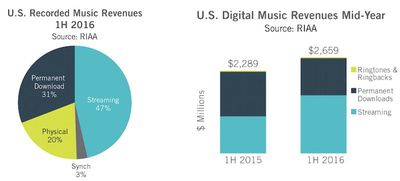
RIAA's data showed that streaming revenue in the U.S. grew 57 percent in the first half of 2016, reaching $1.6 billion, and accounted for almost half of industry sales, while subscriptions totaled $1.01 billion. Altogether, the industry grew 8.1 percent to $3.4 billion in the first half of 2016, which is on track to best the $7 billion yearly average of the last six years.
music-streaming-stats
Apple Music and Spotify remain the biggest forces in the streaming market, and a few label executives noted that "most of the users for Apple Music are people new to paying music, not former Spotify customers." At the last recorded subscriber count, Spotify had 40 million paid subscribers worldwide, while Apple music had 17 million.

Nor is this the first time new technology has come along to get people to pay online. Apple Inc. co-founder Steve Jobs convinced record labels that iTunes would save the industry from piracy, only to vaporize album sales by selling singles instead.

Yet Apple is no longer the only player in the market for digital music. Spotify operates a larger paid subscription service and has showed no signs of slowing down since Apple Music began competing in that market. Most of the users for Apple Music are people new to paying music, not former Spotify customers, according to label executives.

Understandably, retail spending on physical media isn't accounting for any of the overall industry growth. Physical music sales dropped 14 percent in RIAA's data of the first half of 2016, while paid downloads -- like those offered in the traditional iTunes store -- "also shrank by a double digit percentage." Free streaming grew 24 percent in the same data, to $195 million, but "those services aren’t doing enough to convince people to pay for music," nor are they making enough money off free users to continue staying afloat.

That could potentially be why popular free music platforms, like Pandora, are gearing up to introduce new paid listening tiers for users. Amazon is planning to do the same, and both services are predicted to match Apple Music's $9.99 per month cost, while offering similar on-demand singles, albums, radio, and playlists for listeners.
Popular Stories

iOS 26

iOS 26.3 and iOS 26.4 Will Add These New Features to Your iPhone

Tuesday February 3, 2026 7:47 am PST by
We are still waiting for the iOS 26.3 Release Candidate to come out, so the first iOS 26.4 beta is likely still at least a week or two away. Following beta testing, iOS 26.4 will likely be released to the general public in March or April. Below, we have recapped known or rumored iOS 26.3 and iOS 26.4 features so far. iOS 26.3 iPhone to Android Transfer Tool iOS 26.3 makes it easier...
Aston Martin CarPlay Ultra Screen

Apple's CarPlay Ultra to Expand to These Vehicle Brands Later This Year

Sunday February 1, 2026 10:08 am PST by
Last year, Apple launched CarPlay Ultra, the long-awaited next-generation version of its CarPlay software system for vehicles. Nearly nine months later, CarPlay Ultra is still limited to Aston Martin's latest luxury vehicles, but that should change fairly soon. In May 2025, Apple said many other vehicle brands planned to offer CarPlay Ultra, including Hyundai, Kia, and Genesis. In his Powe...
Apple Logo Black

Apple's Next Launch is 'Imminent'

Sunday February 1, 2026 12:31 pm PST by
The calendar has turned to February, and a new report indicates that Apple's next product launch is "imminent," in the form of new MacBook Pro models. "All signs point to an imminent launch of next-generation MacBook Pros that retain the current form factor but deliver faster chips," Bloomberg's Mark Gurman said on Sunday. "I'm told the new models — code-named J714 and J716 — are slated...
Apple MacBook Pro M4 hero

New MacBook Pros Reportedly Launching Alongside macOS 26.3

Sunday February 1, 2026 5:42 am PST by
Apple is planning to launch new MacBook Pro models with M5 Pro and M5 Max chips alongside macOS 26.3, according to Bloomberg's Mark Gurman. "Apple's faster MacBook Pros are planned for the macOS 26.3 release cycle," wrote Gurman, in his Power On newsletter today. "I'm told the new models — code-named J714 and J716 — are slated for the macOS 26.3 software cycle, which runs from...
iOS 26 Home Feature

Apple Gives Final Warning to Home App Users

Tuesday February 3, 2026 8:55 am PST by
In 2022, Apple introduced a new Apple Home architecture that is "more reliable and efficient," and the deadline to upgrade and avoid issues is fast approaching. In an email this week, Apple gave customers a final reminder to upgrade their Home app by February 10, 2026. Apple says users who do not upgrade may experience issues with accessories and automations, or lose access to their smart...

Top Rated Comments

ghostface147 Avatar
122 months ago
I just wish the movie industry would follow suit. All movie access for a fee. $25 a month for all movies, anytime.
Score: 11 Votes (Like | Disagree)
melgross Avatar
122 months ago
Of course, both Pandora and Spotify are losing a lot of money each year. Considering the financial situation of their costs, which don't go down the more subscribers they get, they will just be losing even more money.

I've been saying for some time now, that in the long run, the only companies that will survive in the retail music market are Apple, Amazon, Google and possibly Facebook, if they're interested, and also, possibly, Microsoft.

There has never been a successful music streaming company since the very beginning back around the year 2000. The only way it works is if there's a parent company that absorbs the costs out of other profit centers, because it believes that it benefits those other profit centers in their own sales and profits.

So those companies I mentioned can easily afford the several hundred million a year in losses both Pandora and Spotify are suffering. But neither Pandora nor Spotify can, in the long run.
Score: 4 Votes (Like | Disagree)
smacrumon Avatar
122 months ago
The Courage to Aid the Music Industry's 'Fragile Recovery'. Give me a break.

A dollar for every thousand streaming plays. What a disgrace.

The best way to support music is to get out and go see your favorite artists play.
Score: 4 Votes (Like | Disagree)
bpeeps Avatar
122 months ago
most of the users for Apple Music are people new to paying music, not former Spotify customers
I know AM gets a lot of crap for UI, but I'm sure they've converted a lot of people to paying customers through ease of use and ubiquity. Never thought I'd see the day where I paid for music, but here we are.
[doublepost=1474388786][/doublepost]
Between Amazon Prime Music and free services like di.fm, I am all set with my music needs for time being and do not anticipate to spend even a penny on music in the near future.
Ah yes, Amazon Prime where most of the music I want to listen to is unavailable or only a 10 second sample can be played.
Score: 4 Votes (Like | Disagree)
2457282 Avatar
122 months ago
The idea that iTunes is moving away from standard purchases has been refuted before. In fact, aside from the added Apple Music layer, iTunes has not changed much at all.
Well from where I stand, the fact they they moved the stations behind the paywall making it difficult for me to discover music, is an important change. The fact that just about anything I want to do pops up some message about 3 month free trial is an important and annoying change. And since there is no itunes on the phone, just music which is totally biased towards streaming, I would say that is an important change. Other than that, sure, it hasn't changed at all.
Score: 3 Votes (Like | Disagree)
marty1980 Avatar
122 months ago
While many people are happy about streaming media, I remain cautious about where everything is headed.

To start is bandwidth of the interwebs. Streaming eats a lot of bandwidth that is still a limited resource in most of the world. The more people stream, the more constraints we put on the network. You can argue it forces growth, but it also causes headaches for transition.

This data comes at a premium through most ISPs/Carriers. Data caps make sure that you can only stream as much as they want you to. The more you want to stream the more you have to pay.

Ownership of content is at risk. While anyone born after 1995 is probably comfortable with all their documents, data, music, photos, movies and whatnots "in the cloud" many of us older folk understand why ownership of your content matters. Streaming gives you temporary access to content that is not owned by you. Whenever you don't pay for the streaming service, you immediately lose the music you listen to. It guarantees that customers will always be back for another month because otherwise they have to find some other means to listen. If the industry were to move completely to streaming, nobody would be able to listen to their music without a subscription being paid to a company who has rights to stream.

For a long time, my data cap on my cellular made streaming a non-option. But that cap has significantly increased by itself over time and now I can stream for a time during each billing period without worrying about crazy overage fees. Now that I can though, I don't want to. I buy my music because I believe a purchased album means more to the artist than streaming only their most popular songs. Plus the sound quality of a CD (uncompressed audio file) can't be beat with streaming (yet). Plus there's something to get signed at a concert.

Streaming music is also now introducing "exclusive" music. It used to be anybody could by an "exclsuive" album from Goodies (or Target or Walmart or wherever). Now, "exclusive" means only subscribers of the exclusive provider are allowed to listen. That's a huge difference in who has access to new music.

I know I'm a minority of people who don't like the path streaming music has taken. This is the way the industry is moving and due to all the **** pirates out there, we aren't going back because this keeps the industry alive; the point of he article. I dread the day I start feeling the need to add $10/15 month bills to my plate because it becomes the only way to access new music.
Score: 2 Votes (Like | Disagree)