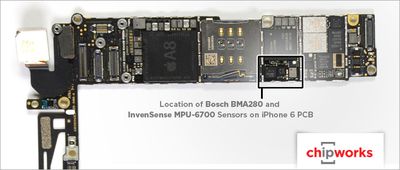
Apple has opted to equip the iPhone 6 and 6 Plus with two separate accelerometers, as discovered in Chipworks' comprehensive iPhone 6 and 6 Plus teardown. There's a three-axis Bosch BMA280 accelerometer and what Chipworks believes is a MPU-6700 six-axis accelerometer from InvenSense.
According to Chipworks, Apple may have decided to incorporate two accelerometers into the iPhone 6 and 6 Plus to both minimize power consumption and "improve the overall user experience."
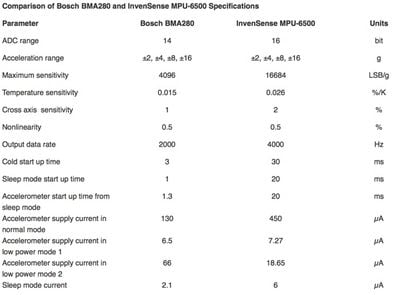
The InvenSense accelerometer has a range of functions, allowing it to operate in several different modes, but it can draw more power than the Bosch accelerometer due to its higher sensitivity. The maximum sensitivity of the InvenSense is at 16684 LSB/g, much higher than the Bosch's 4096.
The InvenSense device can operate as a six axis inertial sensor, or as either a three-axis gyroscope or a three-axis accelerometer. It is rated to consume 3.4 mA in the six-axis mode, 3.2 mA in the gyroscope mode and 450 µA in the accelerometer normal mode. By contrast, the Bosch device operates as a 3-axis accelerometer only and it consumes 130 µA of current in the accelerometer normal mode. Both devices offer two low power levels of operation for the accelerometer function. The InvenSense device actually consumes less current in its lowest power mode, with a 1 Hz update rate.
The main benefit of the InvenSense is full six-axis integration of the data by the on-chip digital motion processor (DMP). This will provide a direct benefit for gaming and other applications that need sophisticated inertial sensing capabilities. In addition the InvenSense provides significantly higher sensitivity than the Bosch device. The price however, is higher power consumption.
The Bosch accelerometer is able to operate at a lower power than the InvenSense and it has a "much faster" cold start up time, at 3ms compared to 30ms, allowing it to be used when complete six-axis integration is unnecessary. Chipworks speculates that it may be used for tasks where higher sensitivity is unneeded, perhaps for rotating the screen from landscape to portrait mode or for pedometer functionality.
According to Chipworks, the inclusion of two accelerometers in the iPhone 6 and 6 Plus is an example of Apple's "elegant engineering." A single InvenSense accelerometer would have enabled the device to work perfectly well, but the addition of the Bosch accelerometer allows for lower power consumption in the appropriate situations.

Friday December 12, 2025 10:56 am PST by Joe Rossignol
Macworld's Filipe Espósito today revealed a handful of features that Apple is allegedly planning for iOS 26.4, iOS 27, and even iOS 28.
The report said the features are referenced within the code for a leaked internal build of iOS 26 that is not meant to be seen by the public. However, it appears that Espósito and/or his sources managed to gain access to it, providing us with a sneak peek...
Monday December 15, 2025 2:05 pm PST by Juli Clover
Last week, details about unreleased Apple devices and future iOS features were shared by Macworld. This week, we learned where the information came from, plus we have more findings from the leak.
As it turns out, an Apple prototype device running an early build of iOS 26 was sold, and the person who bought it shared the software. The OS has a version number of 23A5234w, and the first...
Monday December 15, 2025 3:05 pm PST by Juli Clover
Software from an iPhone prototype running an early build of iOS 26 leaked last week, giving us a glimpse at future Apple devices and iOS features. We recapped device codenames in our prior article, and now we have a list of some of the most notable feature flags that were found in the software code.
In some cases, it's obvious what the feature flags are referring to, while some are more...
The first foldable iPhone will feature a series of design and hardware firsts for Apple, according to details shared by the Weibo leaker known as Digital Chat Station.
According to a new post, via machine translation, Apple is developing what the leaker describes as a "wide foldable" device, a term used to refer to a horizontally oriented, book-style foldable with a large internal display....
Monday December 15, 2025 4:23 pm PST by Juli Clover
Apple is testing iOS 26.3, the next version of iOS 26 that will launch around January. Since iOS 26.3's testing is happening over the holidays, it is a smaller update with fewer features than we've seen in prior betas.
We've rounded up what's new so far, and we'll add to our list with subsequent betas if we come across any other features.
Transfer to Android
Apple is making it simpler...
Friday December 12, 2025 10:10 am PST by Juli Clover
Apple today released iOS 26.2, the second major update to the iOS 26 operating system that came out in September, iOS 26.2 comes a little over a month after iOS 26.1 launched. iOS 26.2 is compatible with the iPhone 11 series and later, as well as the second-generation iPhone SE.
The new software can be downloaded on eligible iPhones over-the-air by going to Settings >...
Thursday December 11, 2025 8:49 am PST by Joe Rossignol
Apple seeded the second iOS 26.2 Release Candidate to developers earlier this week, meaning the update will be released to the general public very soon.
Apple confirmed iOS 26.2 would be released in December, but it did not provide a specific date. We expect the update to be released by early next week.
iOS 26.2 includes a handful of new features and changes on the iPhone, such as a new...
Monday December 15, 2025 7:41 am PST by Joe Rossignol
Apple released the AirPods Max on December 15, 2020, meaning the over-ear headphones launched five years ago today. While the AirPods Max were updated with a USB-C port and new color options last year, followed by support for lossless audio and ultra-low latency audio this year, the headphones lack some of the features that have been introduced for newer generations of the regular AirPods and the ...
OK, so I got the obvious, witty Android joke out of the way. Here's the real point:
A lot of people look at these devices being released every year with the sense that all these companies do (LG, Samsung, and others included) is slap the same old components on the inside and change the case or screen size. In reality, they are re-architecting a lot of the technology every year or two. This is not easy to do.
Only when we get tear downs and such do we get the full story of everything going on inside the shell. These guys are doing amazing work to move technology forward. The result is better devices and increased convenience/utility for the user.
The engineers that put this particular solution together aren't going to be recognized or win any awards, but they're doing great things.