New Low-Cost iMac Nearly 50% Slower in Multi-Core, 10% Slower in Single-Core Benchmarks
Following today's launch of a new entry-level iMac model featuring an ultra-low voltage Intel processor actually used in the MacBook Air, the new iMac appears to have shown up in Geekbench's benchmarking database. The use of an ultra-low voltage chip in the iMac is a somewhat curious move for Apple, as the company has traditionally used much more powerful desktop processors in the line.
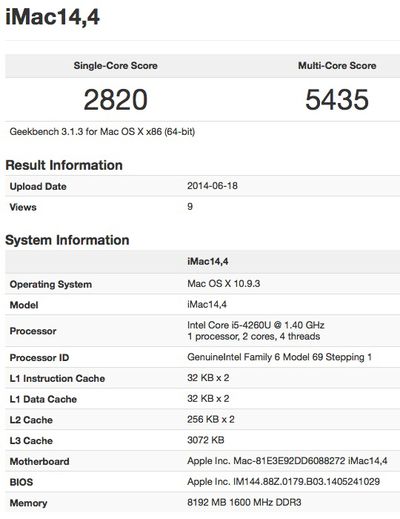
As expected, the new machine posts relatively low 64-bit scores of 2820 in single-core mode and 5435 in multi-core mode. These scores are marginally better than the 2690/5254 scores posted by the current-generation MacBook Air running the same chip and roughly 10% slower than the 3168 single-core score from the previous low-end iMac model, which remains available.
But where this new low-end iMac falls far short of the previous low-end model is in multi-core performance, where the older model clocks in at 10253. This major difference is due primarily to the chip used in the new low-end model being a dual-core chip, while the older low-end chip is quad-core.
The new low-end iMac comes in $200 cheaper than the previous entry-level model, but for that savings users will sacrifice some CPU and graphics performance and will have a 500 GB hard drive rather than the 1 TB drive included in the more expensive low-end model.
Update 12:25 PM: Primate Labs' John Poole has shared a blog post putting the new low-end iMac's performance in perspective compared to other iMac models and highlighting a Tweet from Ars Technica's Andrew Cunningham noting that Apple's decision to use a chip from its MacBook Air line may have been made for graphics reasons.
Update 2: The initial benchmarks for the new low-end iMac were taken in 64-bit mode, while the data was compared to 32-bit results from other machines. This article has been updated to compare 64-bit scores across all machines.
Popular Stories
We are still waiting for the iOS 26.3 Release Candidate to come out, so the first iOS 26.4 beta is likely still at least a week or two away. Following beta testing, iOS 26.4 will likely be released to the general public in March or April.
Below, we have recapped known or rumored iOS 26.3 and iOS 26.4 features so far.
iOS 26.3
iPhone to Android Transfer Tool
iOS 26.3 makes it easier...
The calendar has turned to February, and a new report indicates that Apple's next product launch is "imminent," in the form of new MacBook Pro models.
"All signs point to an imminent launch of next-generation MacBook Pros that retain the current form factor but deliver faster chips," Bloomberg's Mark Gurman said on Sunday. "I'm told the new models — code-named J714 and J716 — are slated...
In 2022, Apple introduced a new Apple Home architecture that is "more reliable and efficient," and the deadline to upgrade and avoid issues is fast approaching.
In an email this week, Apple gave customers a final reminder to upgrade their Home app by February 10, 2026. Apple says users who do not upgrade may experience issues with accessories and automations, or lose access to their smart...
Last year, Apple launched CarPlay Ultra, the long-awaited next-generation version of its CarPlay software system for vehicles. Nearly nine months later, CarPlay Ultra is still limited to Aston Martin's latest luxury vehicles, but that should change fairly soon.
In May 2025, Apple said many other vehicle brands planned to offer CarPlay Ultra, including Hyundai, Kia, and Genesis.
In his Powe...
Apple's first foldable iPhone will feature relocated volume buttons, an all-black camera plateau, a smaller Dynamic Island, and more, according to design leaks from a known Weibo leaker.
The user known as "Instant Digital" today claimed to share several key details about the design of the foldable iPhone:
The volume buttons will be located on the top edge of the device, aligned to the...