Inside Apple's A7 Chip, M7 Motion Coprocessor, and More from the iPhone 5s

At its media event introducing the new iPhones earlier this month, Apple highlighted several chip innovations included on the iPhone 5s including a new A7 main chip with one billion transistors and a smaller M7 "motion coprocessor" designed to efficiently measure accelerometer, gyroscope, and compass data and thus allow for enhanced fitness tracking, navigation, and more.

Chipworks and iFixit have now posted a teardown revealing what's inside these chips, as well as several other components of the iPhone 5s, offering an interesting first glimpse at these components at the heart of the device.

In looking at the A7, Chipworks noted that it is indeed manufactured by Samsung using its 28-nm process node. Apple has been seeking to shift its A-series chip production from Samsung to TSMC, but TSMC's chip production will reportedly not start until early 2014.
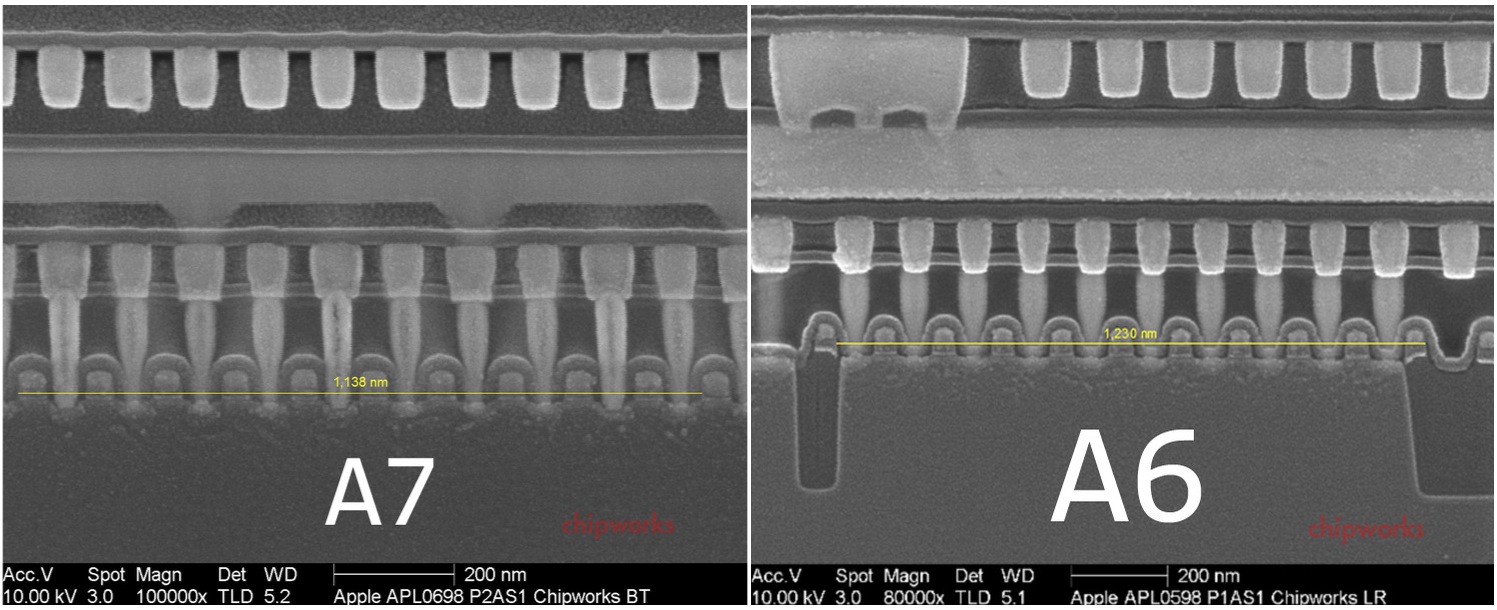
a7_a6_gate_pitch

Gate pitch comparison of A7 and A6 (click for larger)

For the A7, Apple and Samsung have reduced spacing between transistors to 114 nanometers, a 7.3% decrease compared to the A6 chip. That denser transistor packing plus a slightly increased die size has helped Apple to fit approximately one billion transistors on the chip.

It turns out that the A7′s “gate pitch” — the distance between each transistor — is 114 nm, compared to the A6′s 123 nm.

Those 9 nm are a big deal. Looking to improve on their current 32 nm process, Apple decided to make the A7 with the same 28 nm process as the eight-core Samsung Exynos 5410, the current flagship CPU for Samsung’s own Galaxy line.
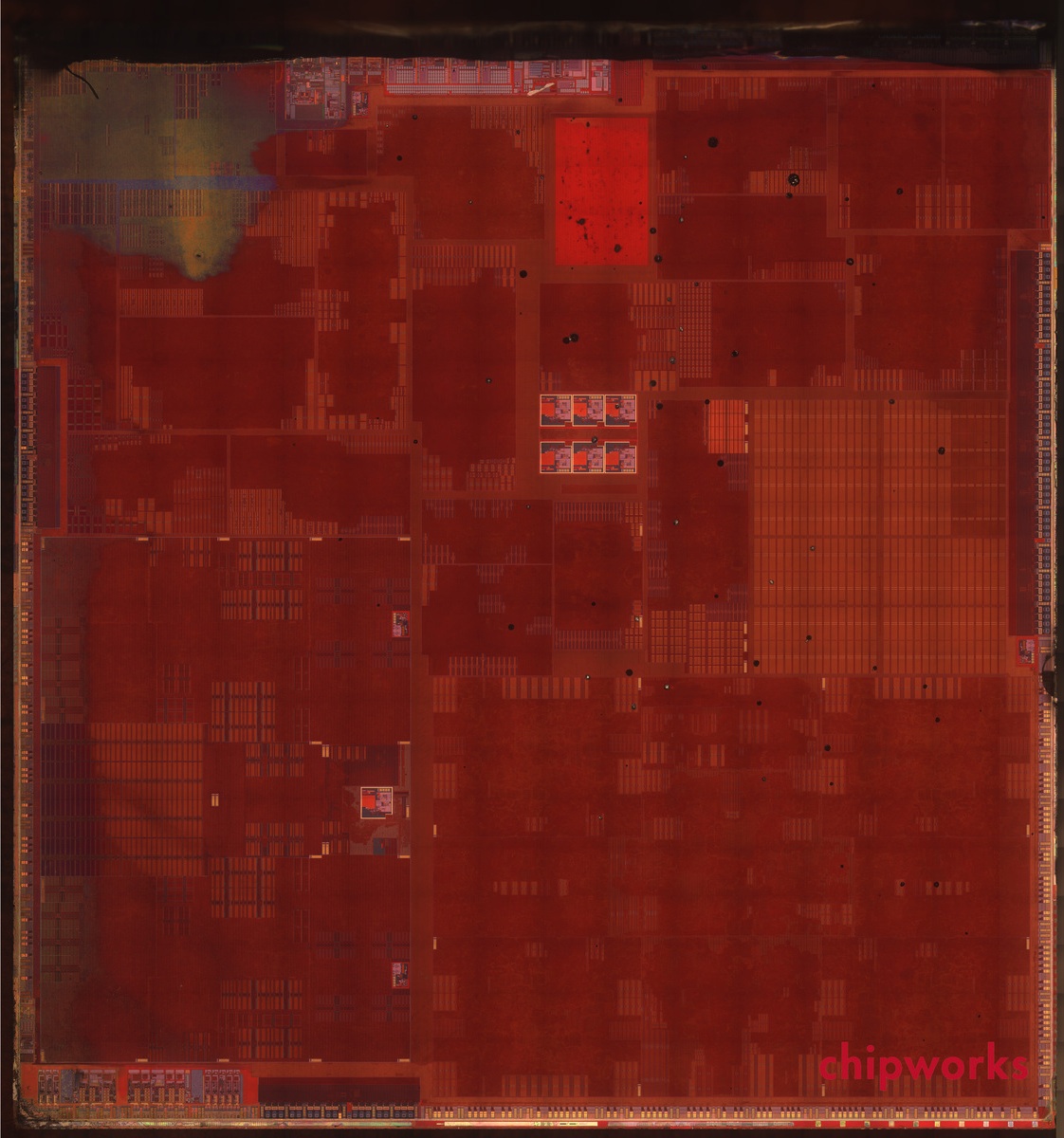
a7_transistor_die

A7 transistor die photo (click for larger)

Chipworks also took a look at the M7, which is actually an ARM Cortex-M3 part from NXP running at 180 MHz. The chip allows for low-power collection of motion data drawn from a Bosch Sensortec accelerometer, an STMicroelectronics gyroscope, and an AKM magnetometer.

After collecting information from the accelerometer, gyroscope, and magnetometer, the M7 performs some matrix math processing magic to produce an absolute orientation of the phone relative to the world. This data is then passed to the A7 in a neat package, probably in the form of three headings (roll, pitch, and yaw).

Using the A7 to monitor this sort of data would be mega-overkill, so the M7 was introduced to maintain a constant, low-power watch over these sensors.
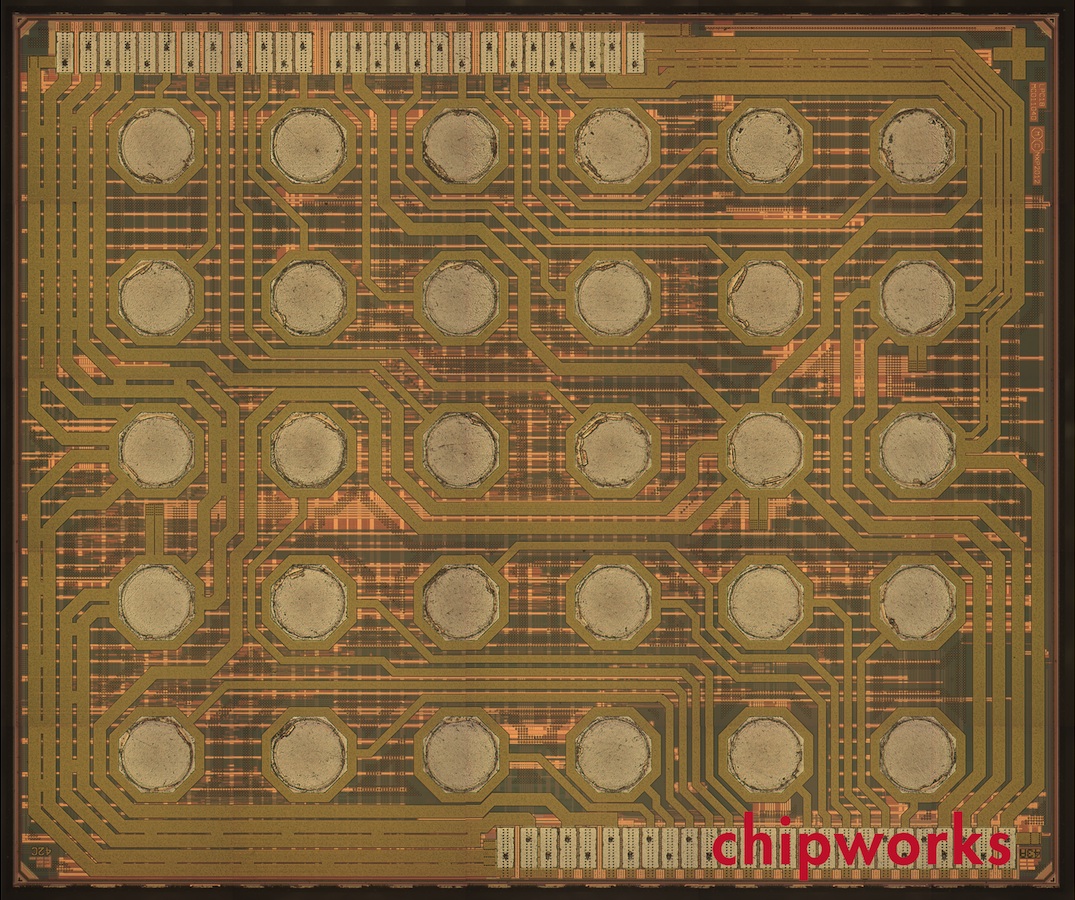
m7_die_photo

M7 die photo (click for larger)

Finally, Chipworks performed some analysis on several other components from the iPhone 5S, including the rear camera sensor and LTE modem, while iFixit pointed to the Wi-Fi module and various radio and power amplifier components that all work together to provide connectivity for the new iPhone.

Related Forum: iPhone

Popular Stories

iOS 26

iOS 26.4 and iOS 27 Features Revealed in New Leak

Friday December 12, 2025 10:56 am PST by
Macworld's Filipe Espósito today revealed a handful of features that Apple is allegedly planning for iOS 26.4, iOS 27, and even iOS 28. The report said the features are referenced within the code for a leaked internal build of iOS 26 that is not meant to be seen by the public. However, it appears that Espósito and/or his sources managed to gain access to it, providing us with a sneak peek...
apple beta 26 lineup

Apple Leak Confirms Work on Foldable iPhone, AirTag 2, and Dozens More Devices

Monday December 15, 2025 2:05 pm PST by
Last week, details about unreleased Apple devices and future iOS features were shared by Macworld. This week, we learned where the information came from, plus we have more findings from the leak. As it turns out, an Apple prototype device running an early build of iOS 26 was sold, and the person who bought it shared the software. The OS has a version number of 23A5234w, and the first...
Apple Logo Top Half

Early iOS 26 Software Leak Uncovers Dozens of Upcoming Apple Features

Monday December 15, 2025 3:05 pm PST by
Software from an iPhone prototype running an early build of iOS 26 leaked last week, giving us a glimpse at future Apple devices and iOS features. We recapped device codenames in our prior article, and now we have a list of some of the most notable feature flags that were found in the software code. In some cases, it's obvious what the feature flags are referring to, while some are more...
Apple Foldable Thumb

Leak Reveals Foldable iPhone Details

Monday December 15, 2025 9:09 am PST by
The first foldable iPhone will feature a series of design and hardware firsts for Apple, according to details shared by the Weibo leaker known as Digital Chat Station. According to a new post, via machine translation, Apple is developing what the leaker describes as a "wide foldable" device, a term used to refer to a horizontally oriented, book-style foldable with a large internal display....
iOS 26

iOS 26.3 Beta 1 Features: What's New So Far

Monday December 15, 2025 4:23 pm PST by
Apple is testing iOS 26.3, the next version of iOS 26 that will launch around January. Since iOS 26.3's testing is happening over the holidays, it is a smaller update with fewer features than we've seen in prior betas. We've rounded up what's new so far, and we'll add to our list with subsequent betas if we come across any other features. Transfer to Android Apple is making it simpler...
iOS 26

Apple Releases iOS 26.2 With Alarms for Reminders, Lock Screen Changes, Enhanced Safety Alerts and More

Friday December 12, 2025 10:10 am PST by
Apple today released iOS 26.2, the second major update to the iOS 26 operating system that came out in September, iOS 26.2 comes a little over a month after iOS 26.1 launched. ‌iOS 26‌.2 is compatible with the ‌iPhone‌ 11 series and later, as well as the second-generation ‌iPhone‌ SE. The new software can be downloaded on eligible iPhones over-the-air by going to Settings >...
iOS 26

iOS 26.2 Coming Soon With These 8 New Features on Your iPhone

Thursday December 11, 2025 8:49 am PST by
Apple seeded the second iOS 26.2 Release Candidate to developers earlier this week, meaning the update will be released to the general public very soon. Apple confirmed iOS 26.2 would be released in December, but it did not provide a specific date. We expect the update to be released by early next week. iOS 26.2 includes a handful of new features and changes on the iPhone, such as a new...
airpods max 2024 colors

AirPods Max 2 Likely to Offer These 10 New Features

Monday December 15, 2025 7:41 am PST by
Apple released the AirPods Max on December 15, 2020, meaning the over-ear headphones launched five years ago today. While the AirPods Max were updated with a USB-C port and new color options last year, followed by support for lossless audio and ultra-low latency audio this year, the headphones lack some of the features that have been introduced for newer generations of the regular AirPods and the ...

Top Rated Comments

sransari Avatar
160 months ago
such gr8 advancements in dental x-ray technology
Score: 11 Votes (Like | Disagree)
JHankwitz Avatar
160 months ago
Chip Technology

This chip technology is mind boggeling and truely amazing. I remember building my first computer (if you can still consider it that) using a few dozen vaccum tubes back in the late '50s. Each of the tubes contained up to 4 electronic switches. That baby was hot... literally. Now this little chips contains a billion switches and just warm to the touch... truely amazing!
Score: 7 Votes (Like | Disagree)
SmoMo Avatar
160 months ago
Integrating

Still haven't figured out what the M7 actually does...

I'm not 100% sure but I would guess it is probably applying a Kalman filter : http://en.wikipedia.org/wiki/Kalman_filter

When you have several overlapping sensor inputs you can combine them in such a way to minimise potential error.

In the case of the iPhone, the Compass heading can be used to calibrate heading and the accelerometer/gyroscope used to integrate minute changes that the compass is not sensitive enough to pickup.

The ultimate goal would be to also integrate GPS coordinates, and have a system accurate enough that it could track your movement ( by integrating accelerations twice ) but as I understand it the accuracy of the sensors is still way too low for this to be feasible.
Score: 5 Votes (Like | Disagree)
firewood Avatar
160 months ago
I wonder if some descendant of the A7 will be able to replace intel inside a future MacBook..

Why wait for a descendant?

I ported some of my extremely compute intensive engineering calculations from my 2009 MacBook Pro to iOS, recompiled for arm64 using the new Xcode, and found that the calculations now benchmark just as fast on an iPhone 5s as on the MacBook Pro (which BTW is a lot faster than was a desktop G5 "supercomputer").

No waiting, equal performance, better battery life, and, very unlike the G5, it fits in my pocket.
Score: 4 Votes (Like | Disagree)
MRSucks Avatar
160 months ago
I disagree. A7/M7/64-bit technology is right here, right now.

The ball is at the hands of the iOS apps developers.

The next six / twelve months will be exciting times for iPhone 5s users.

Next year will just be going thru the motion. Another cycle of pissing contests between the fanboys.
Score: 4 Votes (Like | Disagree)
Paradoxally Avatar
160 months ago
Best way I have heard it explained: The A7 is the chip of tomorrow; not today.

All of the side-by-side comparison tests show no significant real world performance benefit to the A6 in the iPhone 5 (basic OS use, no gaming). By the time the 64-bit architecture catches on and is fully realized by developers, the iPhone 6 will be looming around the corner...

Yes they do. The A7 is noticeably faster in many apps, not just gaming. iOS 7 stutters a bit on the iPhone 5, no stutter on the 5S (in multitasking) - but this is probably due to lack of optimization.
Score: 4 Votes (Like | Disagree)