Qualcomm Supply Issues Providing Further Fuel for Speculation of Fall iPhone Release
Qualcomm yesterday warned analysts that it is experiencing supply issues with some of its advanced mobile phone chips, particularly its new 28-nm modem chips set to power the next wave of LTE devices.
"At this stage we cannot secure enough supply to meet the increasing demand we are experiencing," Chief Executive Paul Jacobs told analysts on a conference call, adding that the issue would limit revenue growth this year. [...]
"Demand went so far ahead of availability that we've decided to start spending more money to get more supply as soon as possible," [Chief Financial Officer Bill Keitel] told Reuters. "Any time we can't make a customer totally happy I'm going to worry. You don't want to give a customer a reason to go elsewhere."
As a result of the issues, analysts believe that vendors may have to slow their rollout of new devices, and a report out today from Piper Jaffray's Gene Munster predicts that the next-generation iPhone will arrive in October.
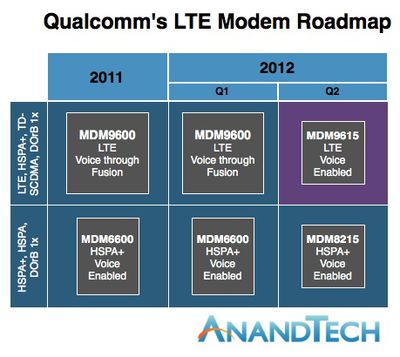
Qualcomm's LTE modem roadmap (Source: AnandTech)Munster had previously been modeling for an August launch as a hedge between those thinking the device may arrive in June and those thinking it will arrive in a September-October timeframe similar to the iPhone 4S. Apple is expected to use Qualcomm's 28-nm MDM9615 modem chip in its next-generation iPhone to provide LTE data and voice services, and the chip appears to be one of those impacted by Qualcomm's supply issues.
QCOM will likely support an Apple iPhone launch in October. Based on our checks, we believe the design win momentum of QCOM's 28nm products has been exceptionally strong and a 28nm LTE baseband is likely designed into the next iPhone. QCOM's supply issue likely pushes the launch of the iPhone to October. Based on the increased capital spending this year from TSMC and QCOM's efforts over the last quarter to port its 28nm designs to UMC and probably Global Foundries, we think QCOM will have the capacity to support a Q4 LTE iPhone 5 launch. Moreover, the slow wireless infrastructure spending in 1H:12 is also likely a result of the lack of availability of a low power 28nm LTE baseband modem.
Apple may have been planning for a September-October iPhone launch all along, but Qualcomm's issues seem to make it less likely that those holding out hope for an earlier launch will see something closer to the June-July timeframe that had been the traditional launch window prior to last year.
Munster believes that it is "irrelevant" whether the iPhone launches in August as his model currently predicts or in October, with the primary driver of success being whether the upgrade is a compelling one for consumers. And with the next-generation iPhone expected to offer LTE support and carry a redesigned form factor, it seems likely that it will be an attractive device for both new and upgrade customers.
Popular Stories
Macworld's Filipe Espósito today revealed a handful of features that Apple is allegedly planning for iOS 26.4, iOS 27, and even iOS 28.
The report said the features are referenced within the code for a leaked internal build of iOS 26 that is not meant to be seen by the public. However, it appears that Espósito and/or his sources managed to gain access to it, providing us with a sneak peek...
Software from an iPhone prototype running an early build of iOS 26 leaked last week, giving us a glimpse at future Apple devices and iOS features. We recapped device codenames in our prior article, and now we have a list of some of the most notable feature flags that were found in the software code.
In some cases, it's obvious what the feature flags are referring to, while some are more...
Last week, details about unreleased Apple devices and future iOS features were shared by Macworld. This week, we learned where the information came from, plus we have more findings from the leak.
As it turns out, an Apple prototype device running an early build of iOS 26 was sold, and the person who bought it shared the software. The OS has a version number of 23A5234w, and the first...
The first foldable iPhone will feature a series of design and hardware firsts for Apple, according to details shared by the Weibo leaker known as Digital Chat Station.
According to a new post, via machine translation, Apple is developing what the leaker describes as a "wide foldable" device, a term used to refer to a horizontally oriented, book-style foldable with a large internal display....
Apple is testing iOS 26.3, the next version of iOS 26 that will launch around January. Since iOS 26.3's testing is happening over the holidays, it is a smaller update with fewer features than we've seen in prior betas.
We've rounded up what's new so far, and we'll add to our list with subsequent betas if we come across any other features.
Transfer to Android
Apple is making it simpler...
Apple today released iOS 26.2, the second major update to the iOS 26 operating system that came out in September, iOS 26.2 comes a little over a month after iOS 26.1 launched. iOS 26.2 is compatible with the iPhone 11 series and later, as well as the second-generation iPhone SE.
The new software can be downloaded on eligible iPhones over-the-air by going to Settings >...
Apple seeded the second iOS 26.2 Release Candidate to developers earlier this week, meaning the update will be released to the general public very soon.
Apple confirmed iOS 26.2 would be released in December, but it did not provide a specific date. We expect the update to be released by early next week.
iOS 26.2 includes a handful of new features and changes on the iPhone, such as a new...
Apple released the AirPods Max on December 15, 2020, meaning the over-ear headphones launched five years ago today. While the AirPods Max were updated with a USB-C port and new color options last year, followed by support for lossless audio and ultra-low latency audio this year, the headphones lack some of the features that have been introduced for newer generations of the regular AirPods and the ...