Apple TV's A5 Chip Includes Surprise Die Shrink to 32nm [Updated: Same Chip Found in iPad 2]

While the new 1080p-capable Apple TV has been available for nearly a month, Chipworks has now gotten around to tearing down the device's custom A5 system-on-a-chip, discovering with some surprise that the chip is actually a new design from Apple using a die shrink from the 45-nm process used in the A5 of the iPhone 4S to a new 32-nm process. The teardown also reveals what many had suspected: that the "single-core" A5 advertised by Apple for the new Apple TV is actually a standard dual-core chip with one of its cores disabled.

The new A5 processor die is not a single core processor, but contains a dual core processor. Either Apple is only utilizing one core or they are binning parts. Parts binning is a common process in semiconductors where devices are segregated (binned) based on meeting a subset of the overall requirements, in this case they could disable the “bad” core, this increases the usable die per wafer, lowering the cost.

As for the die shrink on the Apple TV's A5, the development raises question about why Apple made the investment in such changes to the A5 for a relatively low volume device like the Apple TV. Despite the benefits of a die shrink, the cost of implementing it for the Apple TV alone would not be inconsequential.
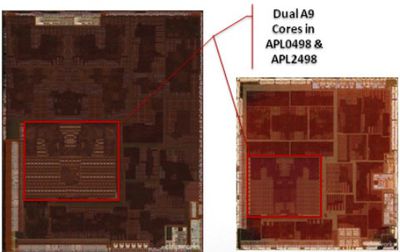
dual a9 cores a5
Dual ARM cores from iPhone 4S A5 chip (left) and Apple TV A5 chip (right)

The new A5 measures nearly 41% smaller than its predecessor, coming in at 69.6 mm². Process shrinking not only reduce costs by fitting more dies on a wafer, but it also improves performance and lowers power consumption. This is a very complex chip for a relatively low volume part (for Apple); one would think they have greater plans for this new A5 variant.

Even the A5X used in the new iPad is manufactured using 45-nm processes, making the Apple TV the company's first iOS device to move to the smaller and more efficient 32-nm process.

Update: Chipworks has now updated its report to note that the 32-nm A5 is also showing up in the latest models of the iPad 2. The observation makes it clear that Apple is using the lower-volume models as a testing ground for the more efficient 32-nm processes, with fully-functional dual-core chips landing in the iPad 2 while the Apple TV receives single-core chips with either one core intentionally disabled or one defective core.

(Thanks, @anexanhume!)

Related Roundup: Apple TV
Buyer's Guide: Apple TV (Don't Buy)

Popular Stories

Aston Martin CarPlay Ultra Screen

Apple's CarPlay Ultra to Expand to These Vehicle Brands Later This Year

Sunday February 1, 2026 10:08 am PST by
Last year, Apple launched CarPlay Ultra, the long-awaited next-generation version of its CarPlay software system for vehicles. Nearly nine months later, CarPlay Ultra is still limited to Aston Martin's latest luxury vehicles, but that should change fairly soon. In May 2025, Apple said many other vehicle brands planned to offer CarPlay Ultra, including Hyundai, Kia, and Genesis. In his Powe...
Apple Logo Black

Apple Just Made Its Second-Biggest Acquisition Ever After Beats

Thursday January 29, 2026 10:07 am PST by
Apple today confirmed to Reuters that it has acquired Q.ai, an Israeli startup that is working on artificial intelligence technology for audio. Apple paid close to $2 billion for Q.ai, according to sources cited by the Financial Times. That would make this Apple's second-biggest acquisition ever, after it paid $3 billion for the popular headphone and audio brand Beats in 2014. Q.ai has...
Apple Logo Black

Apple's Next Launch is 'Imminent'

Sunday February 1, 2026 12:31 pm PST by
The calendar has turned to February, and a new report indicates that Apple's next product launch is "imminent," in the form of new MacBook Pro models. "All signs point to an imminent launch of next-generation MacBook Pros that retain the current form factor but deliver faster chips," Bloomberg's Mark Gurman said on Sunday. "I'm told the new models — code-named J714 and J716 — are slated...
14 inch MacBook Pro Keyboard

Apple Changes How You Order a Mac

Saturday January 31, 2026 10:51 am PST by
Apple recently updated its online store with a new ordering process for Macs, including the MacBook Air, MacBook Pro, iMac, Mac mini, Mac Studio, and Mac Pro. There used to be a handful of standard configurations available for each Mac, but now you must configure a Mac entirely from scratch on a feature-by-feature basis. In other words, ordering a new Mac now works much like ordering an...
Apple MacBook Pro M4 hero

New MacBook Pros Reportedly Launching Alongside macOS 26.3

Sunday February 1, 2026 5:42 am PST by
Apple is planning to launch new MacBook Pro models with M5 Pro and M5 Max chips alongside macOS 26.3, according to Bloomberg's Mark Gurman. "Apple's faster MacBook Pros are planned for the macOS 26.3 release cycle," wrote Gurman, in his Power On newsletter today. "I'm told the new models — code-named J714 and J716 — are slated for the macOS 26.3 software cycle, which runs from...

Top Rated Comments

bse3 Avatar
180 months ago
If this means battery in iPhone 5, I'm all for it. :)

My sources close to Apple indeed indicate that the iPhone 5 will feature a battery!
Score: 43 Votes (Like | Disagree)
Rocketman Avatar
180 months ago
It makes sense when you combine both observations. Binned parts and new die shrink. Shake out the process and begin collecting parts for another device yet to be released. Shake out the manufacturing process. Even when the process is as good as it gets you will still have binned parts to supply ATV as needed and if you get lucky and don't get enough binned (defective) parts, you can use good ones and disregard the second core in software.

Interestingly this means there are "left handed", "right handed", and "ambedexterous" ATV's out there. :D

I guess the question is, what product gets the unbinned die shrunk chips?

Rocketman
Score: 17 Votes (Like | Disagree)
rumplestiltskin Avatar
180 months ago
Good idea

This is actually a great idea. Get production started on a new chip that you expect to have some issues; then use the marginal parts (one core working) in a device that only really -needs- one core until you get the bugs ironed out. Once yields are high enough you can (as others have opined) use it in the next iPod Touch or whatever...and why not as an upgrade to this AppleTV? "We've got two cores!"

Smart. Tim Cook is earning his salary. The best supply-chain manager...ever.
Score: 16 Votes (Like | Disagree)
chrmjenkins Avatar
180 months ago
Please put 128GB in it. PLEASE! I have a 5th gen ipod from 2005 that has 60GB. My current ipod touch has 64GB. 7 years and all we get is a 4GB bump. Come on Apple!

You're comparing flash and magnetic media. Completely different.
Score: 12 Votes (Like | Disagree)
Small White Car Avatar
180 months ago
Haha, not until the sales go down.

Notice how minimal the upgrades to the Touch have been since Zune went away? It may not have sold as well, but it definitely made Apple upgrade more often.

Yeah. It seems like everyone out there wants to make an 'iPhone killer' and an 'iPad killer' but hardly anyone cares about even making an iPod competitor, even.

I find it hard to understand. How many kids with iPod touches are going to eventually move on to iPhones just because it's the path of least resistance? I seriously don't understand the lack of phone-less Android devices.
Score: 11 Votes (Like | Disagree)
ilkhan4 Avatar
180 months ago
Sounds like a perfect way to test the new process: in a relatively low-volume product where even a part that's 50% defective can be used.
Score: 8 Votes (Like | Disagree)