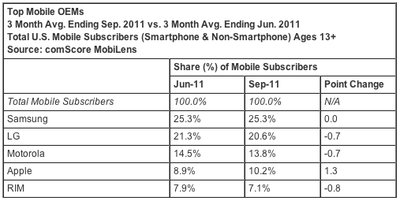
comScore today released the results of its latest survey of mobile phone usage in the United States, noting that Apple has reached a milestone in surpassing a 10% share of the U.S. mobile phone market. As has been the recent trend, Apple again led the major phone manufacturers in growth between the three-month period ending in June and the period ending in September, growing by 1.3 percentage point to hit 10.2% of the U.S. market.
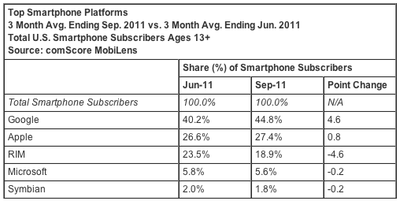
Narrowing down to smartphones, Apple's iOS took 27.4% of the market, up 0.8 percentage points since the previous three-month period but trailing Android's 44.8% share and 4.6 percentage point growth. Apple stood at 9.8% of the overall mobile phone market and 27.3% of the smartphone market in last month's release of the firm's rolling three-month data sets.
comScore's data tracks installed user base rather than new handset sales, making it more reflective of real-world usage but slower to respond to shifting market trends than some other studies. With today's released data covering the period of July through September, it is also important to note that it does not include any surge from the iPhone 4S launch, which took place in mid-October.
Apple has unveiled a whopping nine new products so far this March, including an iPhone 17e, iPad Air models with the M4 chip, MacBook Air models with the M5 chip, MacBook Pro models with M5 Pro and M5 Max chips, the all-new MacBook Neo, an updated Studio Display, a higher-end Studio Display XDR, AirPods Max 2, and now the Nike Powerbeats Pro 2.
iPhone 17e features the same overall design as...
iOS 26.4 isn't the major update with new Siri features that we hoped for, but there are some useful quality of life improvements, and a little bit of fun with an AI playlist generator and new emoji characters.
Playlist Playground - Apple Music has a Playlist Playground option that lets you generate playlists from text-based descriptions. You can include moods, feelings, activities, or...
Wednesday March 18, 2026 7:39 am PDT by Joe Rossignol
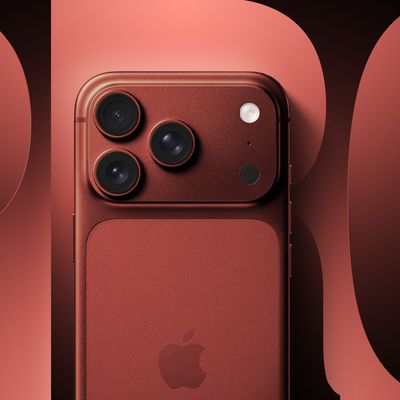
While the iPhone 18 Pro and iPhone 18 Pro Max are not expected to launch for another six months or so, there are already plenty of rumors about the devices.
It was initially reported that the iPhone 18 Pro models would have fully under-screen Face ID, with only a front camera visible in the top-left corner of the screen. However, the latest rumors indicate that only one Face ID component...
4.6% growth for Android compared to .8% for iOS? Ouch. Looking forward to how the fanboys are going to argue that a slower growth rate and a lower market share is actually better for Apple.
They saw 0.8% growth with one phone that was 16 months old. The should have lost market share to the 100s of Android phones on the market, but they were flat. I can't wait for the numbers in January...
So what we've learned here is that it's innovation of LTD determines it to be so and he is free to change his definition at will. Got it.
No you got it wrong.
The defintions of innovation according to LTD is very simple. It is innovating if and only if Apple does it or Apple buys it up.
Everything else is either stealing or it sucks and therefor not innovating.
It is as simple as that. Apple label = good (and it could be dog crap but if it has an Apple logo on it then it is good)
I fail to see how this is impressive. I'd guess 90% of U.S Personal Computer users are now on Windows. That's fairly impressive.
If the iPhone hits 50%, I'll begin to be impressed.
Oh, that's a shame. At the last shareholders meeting, Apple's executive team said everything they've done so far was meant to impress roadbloc on Macrumors.
4.6% growth for Android compared to .8% for iOS? Ouch. Looking forward to how the fanboys are going to argue that a slower growth rate and a lower market share is actually better for Apple.
Zombie Androids. Its really quite simple, if you work in an arena where paying attention to actual device use vs. sales is critical to your business its readily apparent that while Android may be shipping/selling a lot more devices, a significant, perhaps even majority, of Android users are using their phones as little more than phones.
I develop apps and mobile sites and generic Android simply isnt an appealing market for a small developer with the exception of the niche devices, or at least the Nook is proving to be quite a valuable market place and I expect the Amazon Fire will also be a great opportunity. The difference between these two devices and Android as offered by the mobile carriers is they have cultivated an ecosystem that is safe, far less cluttered with crap apps, content and a loyal customer base.
These devices are another type of Android Zombies, but its the devices that are Zombies rather than the users. The users are very active, but the devices are completely orphaned from the Android ecosystem.
A bigger market share is simply a bigger market share. In very simplistic terms 99% market share that earned you $1 isnt better than 1% market share that earned you $100. The iPhone makes more money for Apple than all of Google.
Additionally Google and its partners has failed to create much stickiness with the Android ecosystem. Google because it derives 95% of its income from advertising must appeal to the broadest range of consumers as possible, they will continue to make apps for iOS and Blackberry and if Windows phones get enough traction for Windows phones, because they have to. This makes it easy for an Android user to leave Android and head to WPS7 or Blackberry or iOS. Contrary Apple, Amazon and Barnes & Noble are creating content that requires you to continue to use their products. Every year a user is part of the iOS ecosystem is additional expense moving to another platform.
I see one of two things happening with the market share race. It stays relatively the same with Android hitting 50-ish percent of the market mostly at the expense of BB, while Apple sticks right around 25%. Or as smartphones and tablets become more mainstream some of the Zombie Android users will start to realize the benefits of a smartphone and the superior nature of the iPhone will draw them to iOS.
4.6% growth for Android compared to .8% for iOS? Ouch. Looking forward to how the fanboys are going to argue that a slower growth rate and a lower market share is actually better for Apple.
Or we could all marvel at the proliferation of the smartphone over the last 5 years.