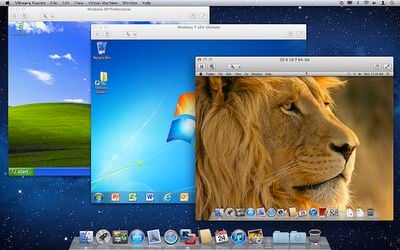
Virtualization firm VMware today announced the launch of its new Fusion 4 software to allow Mac users to run Windows and other operating systems virtualized alongside their native OS X operating systems. Optimized for OS X Lion, VMware Fusion 4 offers more than 90 new features, including the ability to run OS X Lion in a virtual machine as is now permitted by Apple's licensing.
With more than 90 new features and now optimized for today’s multi-core Macs and OS X Lion, key features in VMware Fusion 4 include:
- Built for OS X Lion – VMware Fusion 4 is designed to provide the best Windows experience on OS X Lion. Add Windows programs to Launchpad, experience them in Mission Control, view them in full screen or switch between them using Mac gestures.
- Better Performance and Faster Graphics – VMware Fusion 4 has been engineered to run Windows and Mac applications side-by-side with incredible speed and reliability. As a 64-bit Cocoa application, it is optimized for today’s multi-core Macs and delivers 3D graphics up to 2.5-times faster than previous versions of Fusion.
- Even More "Mac-like" Experience – VMware Fusion 4 enhances the way Windows programs run on a Mac. From the brand new settings menu to the redesigned virtual machine library and snapshot menu, users have even more Mac-like experiences when running Windows programs.
- Lion Squared – VMware Fusion 4 now supports OS X Lion in a virtual machine, allowing users to get more from their Mac by running OS X Lion, OS X Lion Server, Mac OS X Snow Leopard Server and Mac OS X Leopard Server in virtual machines.
VMware Fusion 4 is being offered at a promotional price of $49.99 until the the end of the year, after which time pricing will be set at $79.99. Users who purchased Fusion 3 on or after July 20th are eligible for a free upgrade to Fusion 4.
VMware's primary competitor in the virtualization market is Parallels, which released its own Lion-optimized version two weeks ago.
Tuesday February 3, 2026 7:47 am PST by Joe Rossignol
We are still waiting for the iOS 26.3 Release Candidate to come out, so the first iOS 26.4 beta is likely still at least a week or two away. Following beta testing, iOS 26.4 will likely be released to the general public in March or April.
Below, we have recapped known or rumored iOS 26.3 and iOS 26.4 features so far.
iOS 26.3
iPhone to Android Transfer Tool
iOS 26.3 makes it easier...
Sunday February 1, 2026 12:31 pm PST by Joe Rossignol
The calendar has turned to February, and a new report indicates that Apple's next product launch is "imminent," in the form of new MacBook Pro models.
"All signs point to an imminent launch of next-generation MacBook Pros that retain the current form factor but deliver faster chips," Bloomberg's Mark Gurman said on Sunday. "I'm told the new models — code-named J714 and J716 — are slated...
Tuesday February 3, 2026 8:55 am PST by Joe Rossignol
In 2022, Apple introduced a new Apple Home architecture that is "more reliable and efficient," and the deadline to upgrade and avoid issues is fast approaching.
In an email this week, Apple gave customers a final reminder to upgrade their Home app by February 10, 2026. Apple says users who do not upgrade may experience issues with accessories and automations, or lose access to their smart...
Sunday February 1, 2026 10:08 am PST by Joe Rossignol
Last year, Apple launched CarPlay Ultra, the long-awaited next-generation version of its CarPlay software system for vehicles. Nearly nine months later, CarPlay Ultra is still limited to Aston Martin's latest luxury vehicles, but that should change fairly soon.
In May 2025, Apple said many other vehicle brands planned to offer CarPlay Ultra, including Hyundai, Kia, and Genesis.
In his Powe...
Tuesday February 3, 2026 12:45 pm PST by Joe Rossignol
Apple recently acquired Israeli startup Q.ai for close to $2 billion, according to Financial Times sources. That would make this Apple's second-biggest acquisition ever, after it paid $3 billion for the popular headphone maker Beats in 2014.
This is also the largest known Apple acquisition since the company purchased Intel's smartphone modem business and patents for $1 billion in 2019....
Apparently, all those artists were using the wrong software platform. When you need Windows to run a mission critical application, then Linux is NOT the right choice for you. Whatever ran on those Linux boxes probably would also have run on Windows or could have been written for Windows in the first place. Except for trying hard to not use what everyone else in the world uses was probably the only motivation for going with Linux in the first place, and that alone is not a good enough reason.
Sigh. That's perhaps the most crazy statement I've read today.
When you have several hundred workstations, over a thousand HPC render machines - Windows tends to become a bit pricey. For VFX, Linux *is* the industry standard platform. 95% of the standard 3D modelling and 2D/3D compositing systems run on Linux. You must remember that SGI's IRIX was the dominant OS of that industry for a long time until commodity hardware and Linux took hold and replaced it. SGIs soon became bricks and doorstops.
Photoshop was one of the rare exceptions. Disney and a few other facilities contributed funds to the Wine project to develop it sufficiently to allow Photoshop to run well enough under Linux using the Wine system. Ultimately as hardware got cheaper, VMs were a better solution. There was no other application - open source or commercial that could match Photoshop's feature set. There are one or two other products that required Windows. These were used by a very small number of artists out of the several hundred coming and going through the facility.
You're doing NOBODY a favor by adding unnecessary complexity to a system. Having to instal a VM to run a mission critical application only shows that you made a poor choice. In my book, VMs are only acceptable on developer machines or when you need to make sure that a client system meets certain security and quality standards.
I work for a web hosting firm now. I'd say the majority of all production web sites and applications that we and our customers are running are running on virtual machines. I've been using VMs now in live production environments for years and I couldn't disagree more with your statements.
I've never seen the reason for a VM running Windows on a Mac because the price is almost the same as just buying a low-end laptop with Windows 7.
For school, I needed windows and looked into Parallels and realized that for a few dollars more, I could just buy a separate Toshiba laptop. At least this allows for redundancy because if one computer breaks, I have another.
With a VM, if your Mac breaks, it breaks and that's it.
serious LOL
VMware 4 is about $50 i got win 7 for about the same, so you tell me where I can get a $100 laptop??
In my book, VMs are only acceptable on developer machines or when you need to make sure that a client system meets certain security and quality standards.
Good thing we're not all you. :rolleyes:
A lot of movie editing/artwork is done on alternative platforms. Breaking Microsoft's stranglehold on the industry would help bolster innovation some. They have turned the PC industry into a stagnant cesspool. You're preaching stagnation and immobility. "Hey it works on Windows only, use Windows!". Yeah, way to spur innovation and development.
The laptop I bought was $299 (no tax or shipping charge). Parallels was almost $200. Why pay to put Windows on an existing computer when you can have redundancy by having Windows on a separate laptop?
Virtual Box is 0$. Parallels is 90$.
Carrying only 1 computer with all the tools on it, and be able to interact with your data with software on any OS at the same time : Priceless.
Sorry you can't see the advantages in virtualizations.
Having a VM on a computer IS having two computers. I don't see how a VM with a second desktop operating system running in it actually makes life easier or less complex.
Let's see :
- Share data with cables or external media or a network - Check - Copy/paste without having to use a network based clipboard server that might or might not work properly - Check - Carrying only 1 physical computer around with all my software - Check again.
Yep, a VM is just like a 2nd computer, except for those little annoyances of actual owning 2 physical computers. :rolleyes:
I still firmly believe that when you need a VM with a second desktop OS in it, then you are basically walking with a crutch and your preferred host operating system was not the right choice for you.
My VM is for work. My computer insists on using proprietary technologies that only have Windows client. If it weren't for that, I wouldn't even need the VM. No, my work laptop is not an option (a huge hulking Dell Lattitude... I'm not carrying that POS around).