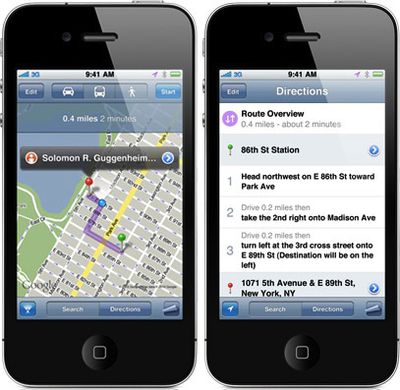
Apple Hints at Future Turn-by-Turn GPS Directions With Traffic for iPhone
As part of its Q&A regarding location tracking
posted earlier today, Apple discloses that it is currently collecting "anonymous traffic data" from users' devices with the aim of providing an "improved traffic experience in the next couple of years".
What other location data is Apple collecting from the iPhone besides crowd-sourced Wi-Fi hotspot and cell tower data?
Apple is now collecting anonymous traffic data to build a crowd-sourced traffic database with the goal of providing iPhone users an improved traffic service in the next couple of years.
That traffic experience would presumably be built on top of a turn-by-turn navigation system separate from the Maps application included in iOS and driven by Google.
In November 2009, an Apple job posting described an iPhone engineering position that would help take Maps "to the next level". The company followed that up last December, with a set of four job listings seeking iOS engineers with experience in developing navigation software, further fueling speculation that Apple is working on its own navigation system.
On a broader scale, Apple has increasingly looked to beef up its own mapping and geolocation services in an attempt to distance itself from Google, which has provided the core Maps application for the iPhone since the device's 2007 debut. Apple acquired mapping company Placebase in July 2009 and followed that up by purchasing small Canadian mapping firm Poly9 one year later. Apple also moved its location services for iOS in-house with the release of iOS 3.2 on the iPad in April 2010, separating itself from Google and Skyhook Wireless for such services.
Google has offered free turn-by-turn navigation on Android since late 2009 and had hinted at that time that it could bring the service to iOS, although the company later backpedaled from those claims.

Popular Stories
We are still waiting for the iOS 26.3 Release Candidate to come out, so the first iOS 26.4 beta is likely still at least a week or two away. Following beta testing, iOS 26.4 will likely be released to the general public in March or April.
Below, we have recapped known or rumored iOS 26.3 and iOS 26.4 features so far.
iOS 26.3
iPhone to Android Transfer Tool
iOS 26.3 makes it easier...
The calendar has turned to February, and a new report indicates that Apple's next product launch is "imminent," in the form of new MacBook Pro models.
"All signs point to an imminent launch of next-generation MacBook Pros that retain the current form factor but deliver faster chips," Bloomberg's Mark Gurman said on Sunday. "I'm told the new models — code-named J714 and J716 — are slated...
In 2022, Apple introduced a new Apple Home architecture that is "more reliable and efficient," and the deadline to upgrade and avoid issues is fast approaching.
In an email this week, Apple gave customers a final reminder to upgrade their Home app by February 10, 2026. Apple says users who do not upgrade may experience issues with accessories and automations, or lose access to their smart...
Last year, Apple launched CarPlay Ultra, the long-awaited next-generation version of its CarPlay software system for vehicles. Nearly nine months later, CarPlay Ultra is still limited to Aston Martin's latest luxury vehicles, but that should change fairly soon.
In May 2025, Apple said many other vehicle brands planned to offer CarPlay Ultra, including Hyundai, Kia, and Genesis.
In his Powe...
Apple's first foldable iPhone will feature relocated volume buttons, an all-black camera plateau, a smaller Dynamic Island, and more, according to design leaks from a known Weibo leaker.
The user known as "Instant Digital" today claimed to share several key details about the design of the foldable iPhone:
The volume buttons will be located on the top edge of the device, aligned to the...